Reseller Tax Deductions: What to Track for Schedule C All Year
Every April a reseller opens a shoebox of receipts, a payout statement that’s already net of fees, and a bank account that doesn’t reconcile with either. The deductions they’re entitled to are real and mostly recoverable — but only if the tracking happened in the aisle, not in the shoebox.
Here’s the list, the one rule that trips up nearly everyone, and a system that takes about ninety seconds a day.
Full walkthrough of the template used in this guide.
This is general information, not tax advice — reselling touches inventory accounting, and it’s worth an hour with a tax preparer once your volume is real.
The Rule Everyone Gets Wrong
Inventory isn’t deducted when you buy it. It’s deducted when it sells.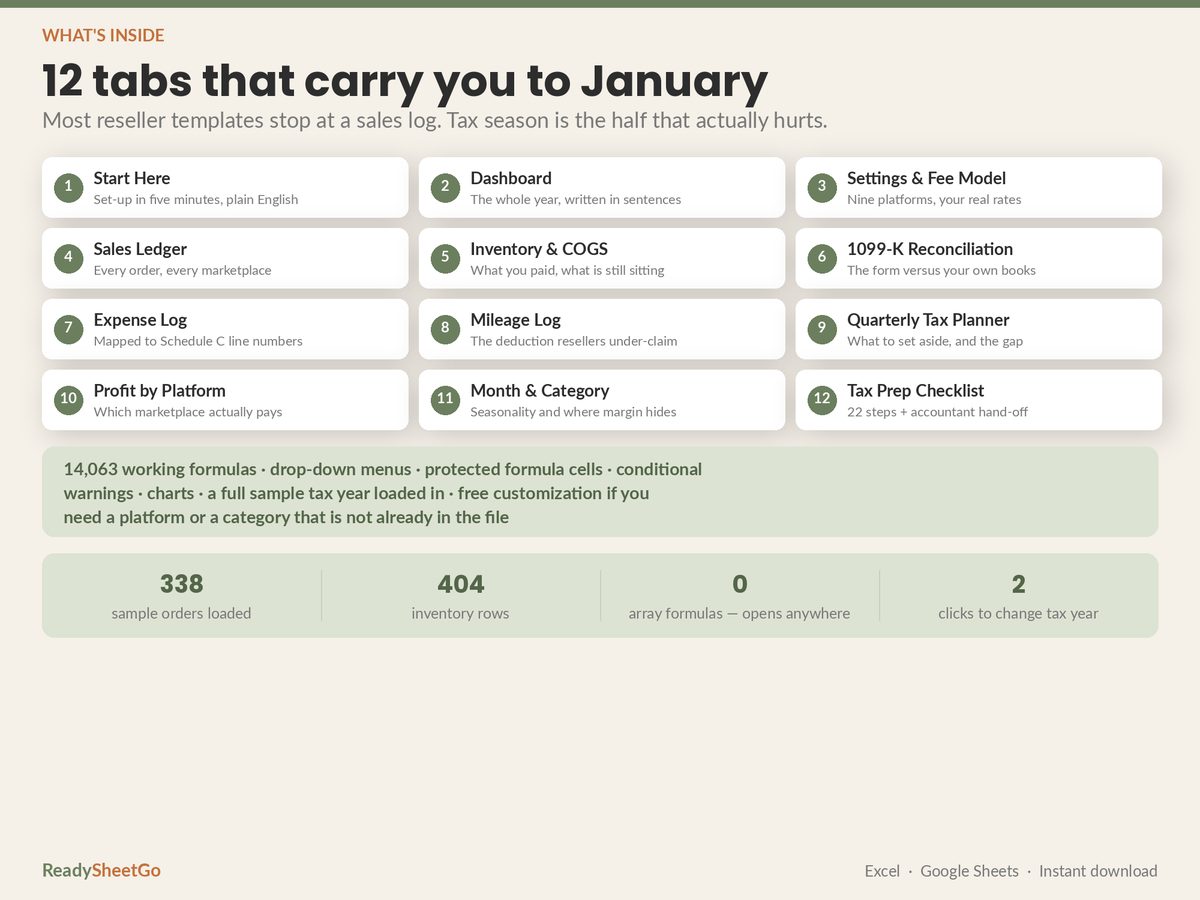
You spend $1,200 on thrift finds in November. On December 31, $900 of that is still in bins in your spare room. That $900 is not a deduction this year. It’s inventory — an asset — and it becomes a deduction as each item sells, one piece at a time, as cost of goods sold.
This is why a reseller’s spreadsheet needs a per-item cost that follows the item to its sale row. Not a monthly “spent at Goodwill” total. The sale in March 2027 needs to know that this specific coat cost $6.99 in a March 2026 sourcing trip.
Two consequences worth planning around:
A big Q4 sourcing spree doesn’t lower this year’s tax bill. Resellers regularly buy hard in December expecting a deduction and get a surprise instead.
Cost of goods sits in Part III of Schedule C, not the expense list. It flows into gross profit before the expense categories start. Adding it to the expense section as well is a double-deduction, and it’s an easy error to make when you’ve been logging everything as “expenses” all year.
Cost of Goods Sold: What Goes In
Beyond the purchase price of the item itself, cost of goods can include what it took to get the item saleable and shipped — freight in, and materials directly consumed by the product. Where a cost sits between COGS and an expense category, what matters most is that it’s counted once, consistently.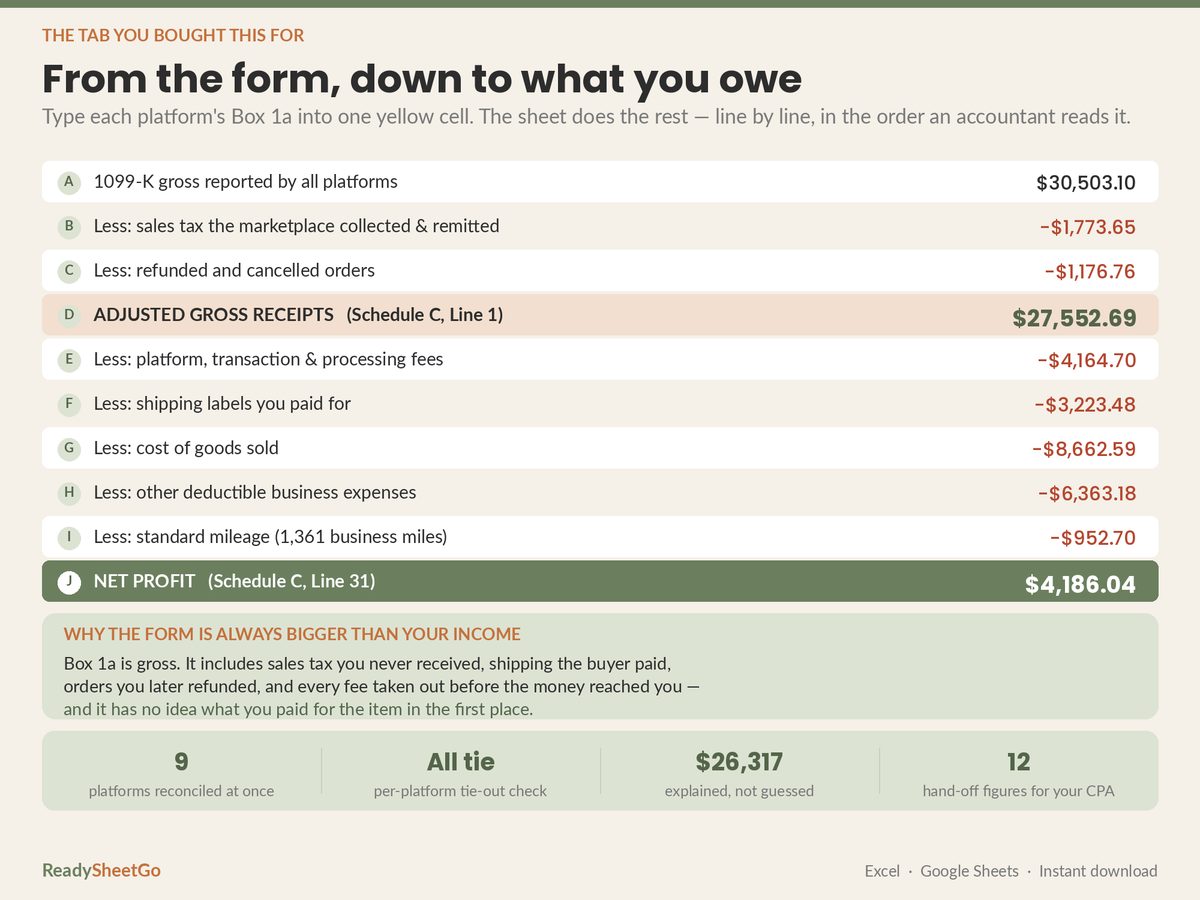
The practical version for a small resale operation:
- Purchase price of each item, with box lots split across the items when you unpack
- Sales tax you paid on the purchase
- Any repair, dry cleaning or replacement parts that made the item saleable
Split box lots the day you unpack. Reconstructing “what did that one thing in the $40 lot cost me” nine months later is guesswork, and guesswork is what gets thin in an audit.
The Expense Categories Resellers Actually Have
| Category | What goes in it |
|---|---|
| Platform seller fees | Final value fees, Poshmark and Mercari commissions, listing fees |
| Payment processing | Where the platform charges it separately from commission |
| Shipping & postage | Labels you bought. Buyer-paid postage is income in and expense out — record both or neither |
| Packing supplies | Poly mailers, boxes, tape, tissue, labels, thermal printer paper |
| Car & truck (mileage) | Sourcing trips, post office runs, bank runs |
| Software & subscriptions | Cross-listing tools, photo editing, cloud storage |
| Advertising | Promoted listings, sponsored placements, Poshmark parties |
| Storage / rent | A rented unit; a home office only under the home-office rules |
| Internet & phone | The business-use percentage only, and be honest about it |
| Office supplies | Printer ink, paper, a scale, a measuring tape |
| Professional services | Tax preparer, bookkeeper, legal |
| Insurance | Business or inventory coverage |
| Returns & allowances | Refunded sales, reducing gross receipts |
The three most commonly missed are mileage, packing supplies and the fees already netted out of your payouts.
That last one is worth spelling out. If you record the $86 payout as your revenue instead of the $100 sale and the $14 fee, you’ve quietly given up a $14 deduction and understated your gross receipts. Over 200 sales that’s a four-figure mistake in both directions. Log the sale gross, and the fee as an expense.
Mileage: The One Worth the Log
Sourcing mileage is usually the biggest deduction a part-time reseller doesn’t claim, because it requires the one thing that’s genuinely tedious: a contemporaneous log with date, destination, business purpose and miles.
The IRS standard business rate for 2026 is 72.5 cents per mile for January 1 through June 30, rising to 76 cents for July 1 through December 31 (IRS, and the mid-year update). A split-year log needs both rates, so if your spreadsheet has a single mileage-rate cell, it needs to become two — one per half of the year.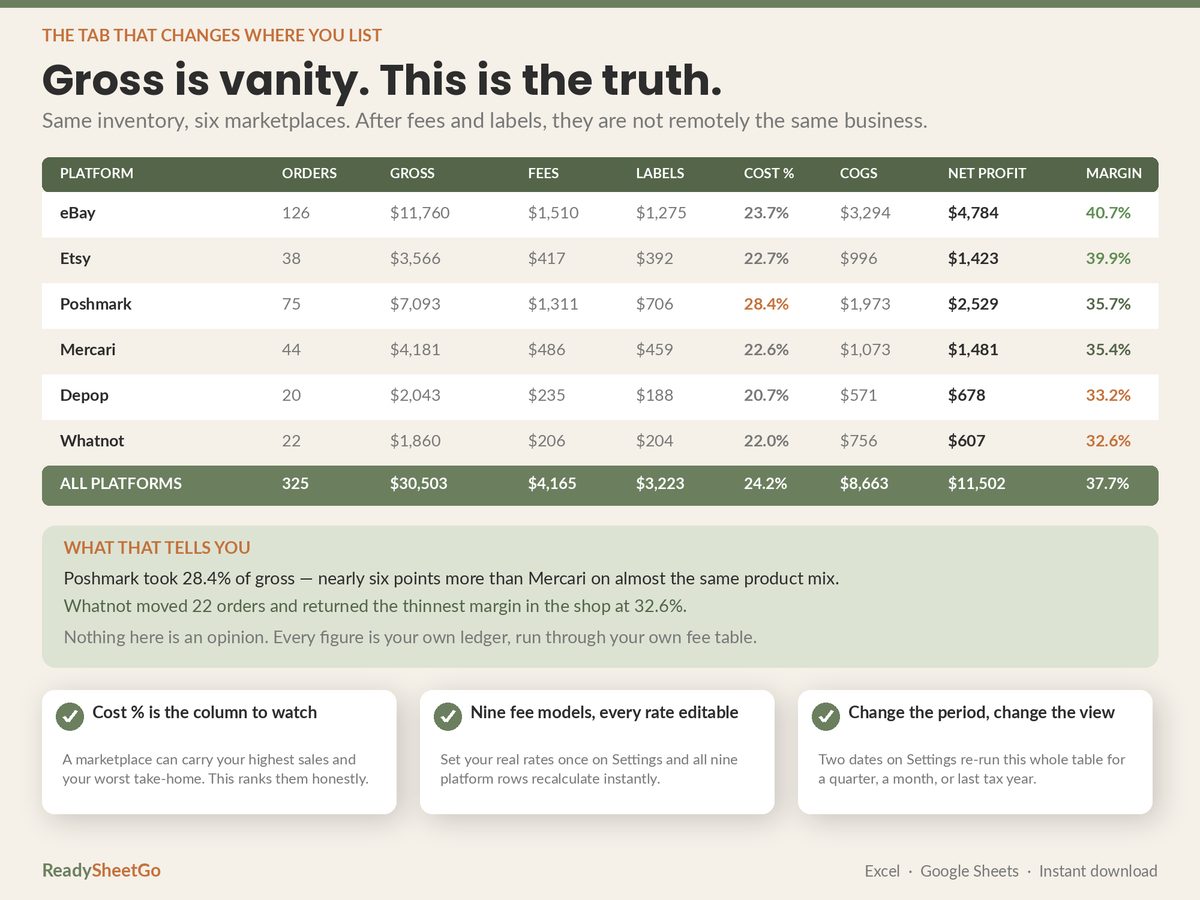
What that’s worth: a reseller doing two sourcing trips a week at 18 round-trip miles, plus a weekly 6-mile post office run, drives roughly 2,180 business miles a year. Split evenly across the two rate periods that’s about $1,620 in deductions. Untracked, it’s $0.
Commuting to a day job doesn’t count. Driving from home to a thrift store to source does.
Will You Get a 1099-K?
For tax year 2026 the federal threshold for a marketplace or payment app to issue Form 1099-K is more than $20,000 in gross payments and more than 200 transactions — both conditions, following the One Big Beautiful Bill Act’s restoration of the older threshold in 2025. Several states set lower thresholds and will trigger a form well below that.
Two things follow, and they’re the ones people get backwards:
A 1099-K is not the tax. It’s an information return. Business income is reportable whether or not one arrives.
A 1099-K reports gross, not net. It shows the full amount buyers paid, before fees, refunds and postage. If you report the 1099-K figure as your profit, you’ll overpay dramatically. The figure to reconcile against it is your gross receipts, with fees and shipping claimed as expenses underneath.
There’s also self-employment tax to plan for on top of income tax once net earnings from the business clear $400 — which is why setting aside a percentage of each sale as it happens beats a March surprise.
The Ninety-Second-a-Day System
- [ ] Log every item’s cost the day you buy it, box lots split at unpacking
- [ ] Log every sale gross, with the fee as a separate line, never the net payout
- [ ] Record the shipping label you bought, separately from buyer-paid postage
- [ ] Photograph or file the receipt for every supply purchase
- [ ] Mileage logged the same day, with destination and purpose
- [ ] Two mileage rate cells for 2026, split at 30 June
- [ ] A running expense total by category, so nothing is reconstructed in April
- [ ] Unsold inventory value at 31 December, because it isn’t this year’s deduction
- [ ] A set-aside percentage moved to a separate account with every payout
Nine habits. The tax return is then a matter of reading totals rather than rebuilding a year.
The per-item cost tracking that makes all of this work is the same structure that tells you what each flip actually nets after fees — the tax return is a by-product of tracking profit properly, not a separate job. And because the fee line is both your biggest expense category and your biggest lever, it’s worth knowing which platform is keeping the most of your money.
Featured on ReadySheetGo
Reseller / Flipping Inventory & Profit Tracker — the Tax Summary tab lays out Schedule C the way the form does: gross receipts, returns and allowances, cost of goods sold and gross profit up top, then sixteen expense categories totalling to net business profit, with a mileage log that converts miles into a deduction at your rate. Platform fees, processing fees and shipping pull through automatically from the Sales Tracker, so those three never have to be reconstructed. Plus a 200-item Inventory Log with per-item cost, a Sales Tracker returning net profit and ROI per sale, a Platform Dashboard, a 12-month P&L, a break-even calculator, a 30/60/90-day Aging report and a Sourcing Trip Log. 9 tabs, 1,900+ formulas. Excel and Google Sheets — $17.99.
Frequently Asked Questions
What can resellers deduct on Schedule C?
Cost of goods sold is the largest one, and it goes in Part III rather than the expense section. Beyond that: platform seller fees, payment processing fees, shipping and postage, packing supplies, mileage for sourcing trips and post office runs, storage space, listing and cross-listing software subscriptions, advertising or promoted listings, the business-use share of your phone and internet, professional services like a tax preparer, and business insurance. The rule is ordinary and necessary for the business — keep the receipt and log it when it happens, not in April.
Do I get a 1099-K from eBay or Poshmark?
For tax year 2026 the federal threshold for a marketplace or payment app to issue a Form 1099-K is more than $20,000 in gross payments and more than 200 transactions — both conditions, restored by the One Big Beautiful Bill Act in 2025. Several states set lower thresholds, so you may receive one well below the federal level. Either way, receiving a form doesn't create the tax and not receiving one doesn't remove it: business income is reportable whether or not a 1099-K arrives.
When do you deduct the cost of inventory you bought?
Generally in the year the item sells, not the year you buy it — that is what cost of goods sold means. Twelve hundred dollars of thrift finds sitting unsold in a spare room on December 31 is not a deduction this year; it becomes one as each piece sells. This is why a reseller's spreadsheet has to link each sale back to what that specific item cost. Some small businesses may elect simplified inventory treatment under the tax code's small-taxpayer rules, which is worth asking a tax preparer about rather than assuming.
Can I deduct mileage for thrift store sourcing trips?
Yes — driving to source inventory, to the post office and to the bank is deductible business mileage if you keep a contemporaneous log with date, destination, purpose and miles. The IRS standard business mileage rate for 2026 is 72.5 cents per mile for January 1 through June 30 and 76 cents for July 1 through December 31, so a split-year log needs both rates. Commuting to a day job is never deductible.