Poshmark vs Mercari vs eBay Fees: Which Actually Pays You More?
The fee percentages are easy to look up and they lead most resellers to the wrong conclusion. Poshmark takes 20%, Mercari takes 10%, eBay takes around 13.6% — so sell on Mercari, obviously.
Except that resellers who move real volume mostly don’t, and the reason is in the second half of the arithmetic.
Full walkthrough of the template used in this guide.
Here’s both halves.
The Fee Structures, Side by Side
| eBay | Poshmark | Mercari | |
|---|---|---|---|
| Commission | ~13.6% for most categories | 20% on sales of $15+; flat $2.95 under $15 | 10% |
| Per-order fee | $0.30 under $10, $0.40 above | none | none |
| Charged on | item + handling + buyer-paid shipping + sales tax | item price | item + buyer-paid shipping |
| Separate processing fee | included in the final value fee | none | none |
| Who buys the label | you | buyer pays a flat rate, Poshmark supplies the label | you, unless the buyer pays |
| Listing fee | free listings up to a monthly allowance | none | none |
Rates change and vary by category — eBay’s in particular runs from roughly 6.7% to over 15% depending on what you’re selling. Check the current schedule before you price: eBay’s selling fees page, and each platform’s own seller help centre.
Worth noting for a fourth option: Depop dropped its selling commission for US sellers and now charges payment processing only, which makes it the cheapest of the mainstream clothing platforms at the moment. Cheapest, again, is not the same as best — Depop’s audience skews narrow, and an item that doesn’t sell earns nothing at any fee rate.
The Same Item, Three Places
A wool coat that cost $6.99 at a thrift store, listed at $58, with $8.90 of shipping.
| Line | eBay | Poshmark | Mercari |
|---|---|---|---|
| Item price | $58.00 | $58.00 | $58.00 |
| Buyer-paid shipping | $8.90 | flat rate, Poshmark’s label | $8.90 |
| Fee base | $66.90 | $58.00 | $66.90 |
| Commission | −$9.10 | −$11.60 | −$6.69 |
| Per-order fee | −$0.40 | — | — |
| Label you bought | −$8.90 | $0.00 | −$8.90 |
| Item cost | −$6.99 | −$6.99 | −$6.99 |
| Net profit | $41.51 | $39.41 | $44.32 |
The headline spread between the highest-fee and lowest-fee platform is 20% versus 10% — which sounds like it should be worth about $5.80 on a $58 item. The actual spread in net profit is $4.91, and Poshmark, the “expensive” one, lands within $2.10 of eBay because it doesn’t charge on shipping and you never buy a label.
That is the first correction: compare net profit per item, not fee percentages. Fee bases and postage responsibility differ enough that the percentages aren’t comparing the same thing.
The Correction That Actually Changes the Answer
Net profit per item sold is still the wrong unit, because it silently assumes every item sells. Most don’t — not this month, anyway.
The number that compares platforms is profit per item listed: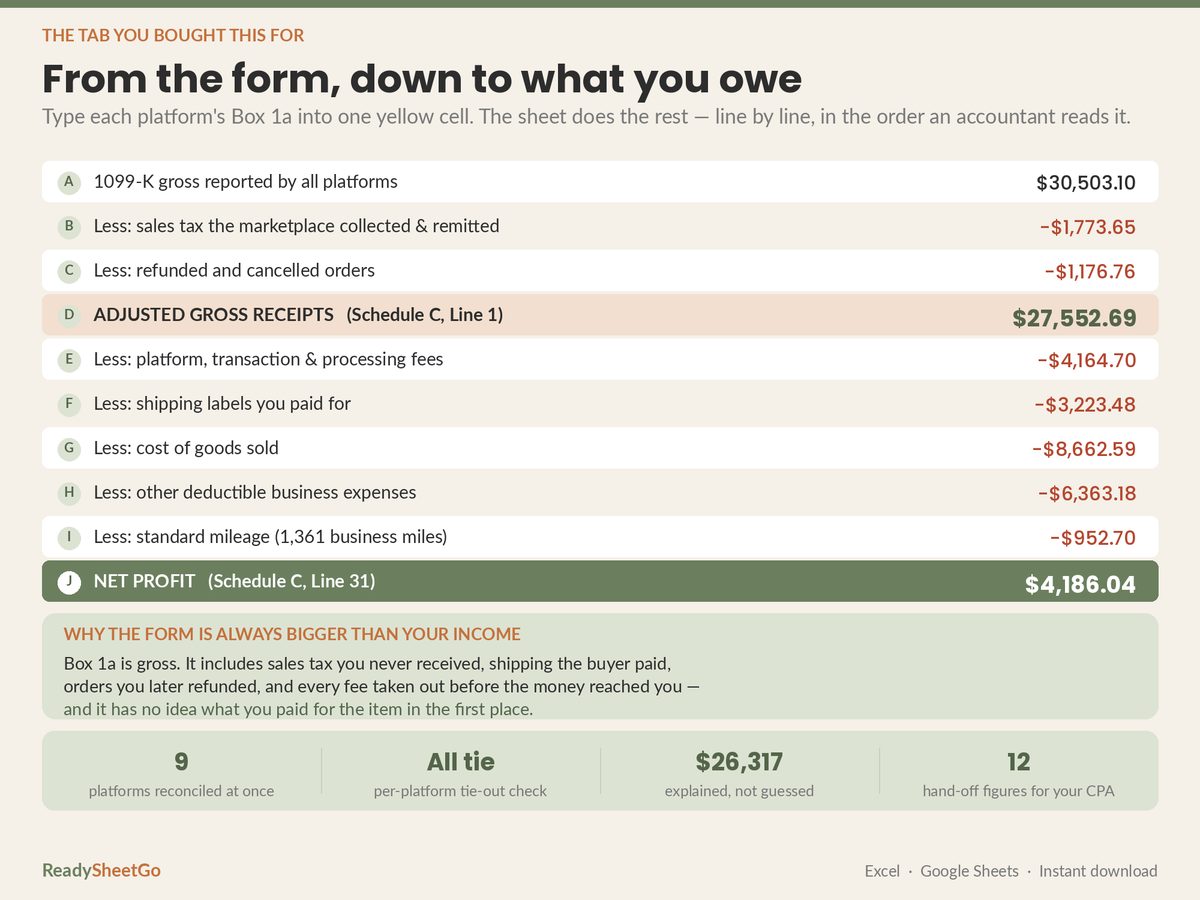
profit per item listed = net profit per sale × sell-through rate
Sell-through rate is items sold ÷ items listed over the same window. Say you list 50 items on each platform over a quarter, with the coat’s economics:
| eBay | Poshmark | Mercari | |
|---|---|---|---|
| Net profit per sale | $41.51 | $39.41 | $44.32 |
| Sell-through (your numbers) | 45% | 55% | 25% |
| Items sold of 50 | 22.5 | 27.5 | 12.5 |
| Quarterly profit | $934 | $1,084 | $554 |
The sell-through figures above are illustrative — use your own, because they’re the variable that differs most between sellers and categories. But the shape of this result is why experienced clothing resellers tolerate Poshmark’s 20%: a platform that moves your inventory at double the rate can afford to take double the commission and still pay you more.
Flip the sell-through rates and the ranking flips with them. That’s the point. The fee percentage is public and identical for everyone; the sell-through rate is specific to you, your category and your photos, and it’s the one you have to measure.
What This Means in Practice
Don’t pick a platform from a fee table. Pick two or three, list comparable inventory on each for a quarter, and let profit per item listed decide.
Price for the highest-fee platform if you cross-list. Set a price that works at 20% and it works everywhere. Set it at 10% and a Poshmark sale quietly halves the margin.
Segment by category, not just platform. The right answer is frequently “clothing on Poshmark, electronics and hard goods on eBay” rather than one winner overall. Your own sales log will say this out loud once you have thirty sales tagged by category.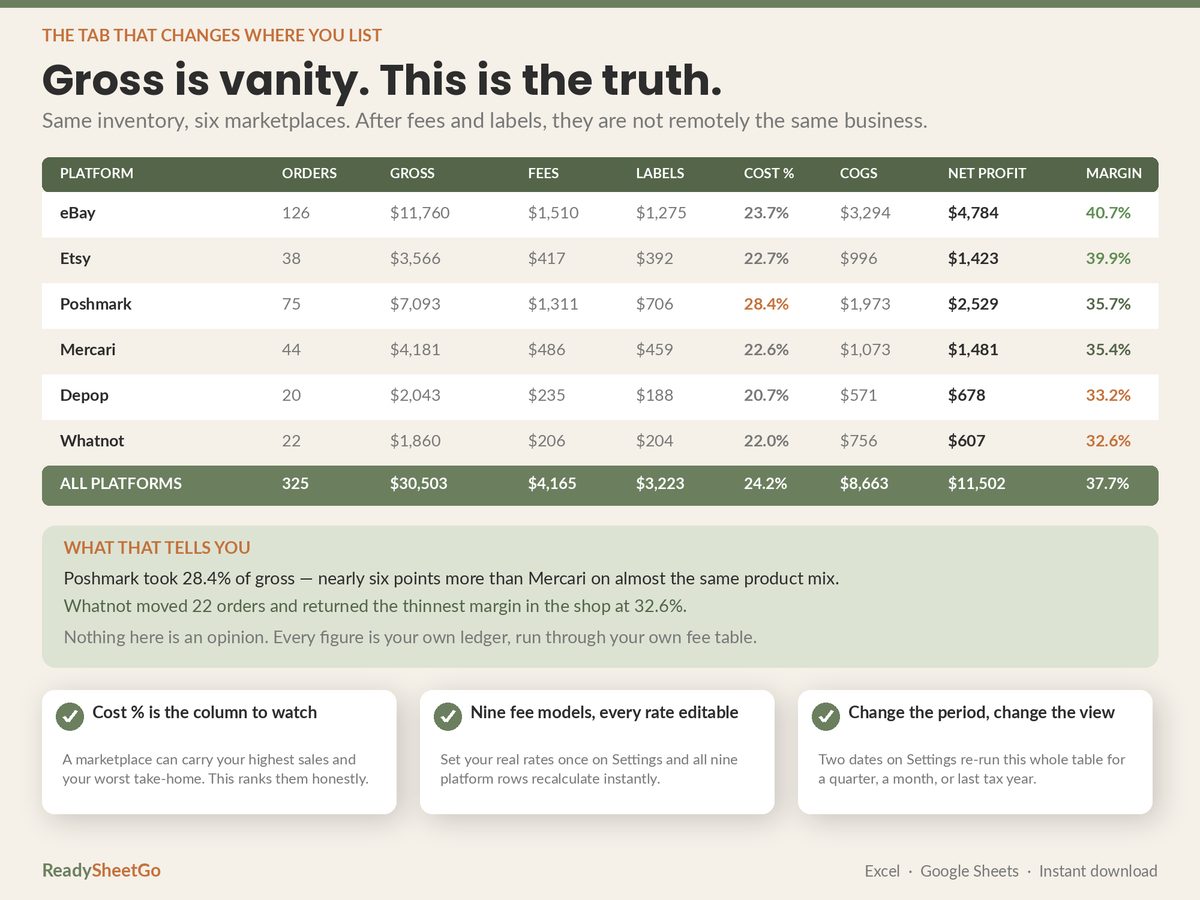
Re-check the rates annually. Every platform in this comparison has changed its structure in the last few years, and a fee rate typed into 200 formulas is a rate that will be wrong within a year. Keep the rates in one editable place.
Reading It From Your Own Data
To run this comparison on yourself you need four columns per sale — platform, sale price, total fees, net profit — plus a listing count per platform so you can compute sell-through. That’s it. The full column-by-column structure, including the aging and sourcing tabs that catch the money the sales log misses, is in the pillar guide. If eBay is your main channel, its fee math is worked out in detail here.
Ninety days of tagged sales will settle the platform question for your inventory better than any comparison article, including this one.
Featured on ReadySheetGo
Reseller / Flipping Inventory & Profit Tracker — the Platform Dashboard does exactly this comparison automatically: revenue, fees, shipping, COGS, net profit, average profit per item, average ROI and sell-through rate, side by side across eBay, Poshmark, Mercari, Facebook Marketplace, Depop, Etsy and Amazon. Plus a 200-item Inventory Log, a Sales Tracker with per-platform fee rates and net profit on every row, a 12-month P&L, a break-even price calculator, a 30/60/90-day Inventory Aging report, a Sourcing Trip Log and a Schedule C tax summary with mileage log. 9 tabs, 1,900+ formulas, sample data pre-filled. Excel and Google Sheets — $17.99.
Frequently Asked Questions
Which resale platform has the lowest seller fees?
Of the big three for clothing, Mercari's 10% commission is the lowest and Poshmark's 20% the highest, with eBay in between at around 13.6% plus a per-order fee for most categories. Depop is currently cheaper still for US sellers, having dropped its selling commission in favour of payment processing only. But lowest fee and highest payout are different questions — a platform that takes more and sells more can pay you more per item listed.
Does Poshmark really take 20 percent?
Yes, on sales of $15 and up Poshmark takes a flat 20% commission, and on sales under $15 it takes a flat $2.95. There is no separate listing fee and no separate payment processing fee, and the buyer pays a flat shipping rate on a Poshmark-supplied label, so your postage cost is zero. That last part narrows the gap with cheaper platforms more than most sellers expect.
Should I sell the same item on multiple platforms at once?
Cross-listing raises your odds of selling any given item and is standard practice among full-time resellers, with the trade-off that you must delist promptly when something sells or risk selling the same item twice. If you cross-list, price for the most expensive platform's fee — you cannot lower a price fast enough to protect a margin that was set for a 10% fee and sold on a 20% one.
How do I compare platforms with my own numbers?
Track two things per platform: net profit per item after fees, postage and cost, and sell-through rate — items sold divided by items listed. Multiply them and you have profit per item listed, which is the number that actually compares platforms. You need roughly 50 listings and a few months per platform before the sell-through figure means anything.