Reseller Inventory and Profit Spreadsheet: Track Every Flip From Sourcing to Payout
You have forty things listed across eBay, Poshmark and Mercari right now. Something sold this morning for $58. You know roughly what you paid for it — maybe $7, maybe $9, it was a Saturday in April and there were six other things in the bag — and you have no idea what actually landed in your account after fees and the label.
That’s the whole problem with reselling. The individual flips feel obviously profitable. The bank balance disagrees, and you can’t tell which of the two is lying because nothing is written down in a form that subtracts.
Full walkthrough of the template used in this guide.
This is what to write down, how to do the subtraction, and what four numbers to read once you have three months of it.
The Only Equation That Matters
Sale price − platform fee − payment processing − shipping you paid − item cost = net profit
Five subtractions. Most resellers run two of them — sale price minus item cost — and that overstates the profit by roughly the fee load, which on the major resale platforms runs 10 to 20 percent before postage.
Two of the five hide especially well:
Shipping you paid is not the shipping the buyer paid. When the buyer covers postage, that money arrives in your payout and then leaves for the label. It nets to roughly zero, and it is not profit. When you offer free shipping, it comes straight out of your margin.
The item cost is easy on a $7 thrift find with a receipt and nearly impossible on a $40 estate-sale box lot of eleven items. Split the box cost across the items when you log them, at the moment you unpack, not eight months later at tax time when you’re guessing.
A Flip Worked End to End
Every number here is a stated assumption. Fee rates change and vary by category, so check your platform’s current fee schedule before copying the percentages — the structure is what transfers.
The item: a wool coat, bought at a Goodwill in March for $6.99, listed on eBay at $58, sold in June for $58 with the buyer paying $8.90 shipping.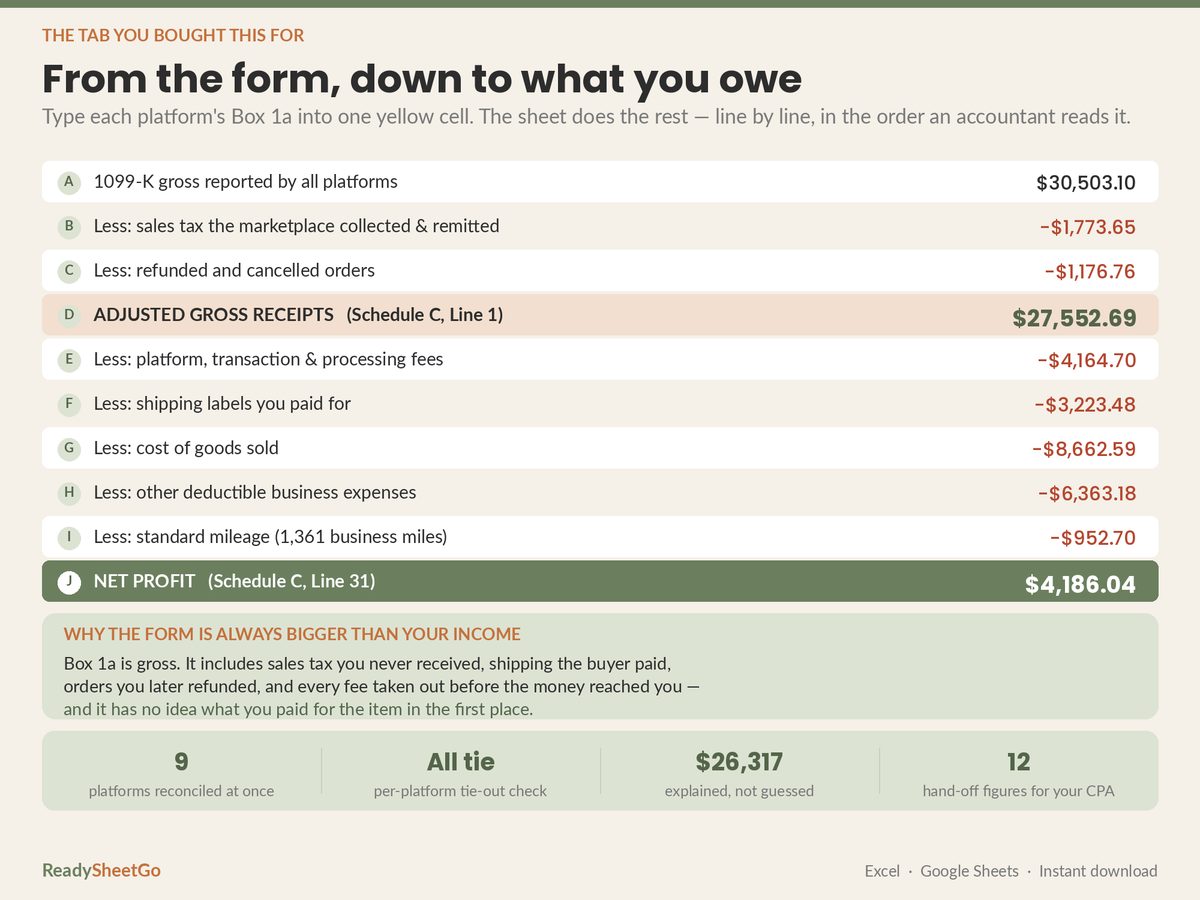
| Line | Amount |
|---|---|
| Sale price | $58.00 |
| Buyer-paid shipping | $8.90 |
| Total the buyer paid | $66.90 |
| eBay final value fee (13.6% of the full $66.90) | −$9.10 |
| Per-order fee | −$0.40 |
| Shipping label you actually bought | −$8.90 |
| Item cost | −$6.99 |
| Net profit | $41.51 |
Two things in that table catch people out.
First, the fee is charged on the total the buyer paid — item price plus buyer-paid shipping plus sales tax — not on the item price alone. Charging the buyer for postage doesn’t get you out of the fee on it. (eBay’s selling fees page sets out the current rate and the fee base: most categories run 13.6% plus a per-order fee of $0.30 on orders of $10 or less and $0.40 above that, with some categories materially higher or lower.)
Second, the flip is a 594% return on a $6.99 cost and it is also $41.51. Both facts matter and they matter differently, which is the point of the four numbers further down. (If eBay is your main channel, the fee side is worked through at three different sale shapes here.)
Now run the same coat somewhere else, so you can see what platform choice is worth:
| eBay | Poshmark | Mercari | |
|---|---|---|---|
| Item price | $58.00 | $58.00 | $58.00 |
| Fee basis | item + buyer shipping | item price | item + buyer shipping |
| Commission | ~$9.10 (13.6%) | $11.60 (20%) | $6.69 (10%) |
| Per-order fee | $0.40 | — | — |
| Postage | you buy the label | buyer pays a flat rate | you buy the label |
| Item cost | $6.99 | $6.99 | $6.99 |
| Rough net | $41.51 | $39.41 | $44.32 |
Same coat, same price, a $4.91 spread. That’s small on one item and it is not small across 200. It’s also the wrong number to optimize on its own — see the sell-through section. The full platform-by-platform version of this comparison is worked out here.
The Columns You Actually Need
Copy this. Two sheets, not one — inventory and sales are different events, and jamming them into one row is why most reseller spreadsheets get abandoned in month three.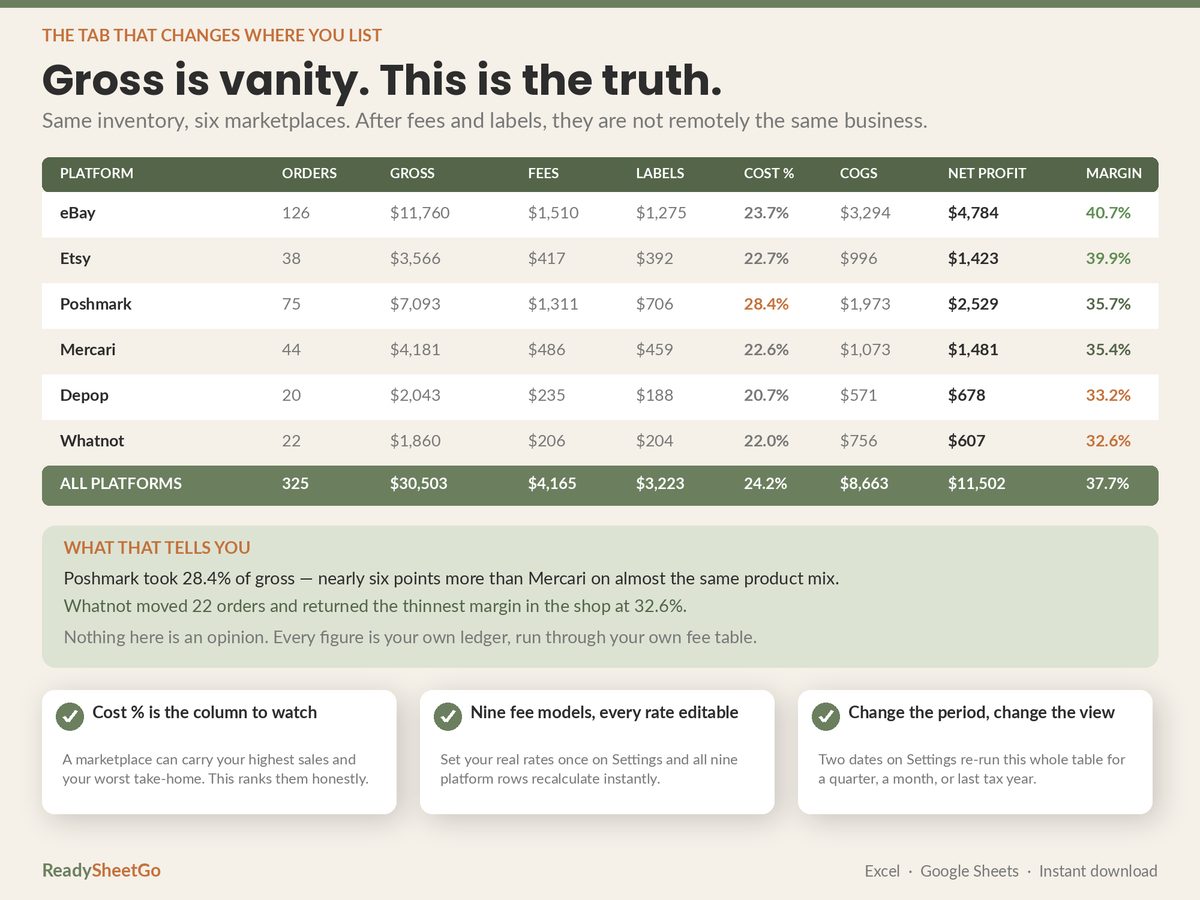
Sheet 1 — Inventory Log (one row per item, filled in the day you buy it)
| Column | Why it earns its place |
|---|---|
| Item # | A number you can write on the tag. Ties the physical item to the row. |
| Item name | Enough to find it in a bin. “Pendleton wool coat, 42R.” |
| Category | Clothing, shoes, home, electronics, toys, books. This is how you learn what you’re actually good at. |
| Source type | Thrift, estate sale, garage sale, auction, retail clearance, wholesale. |
| Source name | The specific store. Feeds the sourcing-trip question below. |
| Purchase date | Starts the clock on how long your money has been tied up. |
| Cost | What you paid, box lots split out across items. |
| Platform | Where it’s listed. |
| Listing price | What you’re asking. |
| Listing date | Not the same as purchase date. Aging runs from here. |
| Status | Sourced / Listed / Sold / Returned / Donated. |
| Days listed | =IF(status="Listed", TODAY()-listing date, "") |
Sheet 2 — Sales Tracker (one row per sale)
| Column | Notes |
|---|---|
| Sale date | |
| Item name | |
| Category | |
| Platform | Drives the fee rate. |
| Sale price | |
| Shipping cost | The label you bought. |
| Fee % | Look it up from the platform, don’t retype it every row. |
| Platform fee $ | = sale price × fee % |
| Processing fee | Where the platform charges one separately. |
| COGS | Pull from the inventory row. |
| Net profit | = sale price − shipping − platform fee − processing − COGS |
| ROI % | = net profit ÷ COGS |
A fee lookup beats a typed percentage. In a spreadsheet that’s a nested IF or a small lookup table:
=IF(platform="eBay", 0.136,
 IF(platform="Poshmark", 0.20,
 IF(platform="Mercari", 0.10,
 IF(platform="Facebook Marketplace", 0, 0))))
Keep the rates in one place you can edit in thirty seconds, because platforms change them. A rate buried inside 200 copies of a formula is a rate you will never update.
The Four Numbers to Read
Once the log has a few months in it, four numbers answer nearly every decision a reseller makes. Everything else is decoration.
1. Net profit per item, by category
Not total revenue. Total revenue rewards volume, and volume in reselling mostly means more trips to the post office. Sort your sales by category and average the net profit. Most people find one or two categories carry the business and one category is a hobby they’ve been subsidising.
2. Sell-through rate, by platform
Items sold ÷ items listed, per platform. This is the number that stops you from chasing the lowest fee. A platform that takes 20% and moves 60% of your listings pays you more than one that takes 10% and moves 15%, because inventory that doesn’t sell has a return of exactly zero however low the fee is.
Run it with real numbers: 50 items listed at an average $40 sale price. At a 20% fee and a 60% sell-through, 30 items sell and gross profit after commission is 30 × $32 = $960. At a 10% fee and a 15% sell-through, 7.5 items sell and it’s 7.5 × $36 = $270. The cheaper platform loses by a factor of three.
3. Aged inventory
Count what’s been listed 30, 60 and 90+ days, and total what you paid for the 90+ bucket. That last figure is cash you converted into a pile in a spare room. It’s the most useful uncomfortable number in reselling, because it’s the one that tells you to reprice or clear out instead of sourcing more this weekend.
4. ROI per sourcing location
Total spent at a location versus revenue eventually realised from what you bought there. Most resellers have a favourite store that is sentimental rather than profitable, and one they visit rarely that quietly returns 4x. You cannot tell which is which from memory. What to actually look for on a sourcing run changes once you know your own numbers.
The Break-Even Price, Before You List
The most useful single formula in reselling is the minimum you can list something for and not lose money:
break-even price = (cost + shipping) ÷ (1 − fee rate)
The division matters. Fees are charged on the final sale price, so you can’t just add them to your cost — you have to gross up.
A $12 item you’ll ship for $5 on a platform taking 13.6%:
($12 + $5) ÷ (1 − 0.136) = $17 ÷ 0.864 = $19.68
Below $19.68 you are paying for the privilege of shipping a stranger a thing. Anything you want to earn sits on top: a 50% margin on cost means listing around $25.50, not $18.
Work this out before you list, and again before you accept an offer. It’s the number that turns “eh, I’ll take $18” into “no.”
Five Mistakes That Cost Real Money
Counting buyer-paid shipping as revenue. It arrives in your payout and leaves for the label. Log it in both directions or not at all — never just the inbound half.
Logging cost as the box price. A $40 lot of eleven items is not eleven $40 items and it is not eleven free items. Split it when you unpack.
Recording the payout instead of the sale. Platform payouts net out fees, refunds and sometimes several sales at once. Log the sale line by line and let the spreadsheet do the netting; otherwise your Schedule C gross receipts will be wrong, because the IRS wants gross sales with fees claimed as an expense, not a net figure.
Ignoring the aging column. Every unsold item is a small negative return compounding quietly. Ninety days is a decision point, not a status.
Tracking only what sold. Your sell-through rate and your sourcing ROI both need the misses in the data. A spreadsheet that only contains wins can’t tell you anything about where the money is going. That’s also where most reseller tax deductions get lost — the unsold, the mileage, the supplies.
Set It Up This Week
- [ ] Two sheets: Inventory Log and Sales Tracker, with the columns above
- [ ] A fee table in one place, with today’s rate for each platform you sell on
- [ ] Box lots split across items at the moment you unpack
- [ ] Buyer-paid shipping recorded in and out, or excluded from both sides
- [ ] A days-listed formula and a 90-day review on the calendar
- [ ] A break-even calculation you run before every listing
- [ ] Net profit averaged by category once you have 30 sales
- [ ] Sell-through by platform once you have 50 listings
Two months of honest entry will tell you more about your business than two years of feeling like the flips are going well.
If you’d rather not build all that from scratch, we sell it done.
Featured on ReadySheetGo
Reseller / Flipping Inventory & Profit Tracker — 9 tabs and 1,900+ auto-calculating formulas that run exactly this system. An Inventory Log for 200 items with category, source type, cost, platform and status; a Sales Tracker that applies a per-platform fee rate and returns net profit and ROI on every single item; a Platform Dashboard comparing revenue, fees, profit and sell-through rate side by side across eBay, Poshmark, Mercari, Facebook Marketplace, Depop, Etsy and Amazon; a 12-month P&L; an ROI tab with the break-even price calculator; an Inventory Aging report flagging items at 30, 60 and 90 days; a Sourcing Trip Log with spend and ROI by location; and a Schedule C tax summary with a mileage log. Colour-coded inputs, dropdown validation, sample data pre-filled. Works in Excel and Google Sheets, no macros. Instant digital download — $17.99.
Frequently Asked Questions
What should a reseller spreadsheet track?
Eleven fields do almost all the work: item name, category, source type, source name, purchase date, cost, platform, listing price, listing date, status and days listed. When the item sells you add sale date, sale price, platform fee, payment processing fee, shipping paid out and cost of goods. Everything else a reseller wants to know — net profit per item, ROI, sell-through rate by platform, aged inventory, Schedule C totals — is calculated from those fields, not entered separately.
How do you calculate net profit on a resale item?
Sale price minus platform fee, minus payment processing, minus the shipping you actually paid, minus what the item cost you. Not sale price minus cost. On a $60 sale with a $4.50 label, $18 of platform and processing fees and a $6 thrift-store cost, the flip clears about $31.50 — not $54. Fees and postage are usually 20 to 30 percent of the sale price, so leaving them out roughly doubles your apparent profit.
What is a good ROI for reselling?
ROI is net profit divided by what you paid for the item, and thrift-sourced resellers commonly work to a 3x-cost rule of thumb — list at roughly three times your cost so that fees, postage and slow sales still leave a margin. A $6 item that nets $31.50 is a 525 percent ROI, which sounds enormous until you notice the dollar figure is $31.50 and it took 40 days to sell. Track both ROI and net profit per item; ROI alone rewards cheap junk that never moves.
Do I need software or is a spreadsheet enough for reselling?
A spreadsheet is enough for most part-time and single-person resale businesses. Reselling arithmetic is simple — fees are a percentage, profit is a subtraction — and the hard part is consistent data entry, which no software solves for you. Paid listing tools earn their keep when you cross-list at volume and need bulk relisting and delisting. For knowing your numbers, a spreadsheet you own outright with no monthly fee does the job and doubles as your tax record.