How Much Does eBay Take From a $100 Sale? The Full Breakdown
Short answer: on a straightforward $100 item in most categories, about $14 — a 13.6% final value fee plus a $0.40 per-order fee, leaving you $86.00 before postage and before what the item cost you.
That’s the number most people want. It is also not the number that shows up on your statement, because eBay’s fee isn’t calculated on the $100. It’s calculated on everything the buyer paid.
Full walkthrough of the template used in this guide.
What the Fee Is Actually Charged On
Per eBay’s selling fees page, the final value fee is a percentage of the total amount of the sale: item price, handling charges, shipping the buyer paid, sales tax, and other applicable fees — plus a per-order fee of $0.30 for orders of $10 or less and $0.40 for orders above that.
So there are three different “$100 sales”: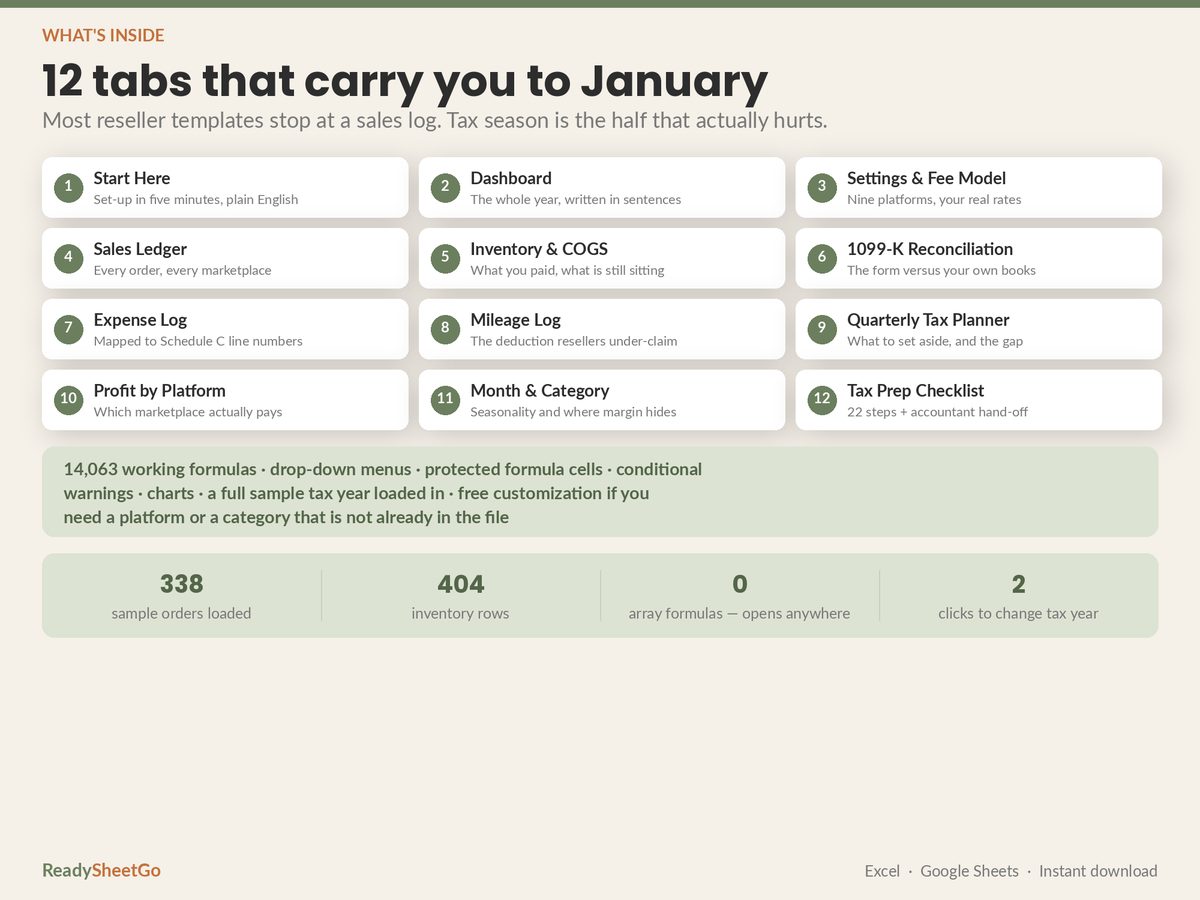
| Scenario | Fee base | 13.6% | + per order | eBay’s cut | You receive |
|---|---|---|---|---|---|
| $100 item, free shipping, no tax | $100.00 | $13.60 | $0.40 | $14.00 | $86.00 |
| $100 item, $10 buyer-paid shipping | $110.00 | $14.96 | $0.40 | $15.36 | $94.64 |
| $100 item, $10 shipping, $8.25 sales tax | $118.25 | $16.08 | $0.40 | $16.48 | $93.52 |
Note what happens in row three. eBay collects the sales tax and remits it to the state, so it never reaches you — but it is in the fee base, so it raises your fee by $1.12 while adding nothing to your payout. You receive item plus shipping minus fees: $110.00 − $16.48 = $93.52.
Row two is the one that catches people. Charging the buyer $10 for postage doesn’t shield that $10 from the fee — it costs you an extra $1.36 in fees, and then you still buy the label.
Two caveats worth holding onto. Rates vary by category — books run materially higher, some instrument categories much lower — so 13.6% is the common case and not a universal rate. And an eBay Store subscription changes the percentage in many categories.
From “Received” to “Kept”
eBay’s cut is only the first subtraction. Here’s the same $100 item all the way down, twice, with different sourcing:
| Thrift find | Retail-sourced | |
|---|---|---|
| Item price | $100.00 | $100.00 |
| Buyer-paid shipping | $10.00 | $10.00 |
| Total buyer paid | $110.00 | $110.00 |
| eBay fee (13.6% + $0.40) | −$15.36 | −$15.36 |
| Shipping label you bought | −$9.20 | −$9.20 |
| Item cost | −$8.00 | −$62.00 |
| Net profit | $77.44 | $23.44 |
| ROI on cost | 968% | 38% |
Identical listing, identical fees, and one of them is a business while the other is a job. The fee percentage is the part everyone asks about and the part you have the least control over. Cost of goods is the part nobody asks about and the part that decides the outcome.
The Break-Even Price on eBay
Before you list — and again before you accept a lowball offer — you want the floor: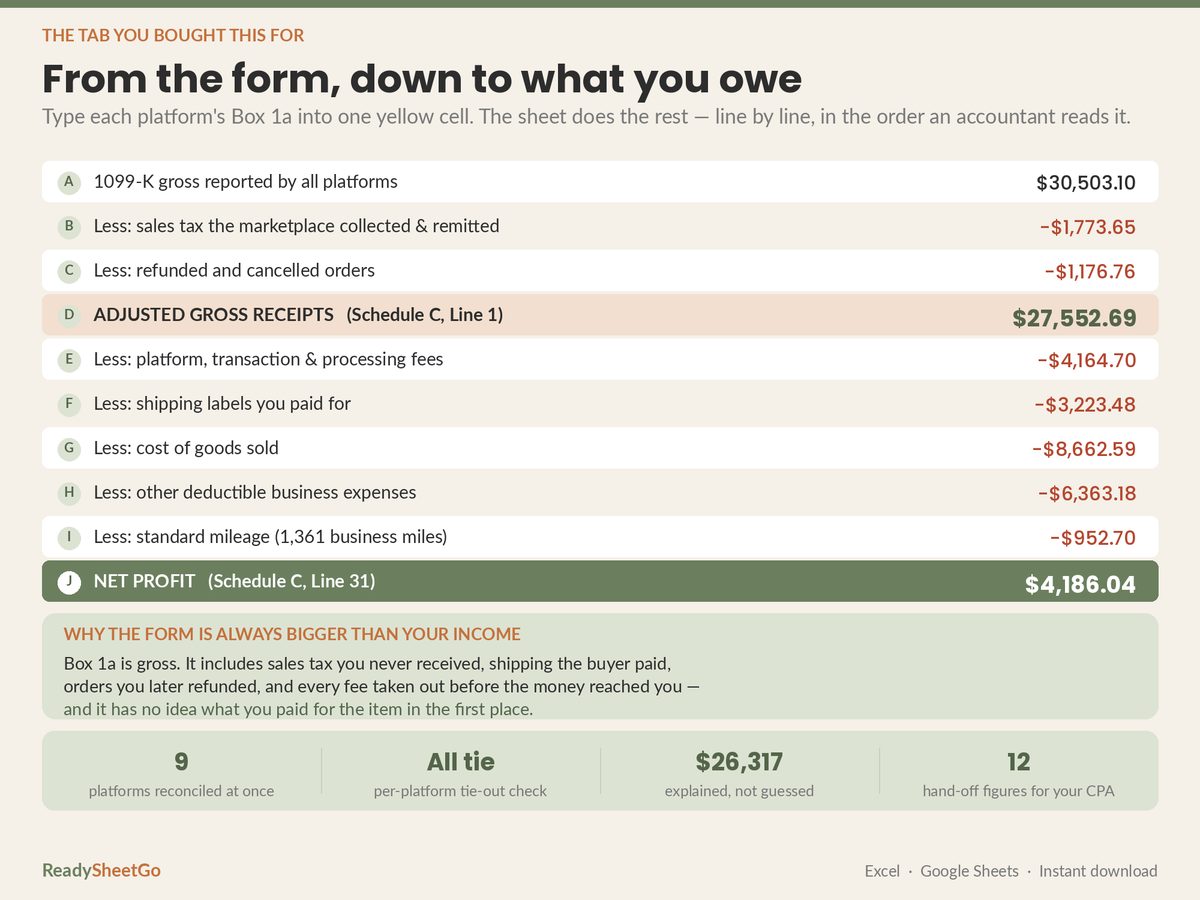
break-even price = (item cost + shipping you'll pay + $0.40) ÷ (1 − 0.136)
You divide rather than add because the fee is charged on the final price, so you have to gross up for it.
Worked: an item that cost $14, shipping you’ll cover at $7.
($14 + $7 + $0.40) ÷ 0.864 = $21.40 ÷ 0.864 = $24.77
At $24.77 you break exactly even. At the $22 an offer-sender proposes, you lose about $2.40 and spend twenty minutes packing it. Margin sits on top of the floor, not on top of the cost: to clear 50% on cost you’re listing near $32, not $21.
Keep this in the same sheet as your listings and it takes two seconds instead of a mental estimate you’ll get wrong when the offer notification arrives at 11pm.
Three Ways the Fee Math Goes Wrong in a Spreadsheet
Applying the percentage to the item price only. Understates the fee on every sale where the buyer paid shipping or tax. Across a year of 200 sales, that’s real money that shows up as an unexplained gap between your spreadsheet and your bank.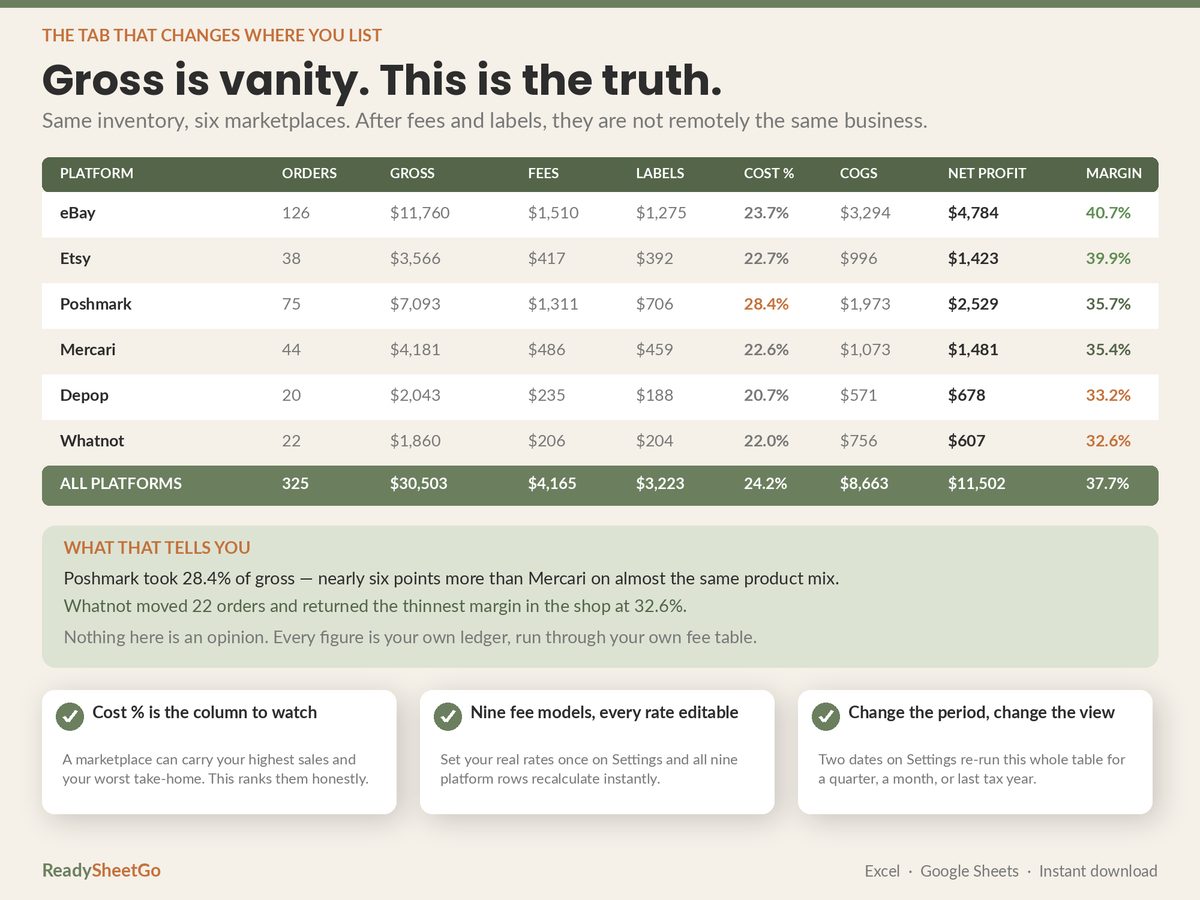
Forgetting the per-order fee. $0.40 is a rounding error on a $100 sale and 4% of a $10 sale. If you sell low-price items in volume, the per-order fee is a bigger drag on your margin than the percentage.
Logging the payout instead of the sale. eBay’s payout is already net of fees and sometimes bundles several orders. If you record the payout as your revenue, your gross receipts are understated and your fee expense disappears — which matters at tax time, because you report gross sales and then deduct fees as an expense rather than reporting the net. More on what to track for Schedule C.
What This Looks Like Across a Whole Business
One sale is arithmetic. Two hundred sales across three platforms is a spreadsheet problem, because the questions change: not “what did eBay take from this one,” but “what did eBay take from me this quarter, and is Poshmark keeping more of my money for the same items?” That comparison is worked out platform by platform here, and the full tracking structure — inventory, sales, fees, aging, sourcing ROI — is in the pillar guide.
The fee is a fixed cost of access to the largest resale audience there is. What you can change is what you pay for inventory, what you list it at, and whether you know the difference.
Featured on ReadySheetGo
Reseller / Flipping Inventory & Profit Tracker — 9 tabs and 1,900+ auto-calculating formulas. A Sales Tracker that applies the platform fee rate and returns net profit and ROI on every item; a Platform Dashboard comparing revenue, fees, profit and sell-through across eBay, Poshmark, Mercari, Facebook Marketplace, Depop, Etsy and Amazon; an ROI tab with the break-even price calculator; an Inventory Log for 200 items; a 12-month P&L; an Inventory Aging report at 30/60/90 days; a Sourcing Trip Log; and a Schedule C tax summary with mileage log. Sample data pre-filled. Works in Excel and Google Sheets — $17.99.
Frequently Asked Questions
How much does eBay take from a $100 sale?
For most categories eBay charges a final value fee of 13.6% plus a $0.40 per-order fee. On a $100 item with no shipping or tax that is $14.00, leaving $86.00. But the fee is charged on the total the buyer paid — item price plus buyer-paid shipping plus sales tax — so a $100 item with $10 buyer-paid shipping and $8.25 of sales tax has a fee base of $118.25 and a fee of about $16.48 — and the sales tax portion never reaches you, because eBay remits it. Always check eBay's current fee schedule for your category; rates run from roughly 6.7% to over 15%.
Does eBay charge fees on shipping and sales tax?
Yes. eBay's final value fee is calculated on the total amount of the sale, which includes the item price, handling charges, shipping collected from the buyer and sales tax. This surprises sellers who assume charging for postage keeps them out of the fee. It doesn't — you pay the percentage on the shipping the buyer paid, then pay for the label as well.
What do you actually keep on a $100 eBay sale?
Take $100, subtract about $14 in eBay fees, subtract the shipping label you bought, and subtract what the item cost you. On a $100 sale with a $9 label and a $15 item cost, you keep roughly $62. If you offered free shipping and the item cost you $40, you keep about $37. The fee is the predictable part; postage and cost of goods are what actually decide whether the sale was worth making.
Is there a way to pay lower eBay fees?
An eBay Store subscription lowers the final value fee percentage in many categories and includes a monthly allowance of zero-insertion-fee listings, so it can pay for itself at volume — run your own last twelve months against the store tiers before subscribing. Category matters too: rates vary widely, so the same item listed in the wrong category can cost you a point or two. Beyond that, the fee is the cost of the audience, and the bigger lever is what you paid for the item.