How to Price Thrift Store Items to Resell for Profit
There’s a $6.99 wool coat in your hands and roughly forty seconds to decide. The question isn’t “is this nice.” It’s “what will this sell for, how long will it sit, and what’s left after fees and postage.”
Here’s the arithmetic, small enough to run in the aisle, and the pricing method to use once it’s home.
Full walkthrough of the template used in this guide.
Start With the Floor, Not the Markup
The single most useful number in reselling is the price below which you’re paying for the privilege of shipping a stranger a coat:
break-even = (item cost + shipping you'll pay + flat per-order fee) ÷ (1 − fee rate)
You divide by one minus the fee rate rather than adding the fee on. The platform charges its percentage on the final sale price, so if you just add the fee to your cost you’ll undershoot every time.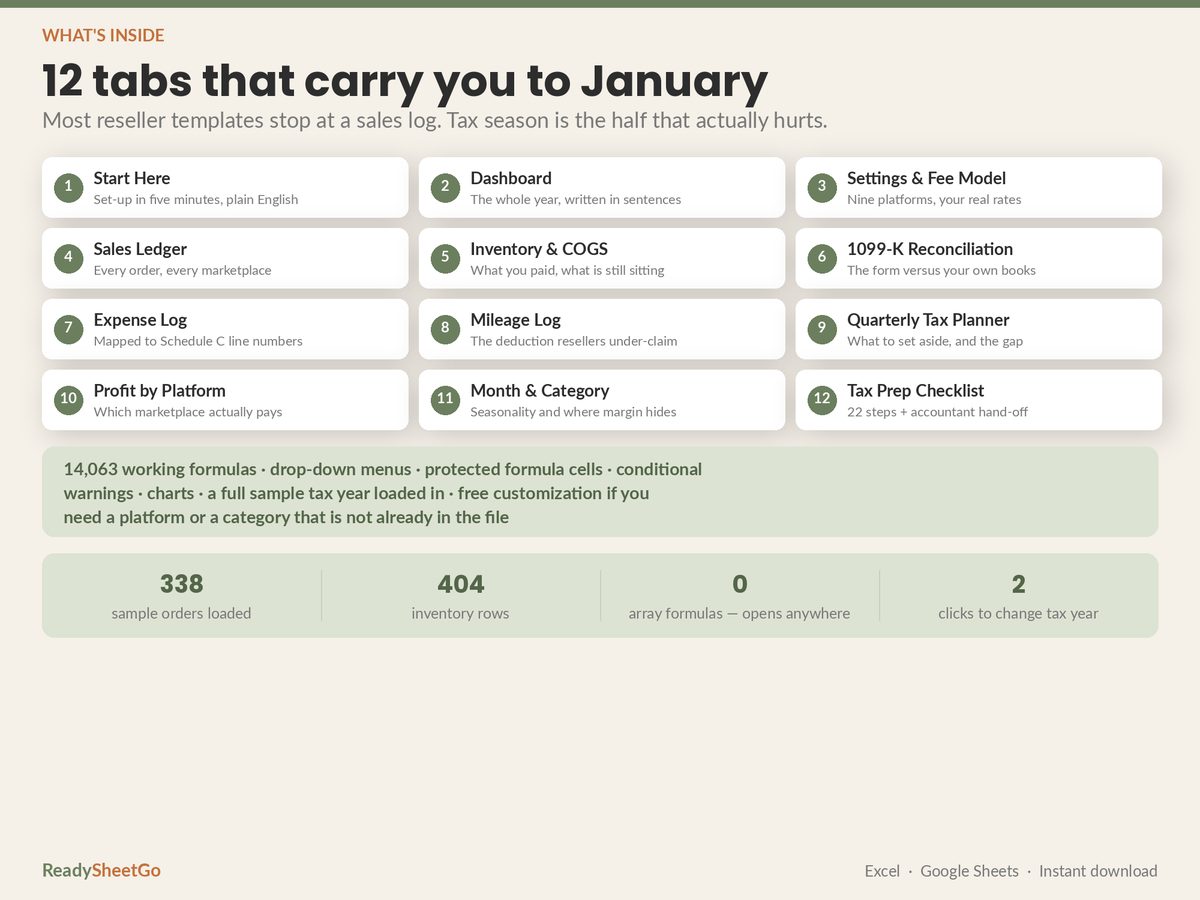
Worked, on the coat: $6.99 cost, a $9 label you’ll cover, a platform taking 13.6% plus $0.40.
($6.99 + $9.00 + $0.40) ÷ (1 − 0.136) = $16.39 ÷ 0.864 = $18.97
So $18.97 is zero. Not “a bit thin” — zero. Every dollar of actual profit lives above it.
Here’s how the floor moves as the numbers move:
| Item cost | Shipping you pay | Fee rate | Break-even |
|---|---|---|---|
| $2.99 | $5.00 | 13.6% | $9.71 |
| $6.99 | $9.00 | 13.6% | $18.97 |
| $6.99 | $0.00 (buyer’s flat rate) | 20% | $8.74 |
| $14.99 | $12.00 | 13.6% | $31.71 |
| $40.00 | $15.00 | 13.6% | $64.12 |
Row three is worth staring at. The same coat on a platform taking a higher percentage but supplying the buyer-paid label has a break-even of $8.74 instead of $18.97, because postage — not commission — is the dominant cost on a low-priced item. Shipping decides more of your margin than fee rates do until you get above about $50.
Then Price From Sold Comps, Not Hope
The break-even tells you the floor. The market tells you the ceiling, and the only honest source for it is sold listings.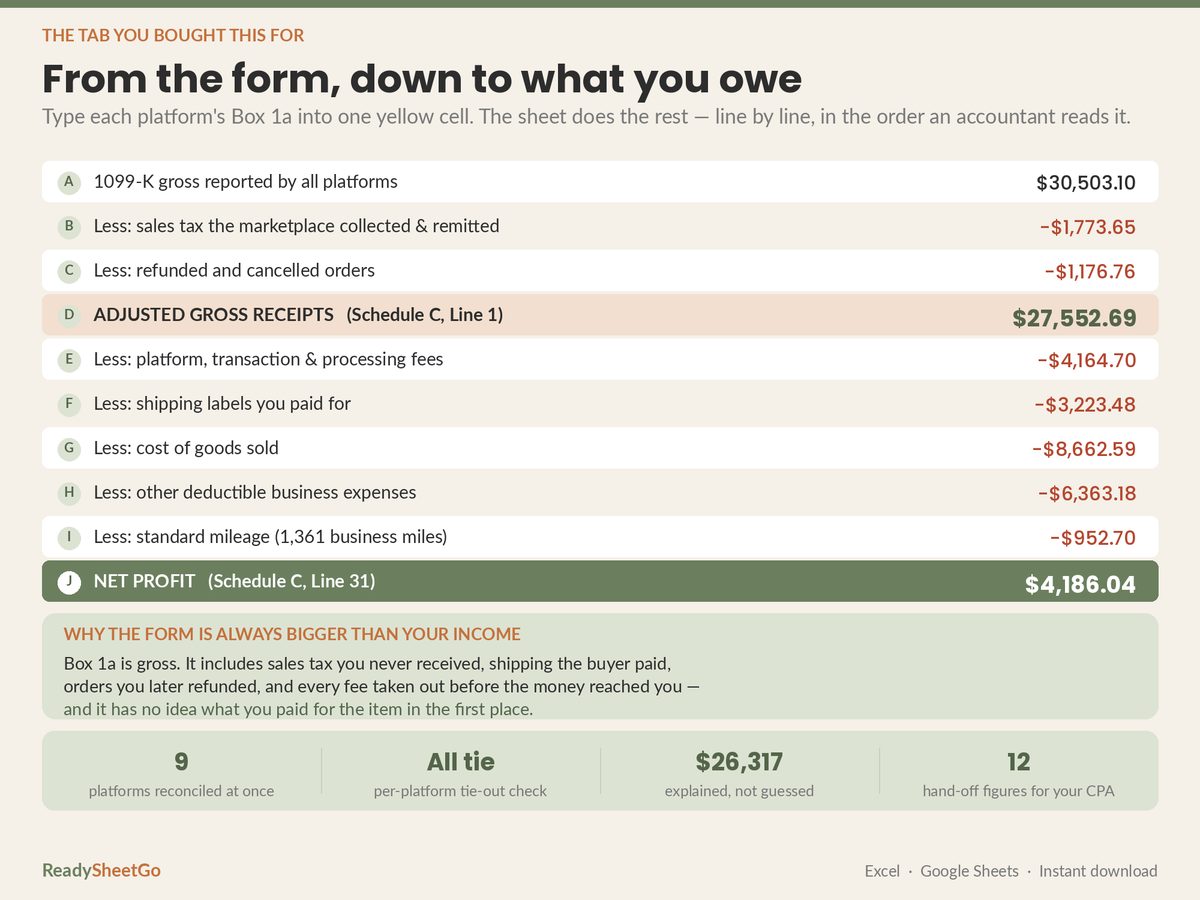
On eBay, search the item and filter to Sold Items. On Poshmark and Mercari, look at what’s marked sold. Active listings tell you what other sellers wish they could get; sold listings tell you what someone actually paid.
Method:
- Search the specific thing — brand, item type, size. “Pendleton wool coat 42R,” not “wool coat.”
- Take the most recent five to ten sold comps.
- Drop the top outlier. There’s always one, it was a bidding war, and it isn’t your item.
- Take the middle of what’s left. That’s your realistic sale price.
- List slightly above it if you’re willing to take offers; at it if you want it gone.
If there are fewer than three sold comps in the last 90 days, there is no demand you can rely on. Put it back. This is the discipline that separates a business from a collection.
Where the 3x Rule Fits
“Buy it if you can list it for three times what you paid” is a good aisle heuristic and a bad pricing method. Watch it break:
| Cost | 3x price | Fee (13.6%+$0.40) | Label | Net profit |
|---|---|---|---|---|
| $2.00 | $6.00 | $1.22 | $5.00 | −$2.22 |
| $6.00 | $18.00 | $2.85 | $5.00 | $4.15 |
| $6.00 | $18.00 | $2.85 | $0.00 (buyer’s label) | $9.15 |
| $25.00 | $75.00 | $10.60 | $9.00 | $30.40 |
| $60.00 | $180.00 | $24.88 | $15.00 | $80.12 |
The $2 item loses money at 3x. The $60 item at 3x requires a $180 comp to exist, which is a much stronger claim than the rule makes it sound.
So use 3x as a screen — a fast way to reject the obviously marginal while standing in a Goodwill — and then price properly from comps with a break-even check before the listing goes live.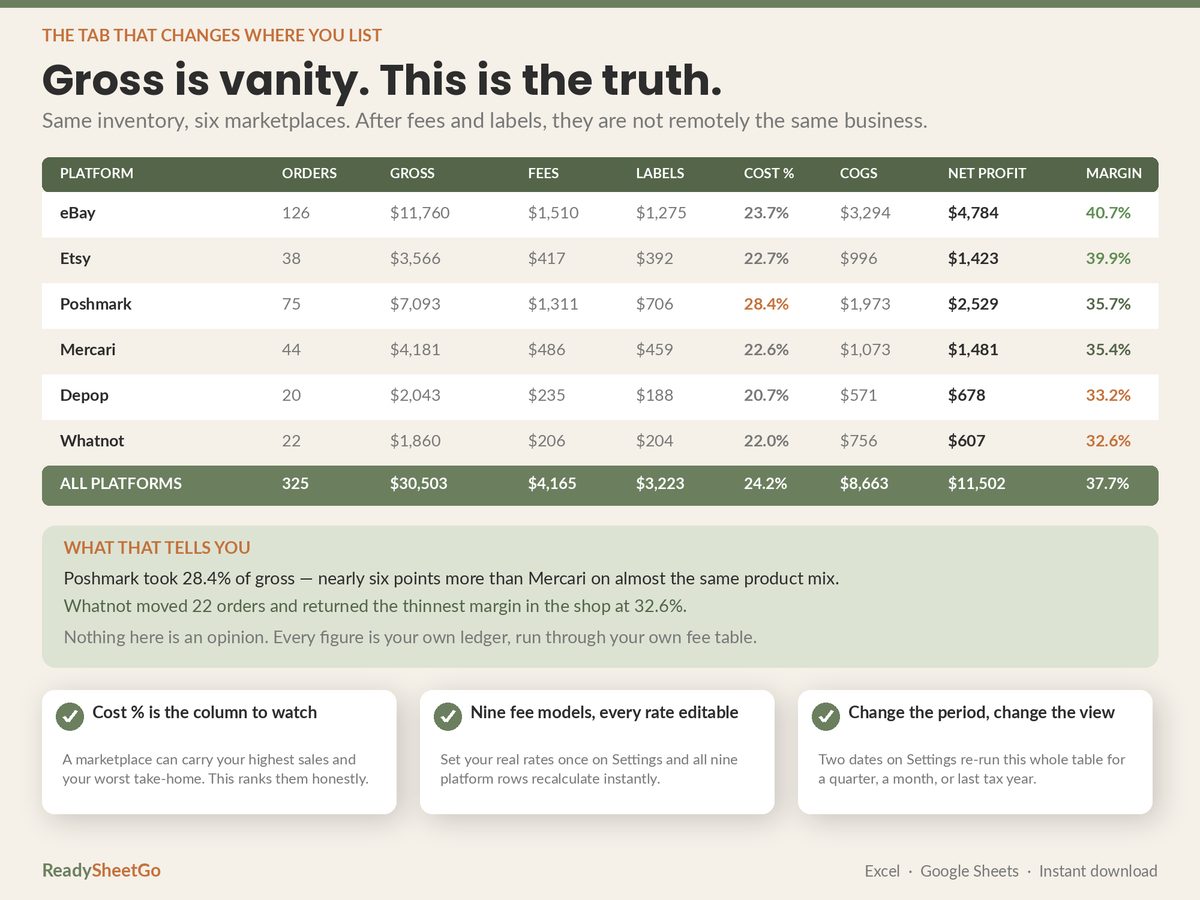
A more useful in-the-aisle version, for low-value items: will it sell for at least $15 more than it costs me, all in? Dollars pay rent; multiples don’t.
The Five-Question Sourcing Filter
Run this before an item goes in the cart. Any “no” is a pass.
- Can I find three sold comps in the last 90 days? No demand data, no purchase.
- Is the middle sold price at least 2.5× my all-in cost including postage? Not just the sticker price.
- Will it ship for under $10? Bulky and heavy items quietly convert profit into postage. A $30 comp on a 9-pound item is often a worse flip than a $20 comp on something that fits in a poly mailer.
- Is the damage in a forgivable place? A small mark inside a hem is fine. Stains at the collar, holes at the elbow, and any smoke or mildew odour are not — odour in particular is the leading cause of returns and there is no photographing your way around it.
- Would I be happy if this took 90 days to sell? Because a meaningful share of it will. If the flip only works when it sells next week, it doesn’t work.
Question five is the one people skip, and it’s the one your aging report will keep reminding you about.
Track the Sourcing Trip, Not Just the Item
Individual item pricing is only half the discipline. The other half is whether the trip paid.
Log four fields per sourcing run: date, location, total spent, and — filled in later — revenue realised from what you bought there. After ten trips you’ll have a genuinely surprising ranking. Most resellers have a favourite store that’s sentimental rather than profitable, and one they visit rarely that returns 3–4x. Nobody can tell those apart from memory, because the memorable finds aren’t the profitable average.
That log is also what stops the most expensive habit in reselling: sourcing on a schedule rather than sourcing when the inventory you already own has cleared. The aging and inventory structure that tells you when to stop buying is the other half of the pricing question, and which platform keeps the most of your price decides how much of your comp research reaches your pocket.
The Pricing Checklist
- [ ] Three or more sold comps in the last 90 days
- [ ] Realistic price = middle of recent sold comps, top outlier dropped
- [ ] Break-even calculated with the divide formula, before listing
- [ ] Shipping cost estimated by weight and box size, not guessed
- [ ] Listing price at or above break-even × 1.5 for a working margin
- [ ] All-in cost logged, box lots split across items
- [ ] Sourcing trip logged with location and total spend
- [ ] A 90-day reprice date on anything still sitting
Run those eight and pricing stops being a feeling.
Featured on ReadySheetGo
Reseller / Flipping Inventory & Profit Tracker — the ROI tab holds the break-even calculator: enter item cost, platform and estimated shipping and it returns your break-even sale price plus target prices at 30% and 50% margin. Alongside it, a 200-item Inventory Log, a Sales Tracker that applies the platform fee and returns net profit and ROI per item, a Platform Dashboard with sell-through by platform, a 12-month P&L, a 30/60/90-day Inventory Aging report, a 100-trip Sourcing Trip Log with spend and ROI by location, and a Schedule C tax summary with mileage log. 9 tabs, 1,900+ formulas, sample data pre-filled. Excel and Google Sheets — $17.99.
Frequently Asked Questions
What is the 3x rule in reselling?
List an item for at least three times what you paid for it. It's a fast in-the-aisle filter, not a pricing method: on a $6 item it puts you at $18, which after a 13.6% fee and a $5 label leaves about $4.55 — thin but positive. The rule fails at both ends. On cheap items 3x barely clears postage, and on a $60 sourced item 3x means $180, which the comps may not support. Use 3x to decide whether to pick it up, then price from comps and check break-even before you list.
How do you calculate the minimum price to sell an item for?
Break-even price = (item cost + shipping you'll pay + any flat per-order fee) ÷ (1 − fee rate). You divide rather than add because the platform fee is charged on the final sale price, so the cost has to be grossed up. A $12 item with a $5 label on a platform taking 13.6% breaks even at about $20.14 — anything below that loses money after you've packed and posted it.
How do you know what a thrift item is worth before buying it?
Search the item on your selling platform and filter to sold or completed listings, not active ones. Active listings are what sellers hope for; sold listings are what buyers paid. Look at the most recent five to ten sold comps, ignore the outlier at the top, and use the middle of the range. If there are fewer than three sold comps in the last 90 days, there's no reliable demand — that's a pass regardless of how good the item looks.
What should you not buy at a thrift store to resell?
Anything bulky or heavy relative to its value, since postage eats the margin; fast-fashion mall brands, which have almost no resale floor; items with damage in the wrong place, meaning stains, holes and odours on visible or hard-to-clean areas; and anything where you can't find sold comps. The most expensive mistake in reselling isn't overpaying — it's buying items with no demand, because they never sell at any price and you can't recover the cash.