Student Loan Avalanche vs Snowball: Which Is Actually Cheaper
The advice is always the same two sentences. Avalanche saves more money; snowball keeps you motivated. Pick the one that suits you.
That is true and almost useless, because it does not tell you the one thing you need: how much more money. If avalanche saves $12,000 you should grit your teeth. If it saves $300 you should take the motivation. The answer is entirely specific to your loans, and it is decided by whether your highest-rate loan is also one of your bigger ones.
Full walkthrough of the template used in this guide.
Here is the same portfolio run both ways, month by month.
The Portfolio
| Loan | Balance | Rate | Minimum |
|---|---|---|---|
| Loan A — Undergrad 1 | $4,180.44 | 4.53% | $58 |
| Loan B — Undergrad 2 | $5,624.19 | 4.53% | $68 |
| Loan C — Undergrad 3 | $6,912.05 | 4.99% | $80 |
| Loan D — Grad 1 | $17,640.88 | 6.08% | $206 |
| Loan E — Grad 2 | $18,011.32 | 7.54% | $219 |
| Loan F — Private | $9,884.61 | 9.25% | $156 |
| Total | $62,253.49 | 6.6406% blended | $787 |
Assumptions: payments start September 2026, $250 a month extra on top of all minimums, and every cleared loan’s minimum rolls forward into the next target. Total monthly outflow is $1,037 and stays $1,037 until the last loan closes. That last condition is not a detail — it is the method.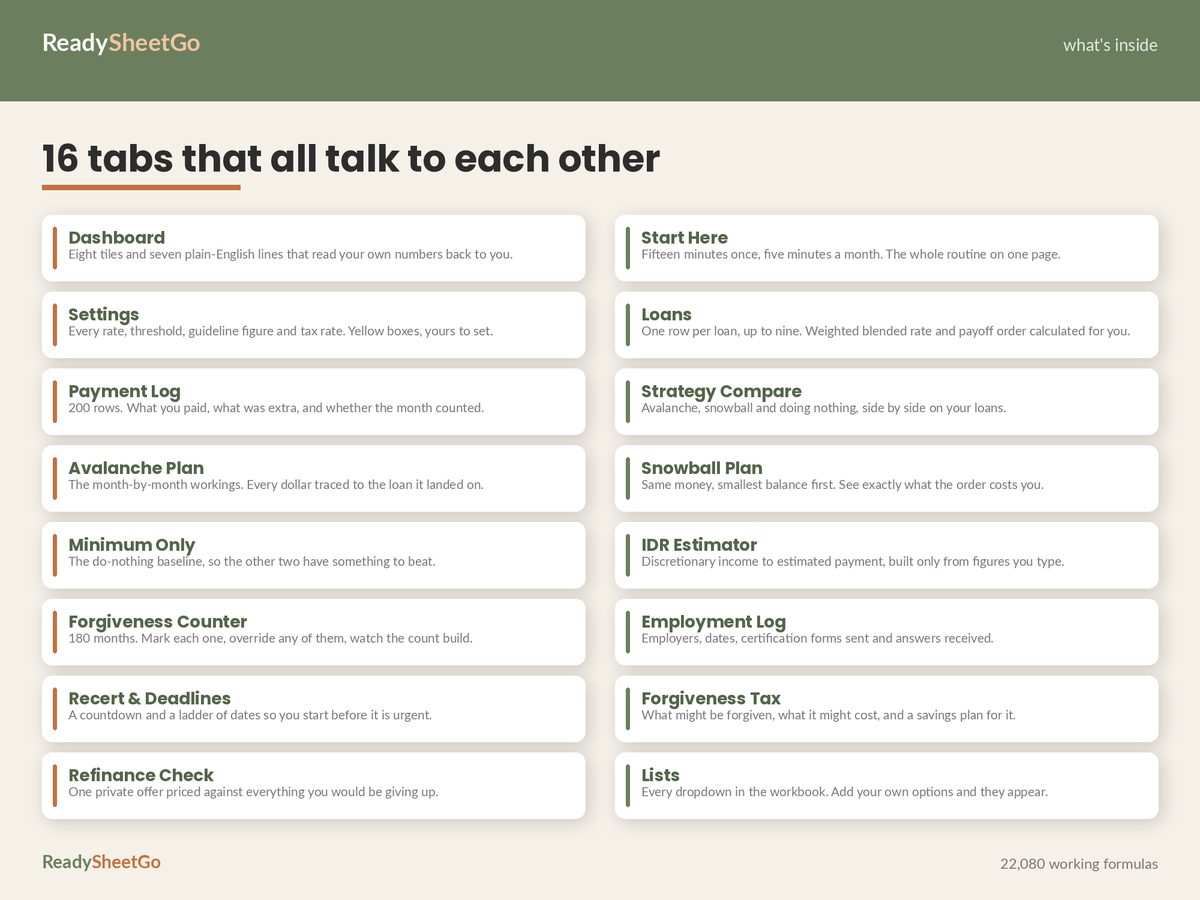
The Two Orders
Sort by rate, highest first — avalanche: F (9.25%), E (7.54%), D (6.08%), C (4.99%), A (4.53%), B (4.53%).
Sort by balance, smallest first — snowball: A ($4,180), B ($5,624), C ($6,912), F ($9,885), D ($17,641), E ($18,011).
The two lists disagree in exactly one meaningful way: Loan F is first under avalanche and fourth under snowball. It is the most expensive loan in the portfolio and only the fourth smallest, so the snowball leaves it accruing at 9.25% for four and a half years while it clears three cheaper loans first. That one disagreement is the entire story.
The Result
| Avalanche | Snowball | Difference | |
|---|---|---|---|
| Months to debt-free | 73 | 74 | 1 month |
| Debt-free date | Sep 2032 | Oct 2032 | |
| Total interest | $12,589.42 | $14,350.53 | $1,761.11 |
| First loan cleared | month 28 (Dec 2028) | month 14 (Oct 2027) | 14 months |
Avalanche is cheaper by $1,761.11 — about 14% of the interest bill, or roughly $24 a month across the life of the plan.
Snowball closes its first account fourteen months sooner, and by the time avalanche has closed its second loan (month 53), snowball has closed four.
The Full Schedules
This is what the two plans actually feel like, which the summary table hides.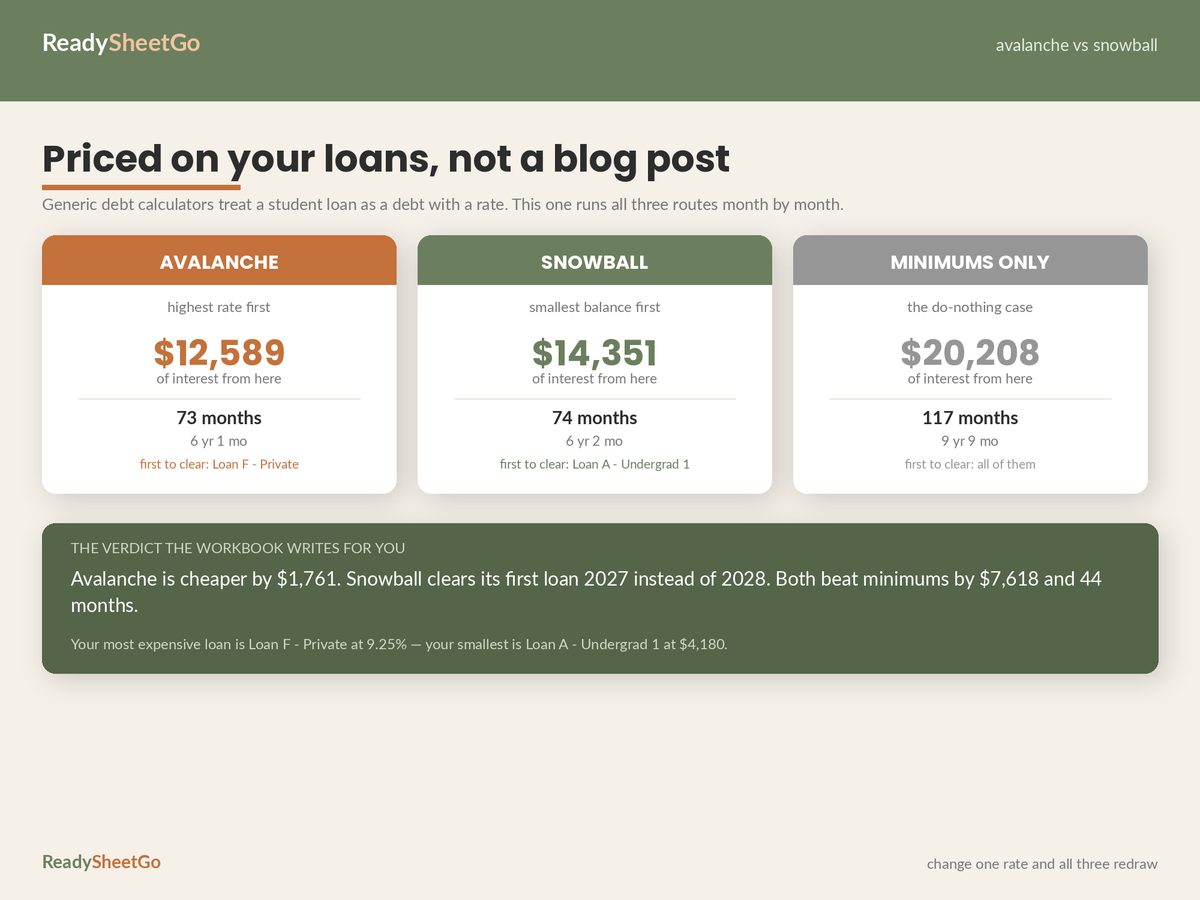
Avalanche — loans clear in this order:
| Loan cleared | Month | Date |
|---|---|---|
| F — Private, 9.25% | 28 | Dec 2028 |
| E — Grad 2, 7.54% | 53 | Jan 2031 |
| D — Grad 1, 6.08% | 67 | Mar 2032 |
| C — Undergrad 3, 4.99% | 70 | Jun 2032 |
| A — Undergrad 1, 4.53% | 71 | Jul 2032 |
| B — Undergrad 2, 4.53% | 73 | Sep 2032 |
Snowball — loans clear in this order:
| Loan cleared | Month | Date |
|---|---|---|
| A — $4,180.44 | 14 | Oct 2027 |
| B — $5,624.19 | 28 | Dec 2028 |
| C — $6,912.05 | 40 | Dec 2029 |
| F — $9,884.61 | 51 | Nov 2030 |
| D — $17,640.88 | 65 | Jan 2032 |
| E — $18,011.32 | 74 | Oct 2032 |
Read those two tables side by side and the trade is obvious. Avalanche spends its first 28 months on one loan and delivers nothing you can see; then it collapses, closing four loans in the final six months. Snowball delivers a closed account in year one, another in year three, another in year four — and pays $1,761.11 for the privilege by leaving a 9.25% loan running until month 51.
Which One Should You Pick
Run this test on your own loans before deciding anything.
Do your two lists agree at the top? If your highest-rate loan is also your smallest, the methods produce the same order and the entire debate is moot. This is more common than people expect — small private loans and credit-building loans often carry both the highest rate and the smallest balance.
How big is the gap in dollars? Not in percentages. $1,761 over six years is real but survivable. If your numbers produce a $9,000 gap, the motivation argument stops being persuasive.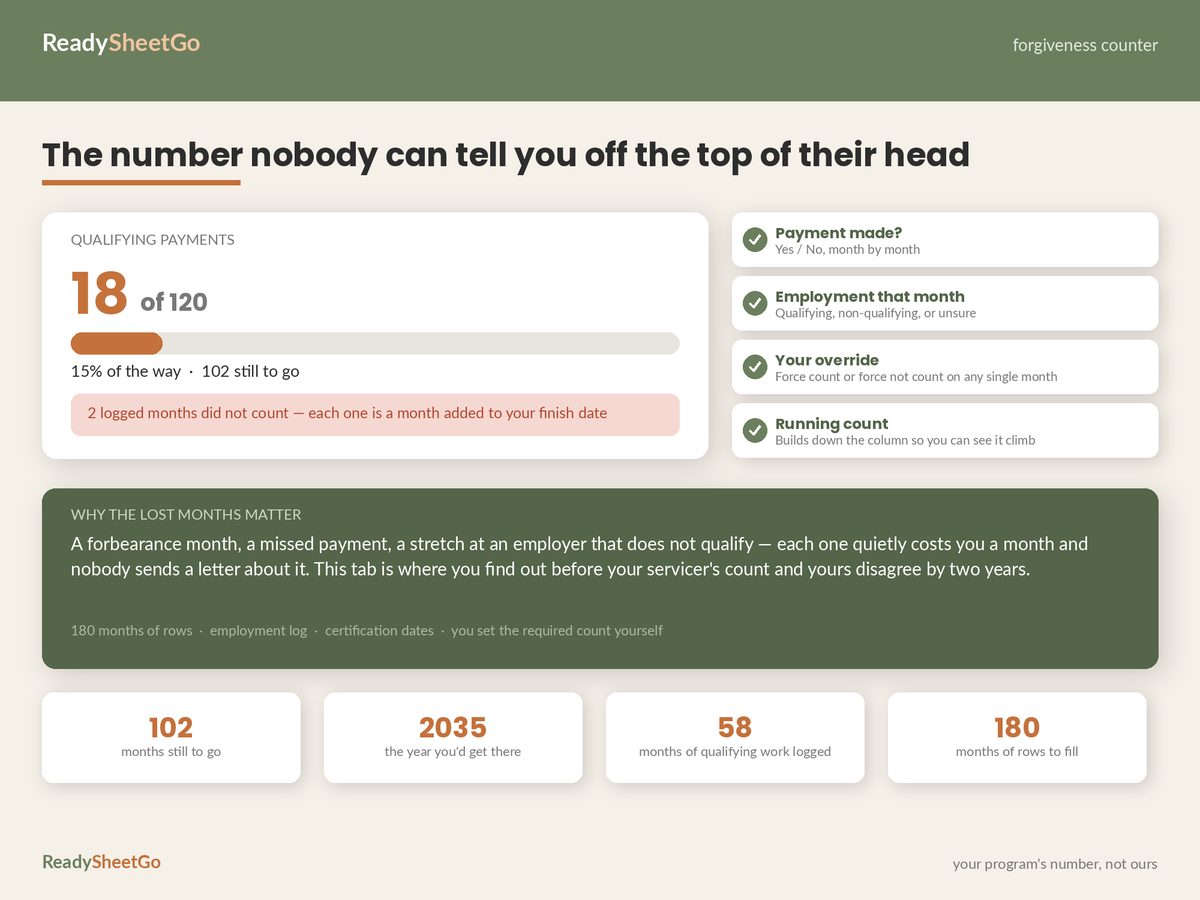
Have you abandoned a payoff plan before? This is the honest question, and only you can answer it. Fourteen months of paying $1,037 a month with no account closing is a long stretch. A plan you quit in month 11 returns nothing, and there is no version of the avalanche that beats a snowball you actually finish.
Is anything on your list a variable rate? A private loan that can reprice upward is a different kind of risk from a fixed federal loan at the same rate today. Being methodical about the cheapest order matters less than not being exposed to the one loan whose rate is not yours to control.
The Comparison That Actually Matters
Both of these beat the default so comprehensively that arguing between them is nearly a rounding error.
| Route | Months | Total interest |
|---|---|---|
| Avalanche + $250 | 73 | $12,589.42 |
| Snowball + $250 | 74 | $14,350.53 |
| Minimums only, nothing rolled | 117 | $20,207.65 |
Avalanche beats snowball by $1,761.11. Either of them beats doing nothing by $7,618.23 and 44 months. The payoff order is worth about 23% of what having a method at all is worth — and the method is mostly one mechanical habit: keep total outflow constant, so that every freed-up minimum rolls into the next loan instead of quietly becoming spending.
If choosing between the two orders is what is stopping you from starting, pick snowball, start on Monday, and switch to avalanche in six months if you feel like it. The switch costs you almost nothing. The six months of not starting costs you six months of momentum and six months of $344.50 interest charges you had a plan to reduce.
For the full method — the blended rate, the interest-per-day figure, and the four things that make a student loan different from a credit card — see the complete guide to tracking every loan and your real payoff date. And before you conclude the extra payment has to be $250, the same portfolio at $100 a month still finishes 28 months early.
Featured on ReadySheetGo
Student Loan Payoff, IDR & Forgiveness Progress Tracker — $14.99
The Strategy Compare tab is where this comparison lives. It runs avalanche, snowball and minimum-only as three full month-by-month simulations of your loans — not a rule of thumb — and returns months to debt-free, total interest and payoff date for each, plus which loan you attack first and when your first loan disappears under each plan. Change one balance or one rate and all three redraw.
Behind it sit Avalanche Plan, Snowball Plan and Minimum Only tabs holding the month-by-month workings, so you can see the exact month each loan clears rather than just the summary. The Loans tab feeds them: one row per loan, up to nine, federal and private together, returning your weighted blended rate, total minimum, interest per month and per day, and both payoff orders worked out for you.
Sixteen tabs in total, including a 200-row Payment Log, an IDR Estimator that tells you whether your payment even covers your interest, a 180-row Forgiveness Counter with an override on every month, a recertification countdown with warnings at 90, 60, 30 and 7 days, a Forgiveness Tax projection and a Refinance Check. Every programme figure is a yellow input box you fill in yourself. Sample data pre-filled across six loans. Works in Excel and Google Sheets.
Get the Student Loan Payoff, IDR & Forgiveness Tracker →
Frequently Asked Questions
Is avalanche or snowball cheaper for student loans?
Avalanche is always cheaper or tied, because paying the highest rate first always removes the most expensive interest first. The question is by how much. On the six-loan portfolio worked through here — $62,253.49 across rates from 4.53% to 9.25%, with $250 a month extra — avalanche finishes in 73 months for $12,589.42 of interest and snowball in 74 months for $14,350.53. The gap is $1,761.11 and one month, or about 14% of the interest bill.
Which student loan should I pay off first?
Rank your loans by interest rate and pay the highest first if you want the cheapest outcome; rank by balance and pay the smallest first if you want an account to close soon. Check whether the two lists agree at the top — in the worked portfolio here they do not, because the 9.25% private loan is fourth by size, and that single disagreement accounts for the entire $1,761.11 difference between the two methods.
How much faster does the snowball method close the first loan?
In this six-loan example the snowball clears its first loan in month 14 and the avalanche not until month 28 — fourteen months of difference. Snowball also closes three loans before avalanche closes its second. If fourteen months of no visible progress is the thing that has made you quit a plan before, that gap is worth more to you than the $1,761.11 avalanche saves.
Does the payoff order matter more than the extra payment amount?
No, and it is not close. Avalanche beats snowball by $1,761.11 in this example, but either method beats paying only the minimums by $7,618.23 and 44 months. The order is worth about 23% of what having any method at all is worth. Pick whichever order you will actually stick to and spend your attention on the size and consistency of the extra payment instead.