How Much Faster Will an Extra $100 a Month Pay Off Student Loans?
You can find $100 a month. Not comfortably, but you can find it.
The question is whether it does anything. On a balance in the sixties, $100 feels like emptying a swimming pool with a mug — and if that is genuinely what it is, you would rather keep the money.
Full walkthrough of the template used in this guide.
Here is the actual arithmetic on a real portfolio, from $25 a month up to $500.
The Portfolio
Six loans, $62,253.49 total, a 6.6406% weighted blended rate, and a $787 total minimum payment across two federal servicers and one private lender. Rates run from 4.53% to 9.25%. Interest accrues at $344.50 a month — $11.33 a day.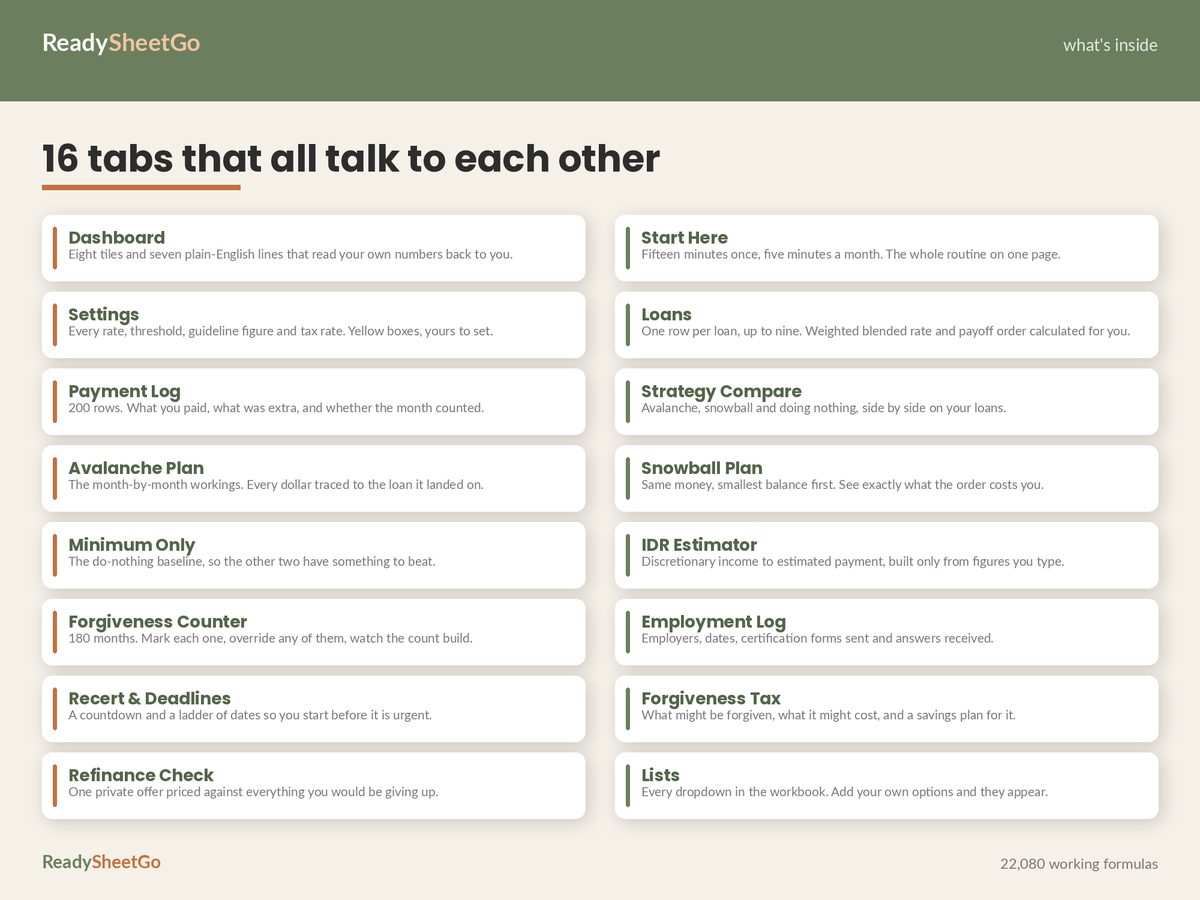
Assumptions: every extra dollar goes to the highest-rate loan first (avalanche), and when a loan clears, its minimum rolls into the next target rather than back into your spending. Total monthly outflow stays constant for the life of the plan. The baseline row is the default you are dropped into if you do nothing: pay each loan’s own minimum, roll nothing forward.
The Table
| Extra per month | Total monthly | Months | Debt-free | Total interest | Interest saved | Months saved |
|---|---|---|---|---|---|---|
| $0 — minimums only | $787 | 117 | May 2036 | $20,207.65 | — | — |
| +$25 | $812 | 100 | Dec 2034 | $18,675.79 | $1,531.86 | 17 |
| +$50 | $837 | 96 | Aug 2034 | $17,663.52 | $2,544.13 | 21 |
| +$100 | $887 | 89 | Jan 2034 | $15,988.92 | $4,218.73 | 28 |
| +$150 | $937 | 83 | Jul 2033 | $14,644.18 | $5,563.47 | 34 |
| +$200 | $987 | 77 | Jan 2033 | $13,531.41 | $6,676.24 | 40 |
| +$250 | $1,037 | 73 | Sep 2032 | $12,589.42 | $7,618.23 | 44 |
| +$300 | $1,087 | 69 | May 2032 | $11,779.44 | $8,428.21 | 48 |
| +$400 | $1,187 | 62 | Oct 2031 | $10,452.55 | $9,755.10 | 55 |
| +$500 | $1,287 | 56 | Apr 2031 | $9,406.98 | $10,800.67 | 61 |
An extra $100 a month takes 28 months and $4,218.73 off this debt. Two years and four months of your life, bought for about $8,900 of payments you were going to make eventually anyway.
The Part That Surprises People
Look at what each additional $50 buys, reading down the table:
| Step | Extra months saved |
|---|---|
| $0 → $50 | 21 months |
| $50 → $100 | 7 months |
| $100 → $150 | 6 months |
| $150 → $200 | 6 months |
| $200 → $250 | 4 months |
| $250 → $300 | 4 months |
The first $50 buys three times as much as the second $50, and five times as much as the sixth. Extra payments have sharply diminishing returns, which is precisely the opposite of the way most people assume this works — the usual instinct is that small amounts are pointless and only a big commitment moves the needle.
Per dollar actually diverted, the picture is the same:
| Extra per month | Roughly, total extra paid | Interest saved | Saved per $1 diverted |
|---|---|---|---|
| $25 | $2,500 | $1,531.86 | $0.61 |
| $50 | $4,800 | $2,544.13 | $0.53 |
| $100 | $8,900 | $4,218.73 | $0.47 |
| $250 | $18,250 | $7,618.23 | $0.42 |
| $500 | $28,000 | $10,800.67 | $0.39 |
The reason is that the earliest extra dollars land while the balance is at its highest, so each one kills interest that would have compounded for the longest time. The last dollars land on a small balance in a short remaining window and cannot do much.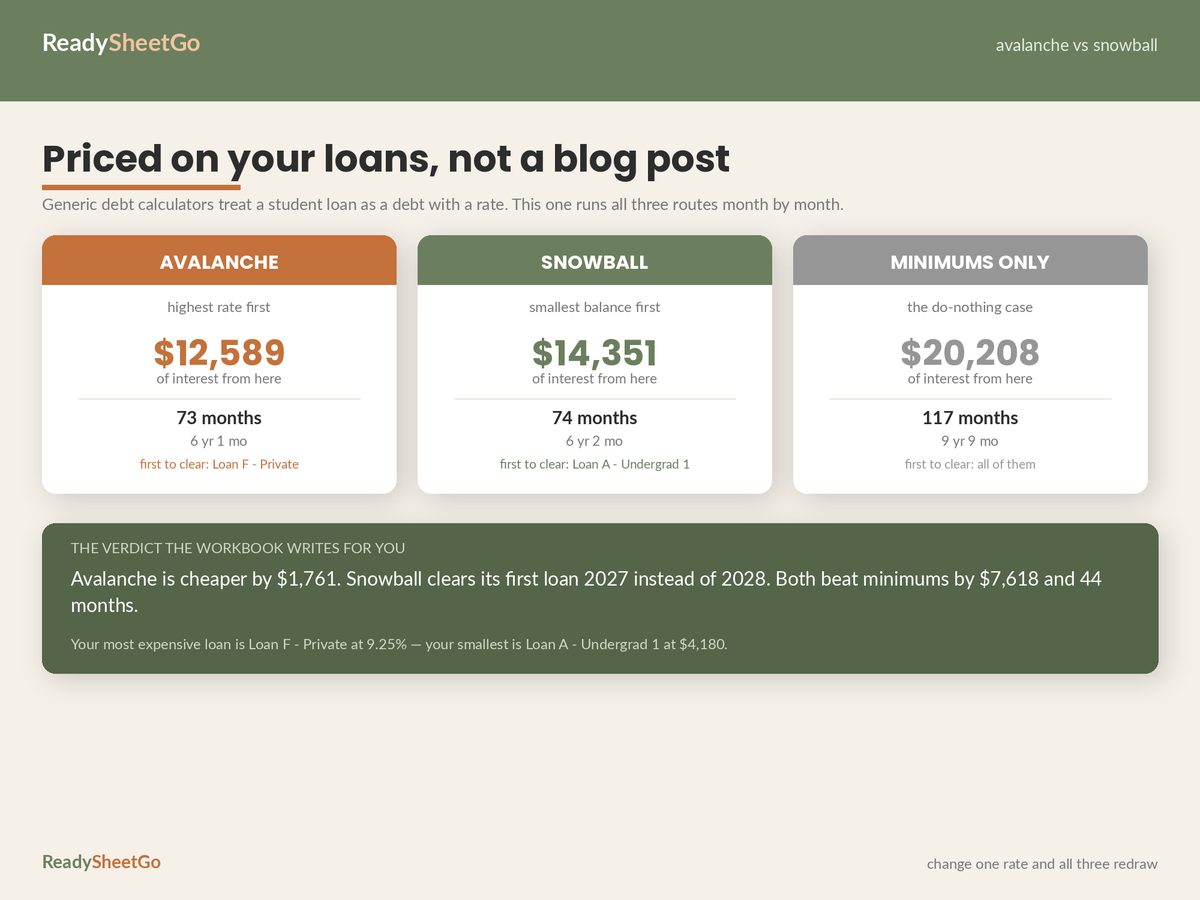
Two practical conclusions follow.
Small is not pointless. $25 a month — one streaming bundle — takes 17 months off. If $100 is genuinely out of reach, $25 is not a rounding error and it is the most efficient money in the table.
Consistency beats size. $100 every month for six years does far more than $600 once a year, because eleven of those twelve months the balance sat higher than it needed to.
Where the Extra Money Actually Goes
Under the avalanche order the extra $100 attacks the 9.25% private loan first. That loan clears in month 47 — July 2030 — and from that point its $156 minimum joins the $100, so $256 a month rolls onto the 7.54% grad loan without you finding another dollar. That rolling is what produces the steep back end of the plan: four of the six loans clear in the final four months.
Which means the mechanism doing most of the work here is not really the extra $100. It is holding total outflow constant so freed minimums roll forward. If the $156 quietly becomes spending in August 2030, the plan reverts to something much closer to the baseline row.
One Thing to Check Before You Send a Dollar
An extra payment only helps if the servicer applies it to principal.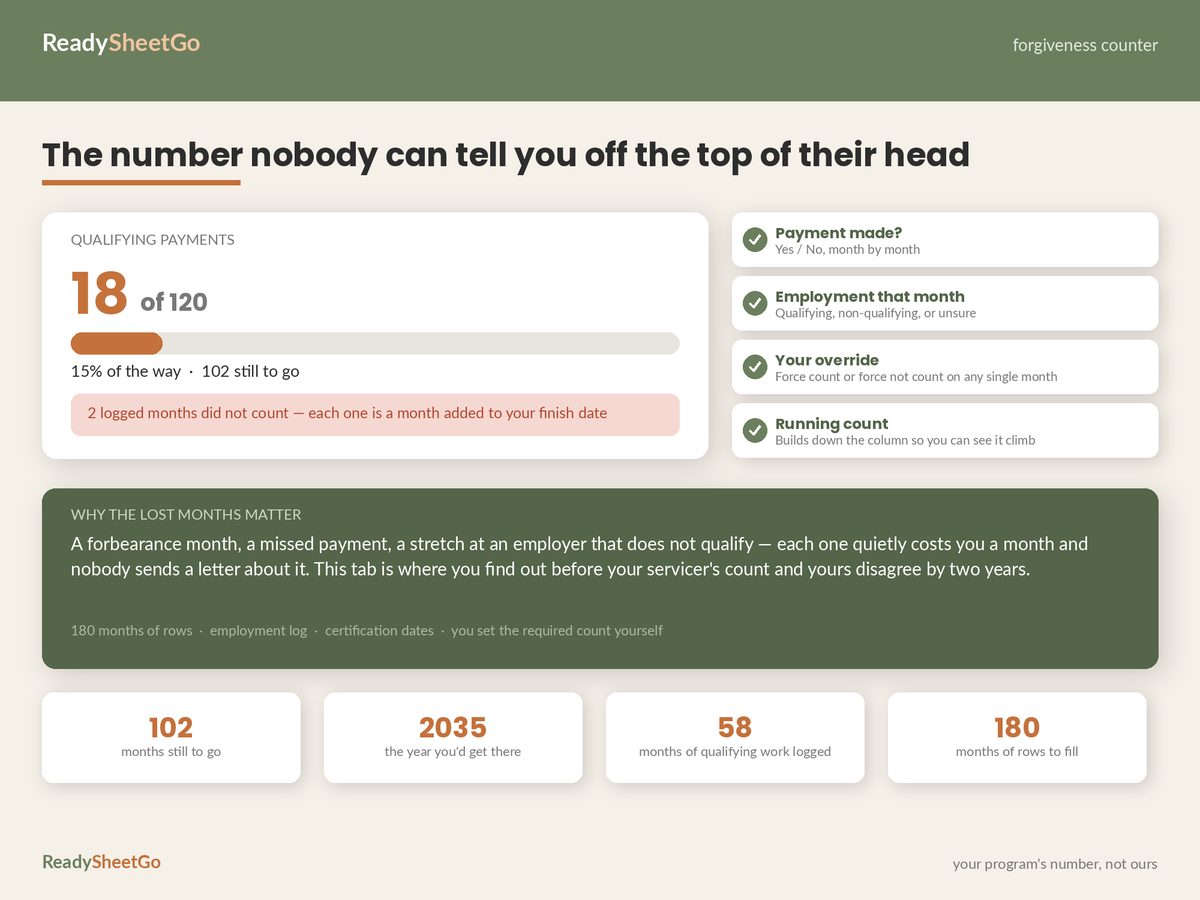
Send $887 against a $787 bill and many servicers will treat the surplus as your next instalment paid early. Your due date advances a month, the statement says “paid ahead”, and the balance barely moves. It is not fraud and it is not unusual — it is the default handling in a lot of systems, and it is close to worthless to you.
Three steps:
- Ask your servicer how overpayments are applied and whether you can set a standing instruction to apply them to principal.
- Where you can, direct the extra to one named loan rather than letting it be spread proportionally across all of them. Spreading it defeats the entire avalanche.
- Check the next statement. Did principal fall by the amount you sent, over and above the scheduled principal? If not, the instruction did not take. This is the single highest-value five minutes in this article.
Picking Your Number
Do this in three steps rather than guessing:
- Work out your blended rate and your monthly interest charge. Balance times rate for each loan, summed, divided by total balance. Monthly interest tells you the floor a payment has to clear before principal moves at all.
- Find the number you can pay every single month, including bad months. Not your best month. The whole benefit compounds from consistency, and a plan calibrated to a good month breaks in the first bad one.
- Fix your total outflow at that figure and never lower it, even as loans close. That rule is worth more than the number you pick.
For the full method — the six columns per loan, both payoff orders, and the four things that make a student loan different from a credit card — see the complete guide to tracking every loan and your real payoff date. If you have not settled which loan the extra should hit, avalanche versus snowball on this same portfolio is worth $1,761.11. And if you are on an income-driven plan heading for forgiveness, check the qualifying-payment side first — extra payments make no sense at all on a balance you will not be repaying.
Featured on ReadySheetGo
Student Loan Payoff, IDR & Forgiveness Progress Tracker — $14.99
This whole table is one input box. The Settings tab holds your extra payment amount; change it from $100 to $250 and the Strategy Compare tab redraws all three routes — avalanche, snowball and minimum-only — returning months to debt-free, total interest and payoff date under each, as full month-by-month simulations of your own loans rather than a rule of thumb.
The Loans tab takes one row per loan, up to nine, federal and private together, and returns your weighted blended rate, total minimum, interest per month and per day, each loan’s share of the debt and both payoff orders. The 200-row Payment Log then records what you actually paid and how much of it was extra, so the plan and the reality stay visible against each other — which is how you catch a servicer applying overpayments to your due date instead of your principal.
Sixteen tabs and 22,080 formulas in total, including an IDR Estimator that tells you whether your payment covers your interest, a 180-row Forgiveness Counter with an override on every month, a recertification countdown, a Forgiveness Tax projection and a Refinance Check. Every programme figure is a yellow input box you fill in yourself. Sample data pre-filled across six loans. Works in Excel and Google Sheets.
Get the Student Loan Payoff, IDR & Forgiveness Tracker →
Frequently Asked Questions
How much does an extra $100 a month save on student loans?
On the $62,253.49 six-loan portfolio worked through here — a 6.6406% blended rate and a $787 total minimum — an extra $100 a month cuts the payoff from 117 months to 89 and the interest bill from $20,207.65 to $15,988.92. That is 28 months and $4,218.73 saved, for about $8,900 of extra payments made. Your own result scales with your blended rate: the higher the rate, the more each extra dollar returns.
Is it worth paying an extra $25 a month on student loans?
Per dollar, it is the best money in the whole table. An extra $25 a month on the worked portfolio saves $1,531.86 of interest and 17 months, and it returns about 61 cents of saved interest for every dollar diverted — against 47 cents at $100 a month and 39 cents at $500. Small extra payments are more efficient than large ones because the first dollars land while the balance, and therefore the daily interest charge, is at its highest.
Does paying extra on a student loan actually reduce the balance?
Only if it is applied to principal. Many servicers will treat an overpayment as paying your next instalment early — your due date advances a month and the balance barely moves, which is close to useless. Check your servicer's policy, set a standing instruction to apply overpayments to principal on a named loan if they allow it, and verify on the following statement that the principal actually fell by the amount you sent.
Should I pay extra on student loans or save it instead?
An extra payment on a 9.25% loan is a guaranteed 9.25% return, which is hard to beat with certainty anywhere else — but it is money you cannot get back, and it is the wrong move if you have no emergency fund, are carrying higher-rate credit card debt, are leaving employer retirement matching on the table, or are on a forgiveness track where the balance will not be yours to repay. Work out the blended rate first, then compare it against the alternatives honestly.