Salon Retail Attach Rate: What Selling Product Actually Adds to a Chair
Retail is the part of a chair that most booth renters treat as optional. It feels like a side activity — a shelf that needs dusting, a shampoo you sell occasionally when someone asks directly, a small pile of money that never seems worth the hassle of ordering.
Then you divide it by your rent and it stops looking optional.
The Measure
The number to track is not retail dollars. It is retail attach rate: retail sales divided by service revenue for the same period.
Take a booth renter’s month — $6,105 of services, $490 of product:
$490 ÷ $6,105 = 8.0% attach rate
The reason to use a ratio rather than a dollar figure is that it separates two problems that look identical in a bank statement. If retail dollars fall and your attach rate held, you were quiet — that is a bookings problem. If retail dollars fall and your attach rate fell, you stopped recommending — that is a behaviour problem. The fixes have nothing in common, and a monthly retail total cannot tell you which one you have.
The Margin Is the Point
Retail is worth attention because the margin is unusually good. Across a typical eight-product range:
| Product | Cost | Retail | Margin |
|---|---|---|---|
| Dry Shampoo | $4 | $20 | 80.0% |
| Hair Oil | $6 | $28 | 78.6% |
| Hairspray | $4 | $18 | 77.8% |
| Styling Cream | $5 | $22 | 77.3% |
| Heat Protectant | $6 | $26 | 76.9% |
| Purple Toning Shampoo | $9 | $30 | 70.0% |
| Shampoo 10oz | $8 | $24 | 66.7% |
| Conditioner 10oz | $8 | $24 | 66.7% |
| Average | 74.2% |
At 74% margin, $490 of retail is $363 of gross profit — on product you did not have to book an appointment to sell, in a conversation you were already having about what you just used on their hair.
Set that against the fixed cost that defines booth rental. At $250 a week, $363 of retail gross profit covers 1.45 weeks of rent every month.
What Each Attach Rate Is Worth
Hold service revenue at $6,105 and vary only the attach rate:
| Attach rate | Retail sales | Gross profit at 74% | Weeks of rent covered |
|---|---|---|---|
| 5% | $305 | $226 | 0.90 |
| 8% | $488 | $361 | 1.45 |
| 10% | $611 | $452 | 1.81 |
| 15% | $916 | $678 | 2.71 |
| 20% | $1,221 | $904 | 3.61 |
| 25% | $1,526 | $1,129 | 4.52 |
Read the bottom row. At a 25% attach rate, the shelf pays your entire month’s booth rent. Not a contribution toward it — all of it, with change.
And read the middle. Moving from 8% to 15% — at an average product price around $24, that is selling on roughly one appointment in two rather than one in four — is worth about $316 a month, or roughly $3,800 a year in gross profit. That is close to a full quarter’s tax reserve, earned by finishing a colour appointment with a sentence about the toning shampoo you just used.
None of these are industry benchmarks and none of them are promises. They are arithmetic on one stated set of prices and costs. Run them on yours and the shape will hold even if the numbers move.
Where the Money Actually Sits
Retail has a cost that services do not: it ties up cash before it earns anything.
The eight-product range above, at the stock levels a working chair carries, is 33 units. At retail that is $734 of inventory value. At cost it is $191 of your money, sitting on a shelf, doing nothing until someone buys it.
That is not a large number, which is the point — the barrier to selling retail as a booth renter is under two hundred dollars, and it returns roughly $363 a month at an unremarkable attach rate. But it does need managing, because the failure mode of a retail shelf is not losing money on it, it is running out of the two products that sell and carrying six that do not.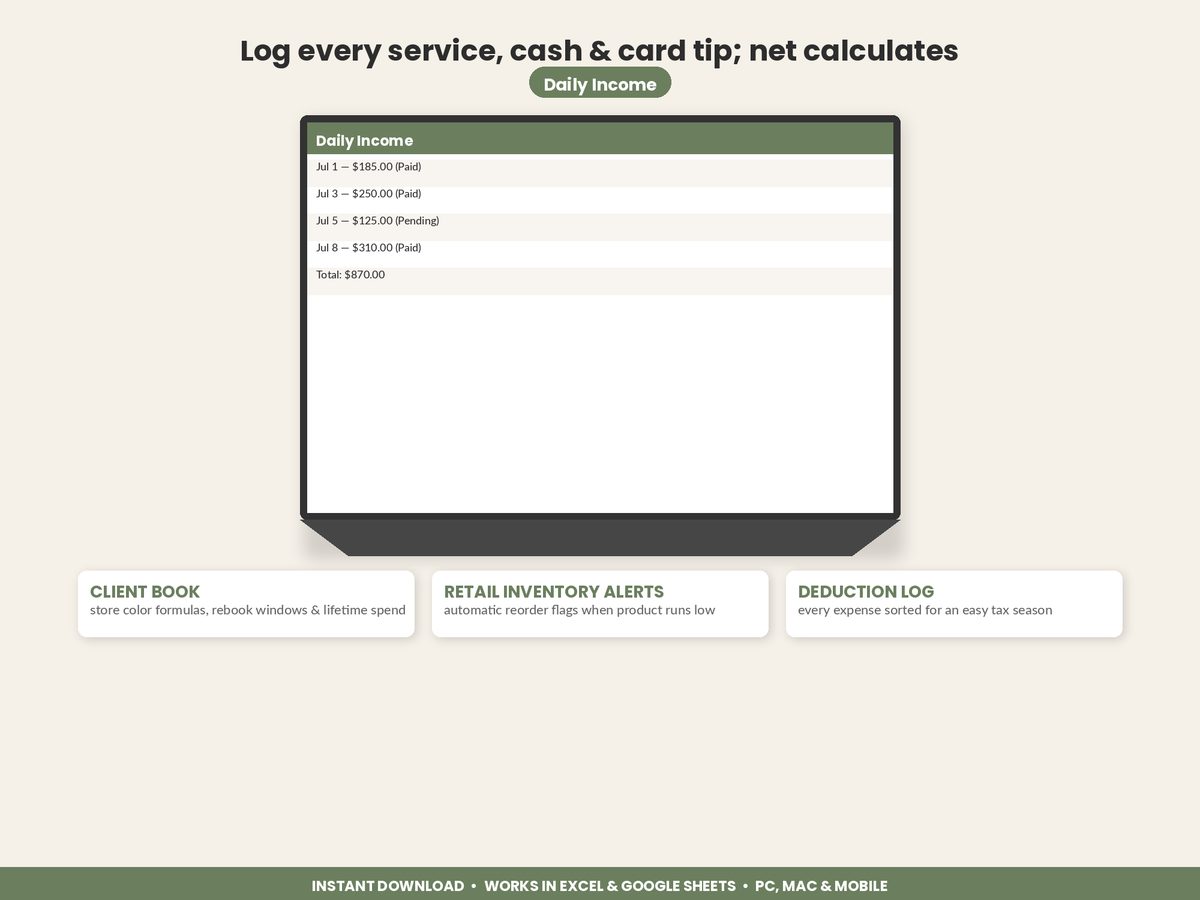
Two habits fix that:
A reorder threshold. Set a level — three units, say — and flag any product at or below it. The moment a client asks for a product you are out of, you have converted a sale into an apology, and the second-best outcome of that conversation is that they buy it somewhere else.
A margin column you actually look at. Not every product earns the same. The dry shampoo at 80% and the conditioner at 67% are thirteen points apart, which over a year of steady sales is a real amount of money. When you are choosing what to restock, restock toward the top of the column.
The Sales Tax Trap
In most states, retail product is taxable even where services are not — which means a stylist who has never charged sales tax on a haircut may owe it on a shampoo.
The bookkeeping consequence matters more than the amount. Sales tax you collect is not income. It is money you hold and hand over, and putting it into your revenue figure inflates every number that follows: your attach rate, your gross income, your net profit and therefore your tax reserve. Track the tax rate separately from the retail price and keep the collected tax out of the revenue column entirely.
State rules vary considerably on both services and tangible goods, so check your own state rather than assuming.
Why This Is a Booth Renter’s Advantage Specifically
Salons that pay retail commission commonly pay somewhere around 10%, though the figure varies widely and some pay nothing at all. A booth renter buys the stock and keeps the margin.
On the same $490 month, that is roughly $49 versus $363 — a difference of about $314 a month, or roughly $3,760 a year, for identical behaviour with identical clients. Retail is one of the clearest financial arguments for renting rather than working a split, and it almost never appears in the comparison people actually run. The full booth rent versus commission break-even.
It is also, unusually, an increase that costs a client nothing they did not already want. Raising a price is a negotiation. Recommending the product you just used is a conversation, and the alternative is that they buy a worse version of it in a supermarket next week.
Start by Measuring It
Most stylists cannot state their attach rate, which means most stylists cannot tell whether last month was a retail problem or a booking problem.
Log retail on the same row as the service — one extra column on the appointment you were already recording — and the ratio calculates itself. Give it four weeks. If it comes back under 10%, the table above tells you exactly what the next five points are worth, and it is very likely more than the price rise you have been putting off.
Featured on ReadySheetGo
Hair Salon, Barber & Booth Renter Income Tracker — $15.99
The attach rate is on the dashboard. The 200-row Daily Income Log puts retail $ on the same row as the service, alongside cash tip, card tip and tip-out, so the ratio builds itself as you work. The Retail Product Inventory tab calculates margin per product from your cost and retail price, values the stock you are holding, and turns a line red with a REORDER flag when units drop to the low-stock level you set once in Settings — which also holds your retail sales tax rate, kept separate from revenue. The Dashboard returns retail sales, retail attach rate as a percentage of service revenue, retail inventory value and products to reorder, next to gross income, net profit, average ticket and average tip per service. Also included: a Service Menu with prices and durations, a Booth Rent tracker with auto-flagged Paid / Partial / DUE status, a Client Book for up to 100 regulars with rebook intervals and lifetime spend, a 150-row categorised Expense log and a Quarterly Tax Set-Aside tab.
Sample data pre-filled. Works in Excel and Google Sheets, no macros and no add-ons.
Get the Hair Salon, Barber & Booth Renter Income Tracker →
Part of the complete guide to tracking income, tips, rent and tax as a booth renter. Figures here are worked examples with stated assumptions, not industry benchmarks — product costs, margins and state sales-tax rules vary, so run them with your own numbers and confirm tax treatment for your state.
Frequently Asked Questions
What is a salon retail attach rate?
Retail sales divided by service revenue for the same period. If you did $6,105 of services and $490 of product in a month, your attach rate is 8.0%. It is a better measure than retail dollars alone because it scales with how busy you were — a quiet month with the same attach rate is not a retail problem, it is a bookings problem, and the two need completely different fixes.
How much profit is there in salon retail?
Margins on professional product are typically high. Across the eight sample products used in this article — costing between $4 and $9 and retailing between $18 and $30 — the average gross margin works out at 74.2%; your own line will differ, so run it on your own costs. That means $490 of monthly retail returns roughly $363 of gross profit — enough to cover about a week and a half of a $250 booth rent every month, which is the useful way to think about a shelf you might otherwise ignore.
Should a booth renter sell retail?
The arithmetic is strongly in favour, because a booth renter keeps the whole margin rather than a commission on it. Where a salon pays retail commission — commonly around 10%, though it varies by salon — a stylist earning that on $490 of product makes about $49, while a booth renter buying the same stock at a 74% margin makes about $363. The trade-off is that the stock is bought with your own cash and sits on a shelf until it sells — roughly $191 of cash to hold the eight-product range in the example.
Is sales tax charged on salon retail?
In most states retail product is taxable even where services are not, which catches out stylists who are used to services being untaxed. The important consequence for your books is that sales tax you collect is not income — it is money you are holding for the state and it should never appear in your revenue figure. Rules vary by state, so check your own state's treatment of both services and tangible goods.