Booth Rent vs Commission: Which Actually Pays a Stylist More?
The argument is usually had in feelings. Booth rent means freedom, your own prices, your own hours, keeping what you earn. Commission means a front desk, a colour room you did not pay for, and a paycheque that shrinks but never goes negative.
Both descriptions are true. Neither answers the question, because the honest answer is a number and it is different for every stylist. Rent is fixed. A split is variable. Where those two lines cross is your break-even, and everything on one side of it is a good decision and everything on the other side is an expensive one.
Here is the crossing point, worked.
The Two Structures, Priced
Commission. You take a percentage of service revenue. Splits vary widely by salon, experience and what the chair includes; this article works the arithmetic at 50%, which sits in the middle of the range commonly quoted, and you should re-run it with whatever number you have actually been offered. The salon covers colour and backbar, towels, cleaning, the front desk, the booking system, card processing and usually your product for the shelf. Your costs are close to zero. Your ceiling is half of what you produce.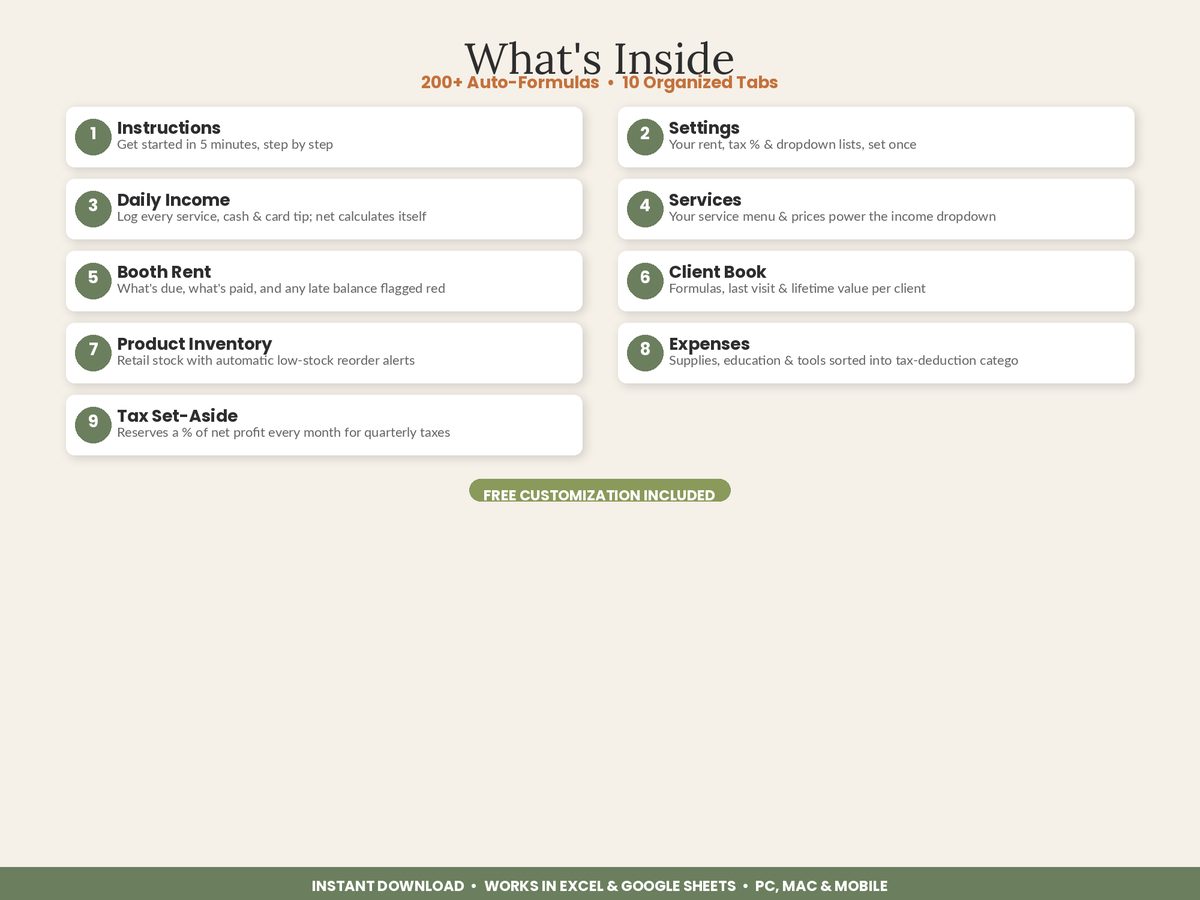
Booth rent. You pay a fixed weekly rent and keep 100% of service revenue. You then pay for everything the salon used to cover.
Those “everything else” costs are what people forget when they compare 100% against 50% and conclude that renting obviously wins. Priced from a real booth renter’s month, they split into two kinds:
Variable — roughly 11% of service revenue. Colour and backbar (about $420 a month on $6,105 of services), supplies like towels, foil and cleaning ($85), and card-processing fees at roughly 2.6% plus a fixed per-transaction charge ($155). Together $660, or 10.8% of service revenue — rounded to 11% in the arithmetic below.
Fixed — about $78 a week. Continuing education ($150 a month), liability insurance ($38), booking software ($30), tool maintenance and blades ($70), marketing ($50). Roughly $338 a month, or $78 a week, and it is owed whether you are busy or not.
The Break-Even
Write both structures as a line and set them equal. With S as weekly service revenue:
- Commission take = 0.50 × S
- Booth take = S − $250 rent − 0.11 × S − $78 fixed = 0.89S − $328
Setting them equal: 0.39S = $328, so S = $841 a week.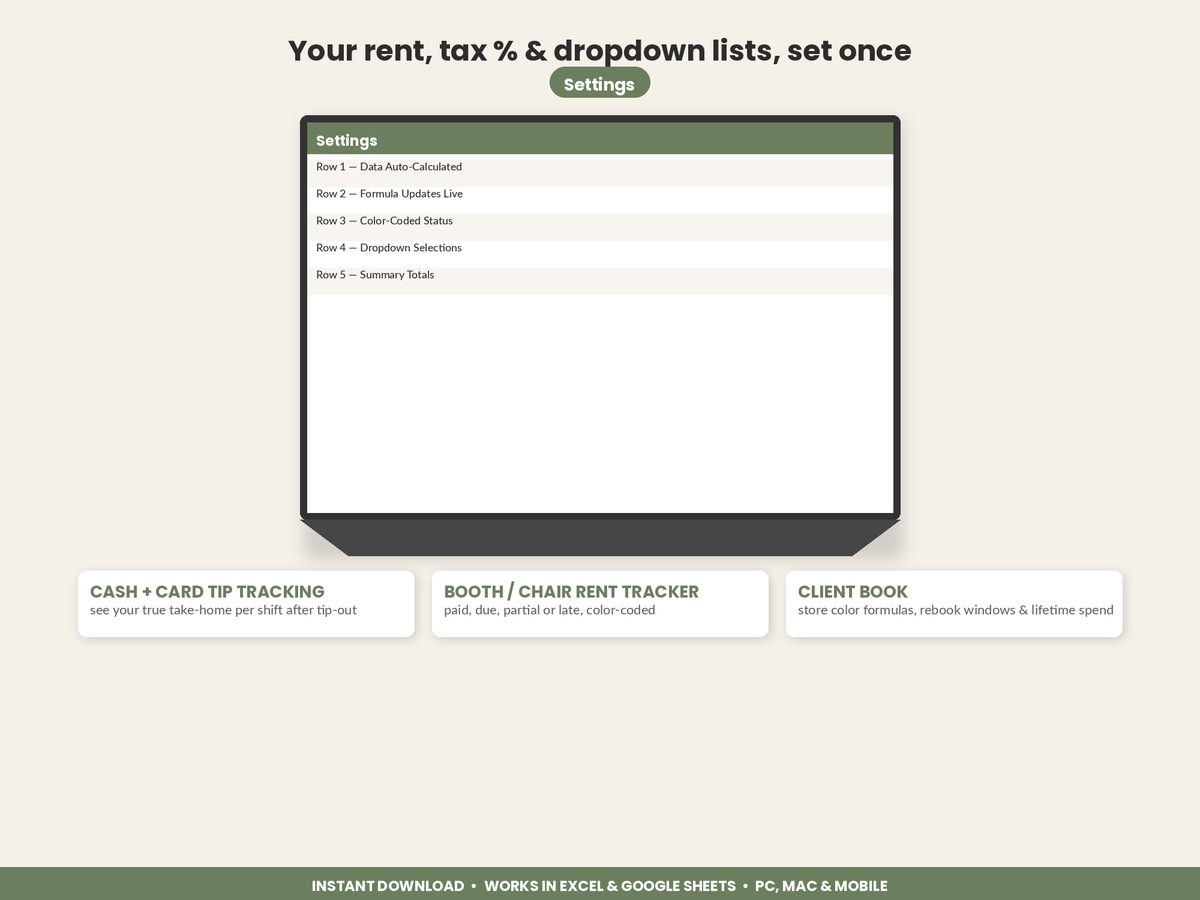
That is the whole comparison in one figure. At $841 of weekly service revenue the two models pay identically, $421. Below it, the commission chair pays more. Above it, the booth renter pulls away — and pulls away quickly, because every extra dollar of service revenue is worth 89 cents to a renter and 50 cents to a commission stylist.
| Weekly service revenue | Commission (50%) | Booth rent, net | Difference |
|---|---|---|---|
| $600 | $300 | $206 | −$94 |
| $700 | $350 | $295 | −$55 |
| $841 | $421 | $421 | $0 |
| $1,000 | $500 | $562 | +$62 |
| $1,200 | $600 | $740 | +$140 |
| $1,500 | $750 | $1,007 | +$257 |
| $2,000 | $1,000 | $1,452 | +$452 |
At $1,500 a week — a busy, colour-heavy column — booth rental is ahead by $257 a week, which is $13,364 a year. At $700 a week it is behind by $55 a week, and the stylist who made that move is paying $2,860 a year for the privilege of buying their own foil.
Your Break-Even Moves With Your Rent
$250 is a midpoint, not a rule. Chair rent varies enormously by city, salon and whether you are getting a suite or a corner. Run the same arithmetic at other rents and the crossing point moves in an almost straight line:
| Weekly booth rent | Break-even weekly service revenue |
|---|---|
| $150 | $585 |
| $200 | $713 |
| $250 | $841 |
| $300 | $969 |
| $350 | $1,097 |
| $400 | $1,226 |
This table is the single most useful thing to have in your pocket when a salon quotes you a chair. A $400 chair is not “expensive” in the abstract — it is expensive if you are doing $900 a week, and cheap if you are doing $2,000. The quoted rent means nothing until you set it against your own production.
To calculate your own: break-even = (weekly rent + weekly fixed costs) ÷ (1 − your variable cost rate − your commission rate). With an 11% variable rate and a 50% split, that denominator is 0.39.
Two Thumbs on the Scale
The table above compares service revenue only, which understates booth rental in two ways.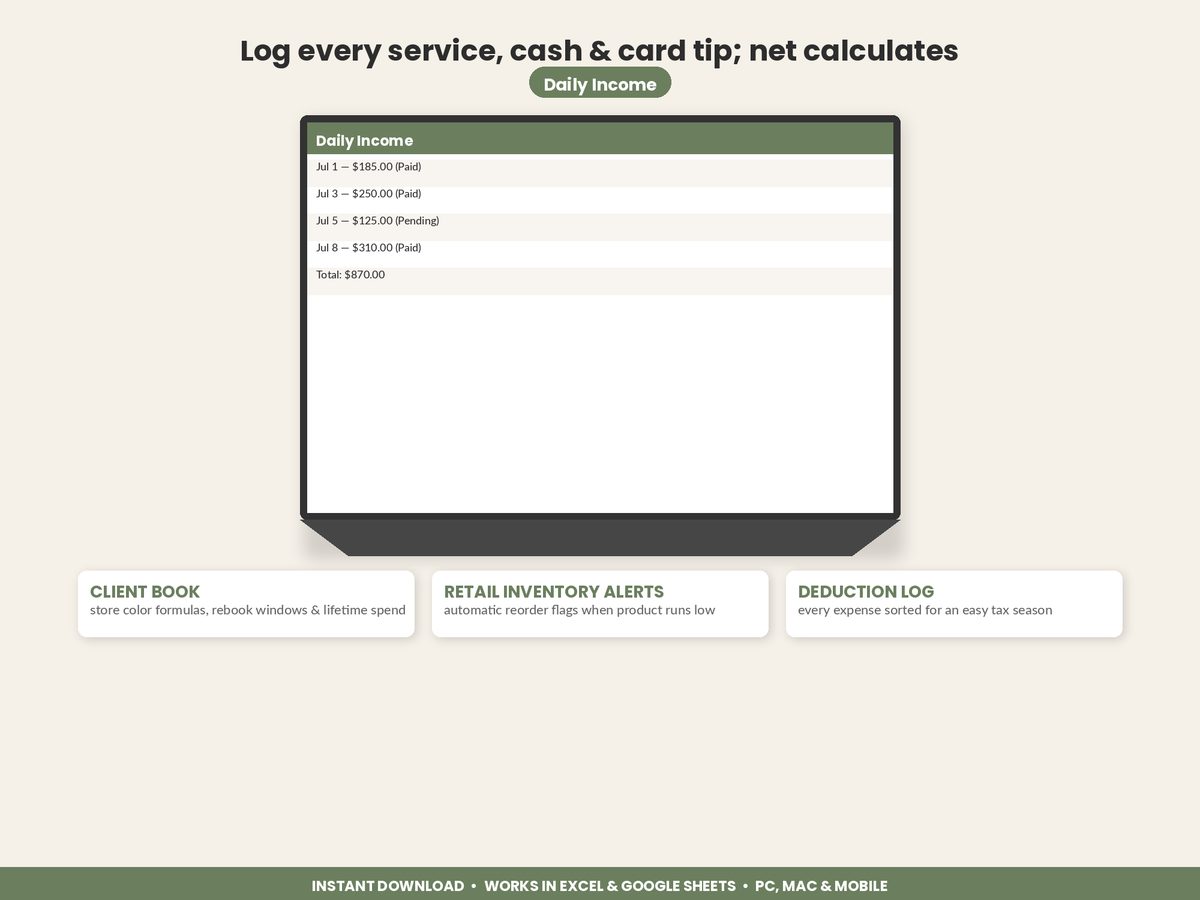
Retail margin. Salons that pay retail commission commonly pay somewhere around 10%, though it varies and some pay nothing. A booth renter buys the stock and keeps the whole margin. On a 74% average product margin, $490 of monthly retail is about $363 of gross profit to a renter and roughly $49 on a 10% commission — a difference of about $314 a month that never appears in a service-revenue comparison. What a retail attach rate is actually worth.
Price control. A renter sets their own menu. That sounds abstract until you rank a service list by dollars per booked hour and find one service quietly paying $48 an hour and another $60, while the rest pay $66 to $80. A commission stylist cannot fix that. A renter can, on a Tuesday. Working backwards from an income goal to a price list.
And One Thumb the Other Way
Rent is due in a slow January. It is due when you are sick, when you take two weeks off, and when a chunk of your book moves out of the area. Commission absorbs all of that for you, and that absorption is a real part of what the other 50% buys.
There is also the tax difference, which is not a difference in what you owe so much as in who does the work. A commission stylist is normally an employee with withholding. A booth renter is self-employed: Schedule C, Schedule SE, quarterly estimated payments, and self-employment tax at 15.3% on 92.35% of net earnings, with nothing withheld at source (IRS Topic 554). Nobody sets that money aside for you. How much to reserve, and when it is due.
So the sensible version of the rule is not “switch when you cross break-even”. It is: switch when you have been comfortably above break-even for several months in a row, and when a few weeks of rent are already in the bank.
Answer It With Your Own Numbers
Everything above rests on three figures: your weekly service revenue, your variable cost rate, and the rent you are being quoted. The rent is the only one you are handed. The other two come from logging a few weeks of actual services and actual receipts — which is also how you find out that your weekly production is not the number you have been telling people.
Run the arithmetic before you sign, not after. The break-even does not care how the chair feels.
Featured on ReadySheetGo
Hair Salon, Barber & Booth Renter Income Tracker — $15.99
Ten tabs that produce both sides of this comparison from your own book. The Daily Income Log takes date, client, service, service $, retail $, cash tip, card tip and tip-out on a 200-row sheet and nets each line automatically, so your real weekly service revenue is a fact rather than an estimate. The Expense log categorises backbar, supplies, tools, education, marketing and fees into the variable and fixed costs the break-even depends on. The Booth Rent tracker logs every payment against its due date with an auto-flagged Paid / Partial / DUE status and a running balance owed. The Service Menu holds your prices and durations, the Client Book tracks up to 100 regulars with rebook intervals and lifetime spend, Retail Product Inventory calculates margin and flags reorders, and a Quarterly Tax Set-Aside tab reserves against each month’s net profit. The Dashboard returns gross income, net profit, average ticket, average tip per service, retail attach rate and rent balance owed.
Sample data pre-filled. Works in Excel and Google Sheets, no macros and no add-ons.
Get the Hair Salon, Barber & Booth Renter Income Tracker →
Part of the complete guide to tracking income, tips, rent and tax as a booth renter. Figures here are worked examples with stated assumptions, not industry benchmarks — commission splits, rents and costs vary widely, so run the arithmetic with your own. This is general information, not tax or financial advice; confirm your own position with a professional.
Sources: IRS Publication 4902 — Tax Tips for the Cosmetology and Barber Industry · IRS Topic no. 554 — Self-employment tax
Frequently Asked Questions
Is booth rent better than commission?
Only above a certain weekly production, because booth rent is a fixed cost and commission is a variable one. Against a 50% split, with $250 a week rent and self-funded backbar, supplies and card processing, the break-even lands at about $841 of weekly service revenue. Below that a commission chair pays more; above it the gap widens fast, and at $1,500 a week the booth renter is roughly $257 a week ahead. Your break-even moves with your rent, so calculate it with your own number rather than borrowing anyone else's.
What costs does a booth renter pay that a commission stylist does not?
Typically colour and backbar, towels, capes, foil and cleaning supplies, card-processing fees, a booking system, liability insurance, continuing education and their own retail stock. In the worked example those variable costs run about 11% of service revenue plus roughly $78 a week of fixed costs on top of the rent itself. A commission stylist usually has those absorbed by the salon, which is exactly what the other half of the split is buying.
Do booth renters keep 100% of their tips?
Booth renters keep their tips in both models in practice, so tips rarely decide the comparison — but they are taxable income either way. What booth renters do keep that commission stylists usually do not is the full retail margin. On a 74% average product margin, a stylist doing $490 a month in retail keeps about $363 of gross profit rather than a 10% commission of roughly $49, which is another $314 a month tilting the scale toward renting.
At what point should I switch from commission to booth rent?
When your weekly service revenue has sat consistently above your calculated break-even for several months, not when it touches it once. Rent is due in your slow weeks, in January, and when you are sick, which is the real risk a commission split absorbs for you. A common rule is to want a comfortable margin above break-even — enough that a bad month is annoying rather than expensive — plus a few weeks of rent saved before you sign anything.