Salon Booth Renter Spreadsheet: Track Income, Tips, Chair Rent and Tax
Renting a chair makes you a business owner about four minutes after you sign the agreement, and nobody hands you the paperwork that goes with it. The salon takes rent whether you were busy or not. The colour on the shelf is yours. The card processing fee is yours. The tax nobody withheld is very much yours.
What makes this hard is not the arithmetic — it is that a booth renter’s money arrives in four streams that never appear in the same place. Service dollars land in the card reader. Cash tips land in an apron. Retail sales land somewhere between the two. Rent leaves by Venmo or a cheque on a Friday. Ask a busy stylist what they actually made last month and the honest answer is usually a bank balance, which is the one number that answers nothing.
Here is a full month for one booth renter, every figure computed rather than asserted, and the structure that produces it.
The Worked Month
Ava rents a chair at $250 a week. She works four days, keeps a colour-heavy book, and sells a little retail. This is her month.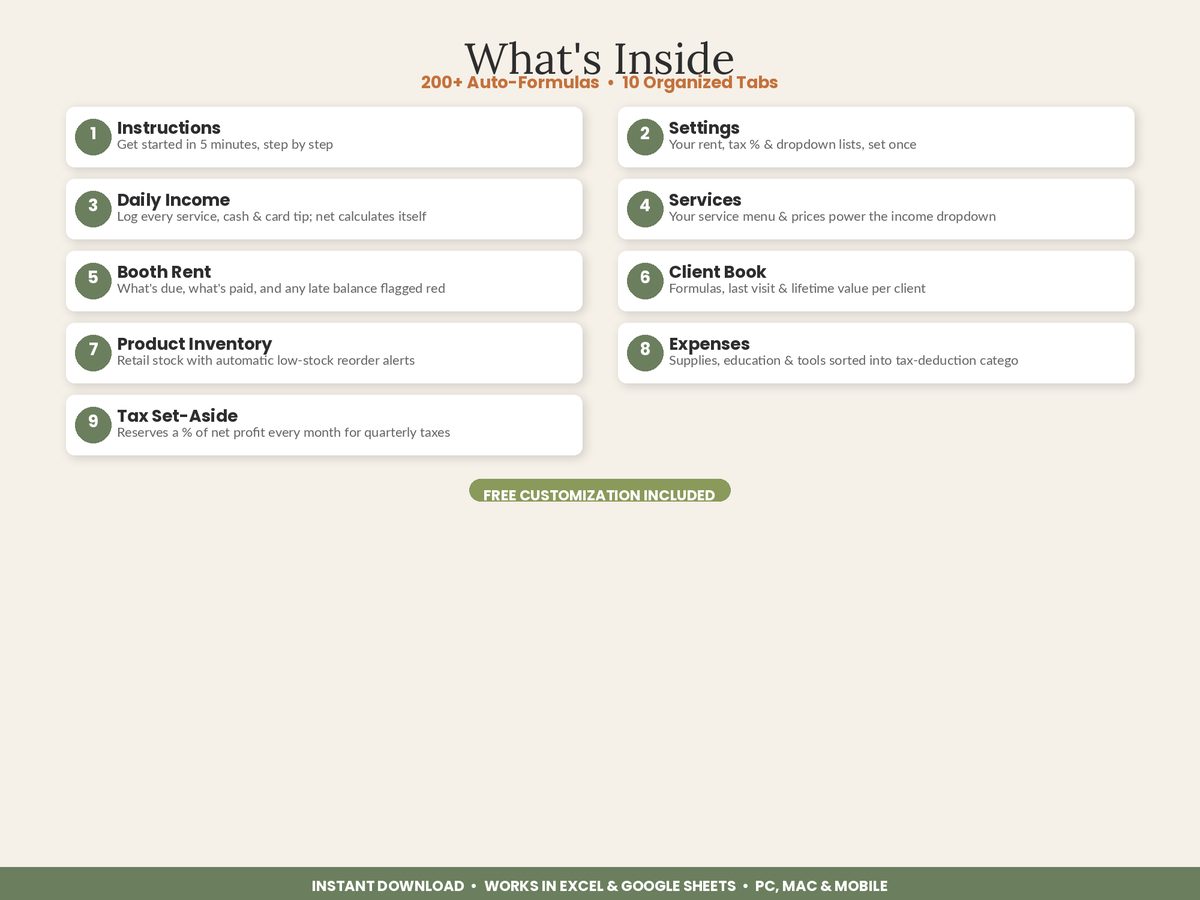
Services — 78 clients
| Service | Price | Count | Revenue |
|---|---|---|---|
| Cut & Color | $145 | 10 | $1,450 |
| Highlights | $175 | 5 | $875 |
| Balayage | $220 | 4 | $880 |
| Root Touch-Up | $90 | 8 | $720 |
| Women’s Cut | $55 | 12 | $660 |
| Blowout | $55 | 9 | $495 |
| Men’s Cut | $35 | 14 | $490 |
| Deep Conditioning | $40 | 5 | $200 |
| Toner/Gloss | $50 | 3 | $150 |
| Kids Cut | $22 | 5 | $110 |
| Beard Trim | $25 | 3 | $75 |
| Total | 78 | $6,105 |
Average ticket: $78.27.
Everything else that came through the chair
| Stream | Amount |
|---|---|
| Service revenue | $6,105 |
| Retail sales | $490 |
| Tips (cash + card) | $760 |
| Tip-out paid to the assistant | −$120 |
| Gross income | $7,235 |
What left
| Cost | Amount |
|---|---|
| Booth rent (4 rent Fridays × $250) | $1,000 |
| Colour and backbar restock | $420 |
| Retail stock restock | $165 |
| Card processing fees | $155 |
| Continuing education | $150 |
| Supplies — towels, foil, cleaning | $85 |
| Tools — shear sharpening, blades | $70 |
| Marketing | $50 |
| Liability insurance | $38 |
| Booking app | $30 |
| Total out | $2,163 |
This is a clean four-week month, so rent lands four times. Four months a year carry a fifth rent Friday, which is the difference between $12,000 and the $13,000 you actually pay — see point 6 below.
Net profit: $5,072. Set aside 25% for tax — $1,268 — and Ava’s take-home for the month is $3,804.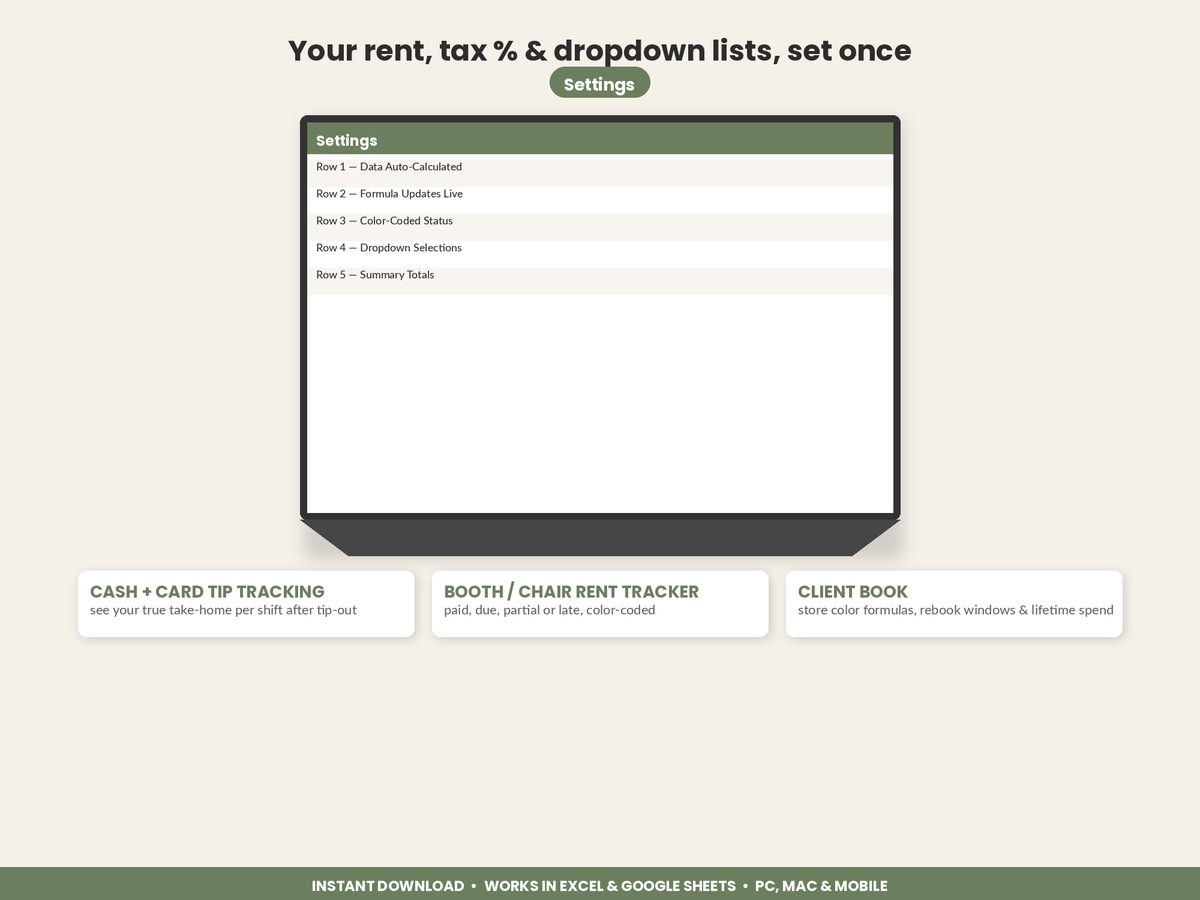
Now the number that changes how people run a chair. Counting service dollars, retail and tips before the tip-out comes off, $7,355 went through Ava’s hands this month and $3,804 of it was hers. She keeps 51.7 cents on the dollar. Ask her on a Saturday night and she would have said seventy or eighty cents, because the rent and the colour order and the tax reserve all leave on different days and none of them feels like it belongs to the busy week that funded it.
That gap — between what the day feels like and what the month actually pays — is the entire reason for the file.
The Nine Numbers a Chair Rental Hides
Nothing above is exotic. It is nine ordinary figures that simply live in nine different places.
1. Service revenue. The only figure most stylists can estimate, and even then usually from memory of a good week.
2. Retail sales. Small per transaction, real per year. Ava’s $490 a month is $5,880 a year of revenue that most people round to zero. What a retail attach rate is actually worth, in weeks of rent.
3. Cash tips. Invisible to every app you own. Also, unambiguously, income: IRS Publication 4902 tells booth renters that tips received in the normal course of business go into gross receipts. Log them the day they happen or they are gone.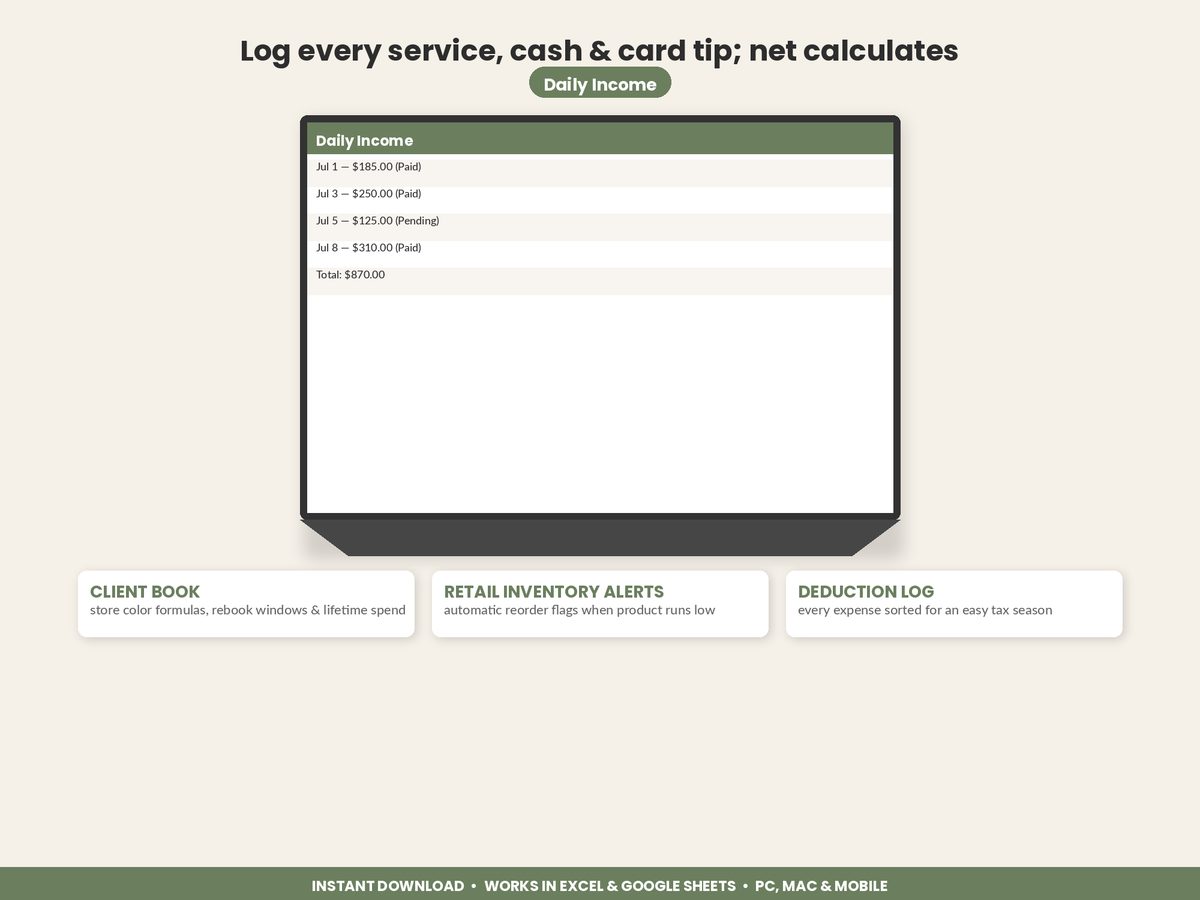
4. Card tips. These do land in your processor’s reports, mixed in with service dollars, which is why processor totals and service totals never agree.
5. Tip-out. If you share an assistant or a shampoo tech, this comes off the top and almost nobody nets it out.
6. Booth rent. Simple, until you notice that $250 a week is $13,000 a year, not $12,000 — because four months a year contain five rent Fridays. Budgeting rent as a monthly figure understates it by a full week’s rent every quarter.
7. Backbar versus retail. These are different piles of money. The colour you put on a client is a cost of the service. The shampoo you sell them is inventory you bought with your own cash. Mixing them makes both margins meaningless.
8. Card processing. A rate of roughly 2.6% plus a fixed per-transaction fee is invisible on any single sale and $155 a month here — more than Ava’s insurance and booking app combined. Check your own processor’s current published rate; they change.
9. Tax. No withholding, no employer half, no safety net. Self-employment tax alone is 15.3% on 92.35% of net earnings — the Social Security portion capped at an annual wage base, the Medicare portion uncapped (IRS Topic 554) — before any income tax.
The Tabs That Do the Work
A booth-renter file needs eight working sections. Not seven, not fifteen.
A settings sheet. Your rent amount and rent period, your tax set-aside percentage, your retail sales tax rate, your low-stock threshold. Enter each once, let every other sheet read from it. When the salon raises rent, you change one cell, not forty.
A service menu. Your prices and, critically, your average duration per service. Price alone tells you nothing. Price divided by duration tells you which half of your menu is quietly funding the other half. How to work backwards from an income goal to a price list.
A daily income log. One row per service: date, client, service, service $, retail $, cash tip, card tip, tip-out. The net on the line should compute itself, because the only version of this that survives a busy Saturday is the one that takes eleven seconds between clients.
A booth rent tracker. Every rent period with its due date, what was owed, what was paid, and a status that flags itself Paid, Partial or DUE. This exists for one reason: a partial payment in a slow week is the easiest debt in the world to lose track of, and it is owed to the person who controls your chair.
A client book. Name, usual service, last visit, rebook interval, visit count, lifetime spend, and the colour formula. Two of those columns are business intelligence — lifetime spend tells you who your book actually rests on, and last visit plus rebook interval tells you who has quietly stopped coming. A client who books every six weeks and last came ten weeks ago is not a loyal client, they are a client you have already lost and not noticed.
A retail inventory sheet. Cost, retail price, margin, units in stock, reorder flag. Ava’s eight products carry a 74% average margin and $191 of her cash is sitting on that shelf at any moment.
An expense log. Categorised, dated, and totalling to something you can hand a preparer. Backbar and product, tools, education, supplies, marketing, insurance, fees. Nothing is withheld at source in booth rental, which means every unlogged expense is a deduction you paid for and never claimed.
A tax set-aside sheet. Net profit by month, your reserve percentage, and the running total. How much a booth renter should actually set aside, and the quarterly dates.
And on top, a dashboard: gross income, net profit, average ticket, average tip per service, retail attach rate, active clients, products to reorder, and rent balance owed.
Seven Columns, Eleven Seconds
The whole system depends on one habit, and it is smaller than people expect. Between clients, one row:
Date | Client | Service | Service $ | Retail $ | Cash Tip | Card Tip | Tip-Out
That is it. Eight cells, and the net calculates itself. Do it at the chair while you are wiping down, not at 11pm on the last day of the month — because the cash tip you cannot remember is the one that never makes it into the file, and cash tips are 100% of the income that has no other paper trail.
Two rules that make the difference between a file you keep and a file you abandon:
Log the service the moment it ends, not the payment. Payments get split, deferred, tipped later, and refunded. The service happened once, at a known price, at a known time.
Never log a total. “Saturday: $640” tells you nothing next March. Eight rows tell you your average ticket, your best day of the week, your retail attach rate and which clients carry your book.
The Rent Question Underneath All of This
Once a month of real numbers exists, the obvious question arrives: is renting this chair better than working commission somewhere?
For Ava, it is not close. At $6,105 of monthly service revenue — about $1,526 a week — booth rental nets her roughly $267 a week more than a 50% commission split at the same production, which is around $13,900 a year. But that answer is entirely a function of her volume. The same $250 chair is a worse deal than commission for anyone doing under about $841 a week in services, because rent is fixed and a commission split is not. The break-even, worked at six different rent levels.
You cannot answer that question from a bank balance. You can answer it in about four seconds from a month of logged rows.
Start With One Week
Do not try to reconstruct the year. Open a file on Monday and log one week — every service, every tip, every product, and the rent payment. Seven days.
At the end of it you will have an average ticket, a tips figure that is probably higher than you guessed, and a costs figure that is definitely higher than you guessed. Multiply by four and you have a month. Multiply by fifty-two and you have the first honest answer you have ever had to the question of what the chair pays.
Most stylists find the same two things: their average ticket is lower than the price they quote people, because add-ons and kids’ cuts pull it down, and their real hourly rate on chemical services is worse than on the quick work they think of as filler.
Both are fixable. Neither is visible without the rows.
Featured on ReadySheetGo
Hair Salon, Barber & Booth Renter Income Tracker — $15.99
Ten tabs, built exactly as above. A Settings tab holds your profession, rent type, rent amount and period, tax set-aside percentage, retail sales tax rate and low-stock alert level, and every other tab reads from it. A 200-row Daily Income Log takes date, client, service, service $, retail $, cash tip, card tip and tip-out, and returns the net on the line automatically. The Service Menu arrives pre-loaded with twelve services and their average durations, from a $22 kids cut to a $220 balayage, and feeds the income log. The Booth Rent tracker logs every payment against its due date with a status that auto-flags Paid, Partial or DUE and a running balance owed. The Client Book holds up to 100 regulars with usual service, last visit, rebook interval, visit count, lifetime spend and colour formula notes. Retail Product Inventory calculates margin per product, values your stock and turns a line red with a REORDER flag at your alert level. A 150-row Expense log categorises backbar, tools, education, supplies and marketing straight into your deductible total. The Quarterly Tax Set-Aside tab applies your rate to each month’s net profit and totals the year. The Dashboard returns service revenue, retail sales, total tips, tip-out, gross income, rent paid, expenses, net profit, average ticket, average tip per service, retail attach rate, active clients, products to reorder and outstanding rent balance.
Sample data pre-filled. Works in Excel and Google Sheets, no macros and no add-ons.
Get the Hair Salon, Barber & Booth Renter Income Tracker →
This is general information, not tax advice — arrangements, state rules and personal circumstances vary, so confirm your own position with a tax professional.
Sources: IRS Publication 4902 — Tax Tips for the Cosmetology and Barber Industry · IRS Topic no. 554 — Self-employment tax · IRS — Self-employment tax (Social Security and Medicare taxes)
Frequently Asked Questions
How do booth renters keep track of income?
Line by line, per service, because a booth renter's income arrives in four separate streams that no single app captures. Every entry needs the date, the client, the service, the service dollars, any retail dollars, cash tips, card tips and any tip-out paid. Card processors only see the card side, so a booking app total and a bank balance both understate the real number. The log itself is also the record the IRS expects: Publication 4902 tells booth renters to report tips received in the normal course of business in gross receipts, and cash tips generate no paperwork at all, so the only evidence they existed is the one you write down the same day.
Is booth rent a tax write-off?
Yes. For a booth renter, chair or booth rent is an ordinary and necessary business expense and is deductible on Schedule C, along with backbar and colour, retail stock, tools, licensing, liability insurance, continuing education and card-processing fees. This is why booth renters need an expense log at all: unlike a commission stylist, nothing is deducted at source, so an unrecorded expense is simply a deduction you never take. Confirm your own situation with a tax professional, since deductibility depends on the facts of your arrangement.
How much should a booth renter save for taxes?
Self-employment tax alone is 15.3% applied to 92.35% of net earnings — the Social Security portion capped at an annual wage base, the Medicare portion uncapped — which works out to roughly 14% of net profit before any income tax at all. Federal income tax and any state tax sit on top of that, which is why a 25 to 30 percent set-aside of net profit is the usual working rule. On the worked month in this article — $5,072 of net profit — a 25% reserve is $1,268 a month, or about $16 per client through the chair.
What is a good average ticket for a booth renter?
There is no universal figure, because the number that matters is not the ticket, it is dollars per booked hour. A $220 balayage that takes three hours earns $73 an hour; a $40 deep conditioning add-on that takes half an hour earns $80. Divide every service on your menu by its duration and rank them, and the underpriced work becomes obvious immediately — it is usually the long chemical services, not the quick ones.