How Much Should a Contractor Charge Per Hour? Labor Burden Explained
Your helper is on $25 an hour. You bill him out at $50.
Doubling your money, right?
Full walkthrough of the template used in this guide.
You are making about $1.38 an hour on him. Here is the arithmetic that closes that gap, in two steps — what an hour costs, and how many hours you actually get to sell.
Step One: The Wage Is Not the Cost
An hourly wage is the visible part. Underneath it sits a stack of costs that arrive whether or not the hour was productive.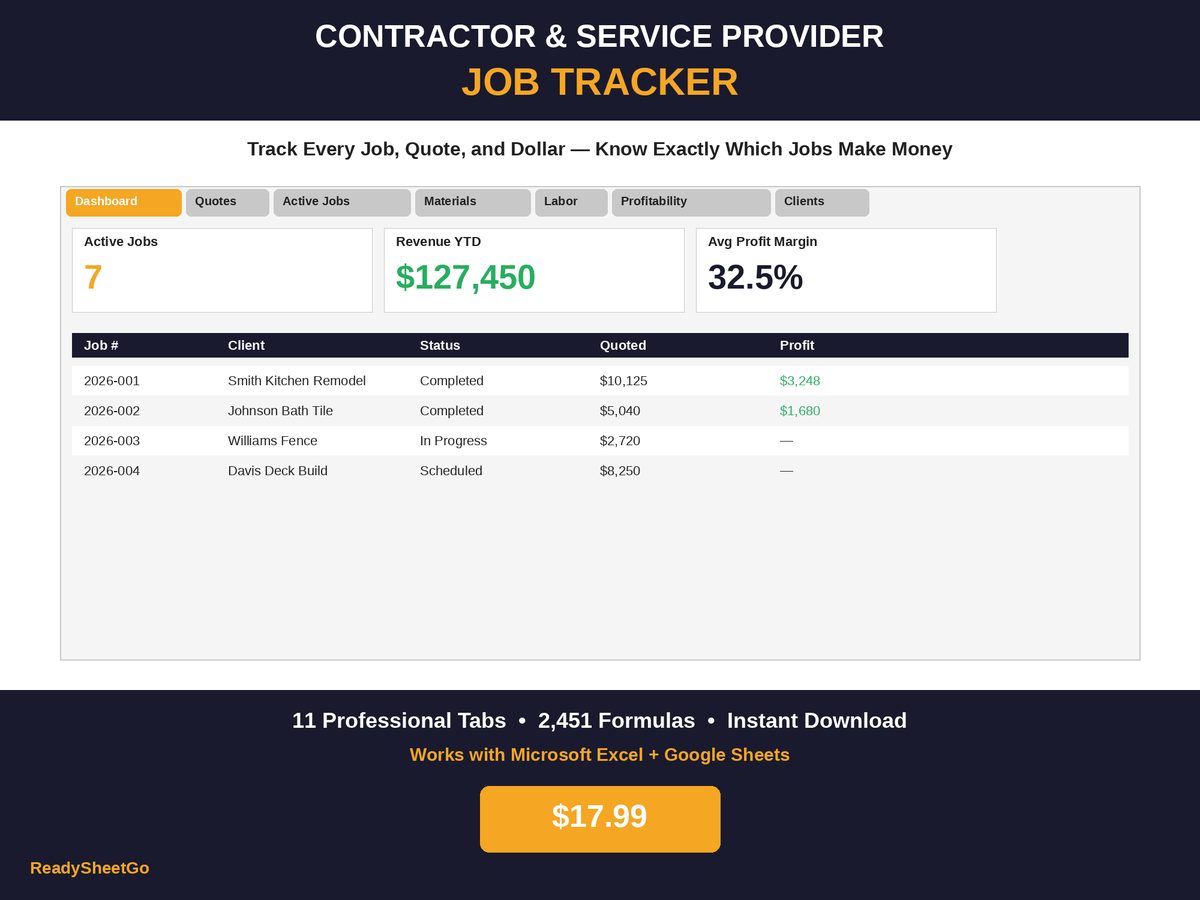
All figures below are clearly labelled assumptions on a $25.00 base wage. Substitute yours — particularly the workers’ comp line, which is the one that moves most.
| Component | Assumption | Per hour |
|---|---|---|
| Base wage | — | $25.00 |
| Employer FICA (Social Security + Medicare) | 7.65% of wages | $1.91 |
| Federal + state unemployment | 2.0% of wages | $0.50 |
| Workers’ compensation | $8.00 per $100 of payroll | $2.00 |
| General liability allocation | 1.5% of wages | $0.38 |
| Paid time off | 11 days of 260 (4.2%) | $1.05 |
| Burdened hourly cost | $30.84 |
That is a 23.4% burden on top of the wage — and it is a conservative build. It excludes health insurance, a retirement match, uniforms, phone allowance and per-diem, any of which push it well past 30%.
Employer FICA at 7.65% is fixed and non-negotiable. Workers’ compensation is the volatile one: rates are set per $100 of payroll and vary by state and by class code, so a general carpentry class might land near the $8.00 assumed here while roofing runs several times that and a low-risk finishing trade runs well under. Get your actual rate off your policy declarations page — guessing at this line is the single biggest source of error in the whole calculation.
Step Two: You Cannot Sell 2,080 Hours
Here is where most contractors’ pricing quietly falls apart.
You pay for 2,080 hours a year. You cannot bill 2,080 hours. Nobody can. What disappears:
- Drive time between jobs
- Material runs and supplier waits
- Shop time, truck loading, tool maintenance
- Weather days on exterior work
- Callbacks and warranty work
- The gaps between one job finishing and the next starting
A 75% billable ratio — 1,560 hours — is a realistic residential planning figure. Some outfits do better with tight routing and a full schedule; plenty do worse.
Spread the same annual cost across the hours you can actually sell:
$30.84 × 2,080 paid hours = $64,147.20 per year $64,147.20 ÷ 1,560 billable hours = $41.12 per billed hour
A $25.00 wage costs $41.12 every time you put that person on a job. That is 64% above the wage, and it is the number your pricing has to clear.
Watch how sensitive it is to the ratio alone:
| Billable ratio | Billable hrs | True cost per billed hour |
|---|---|---|
| 85% | 1,768 | $36.28 |
| 80% | 1,664 | $38.55 |
| 75% | 1,560 | $41.12 |
| 70% | 1,456 | $44.06 |
| 65% | 1,352 | $47.45 |
Twenty points of billable ratio is eleven dollars an hour. Tightening your scheduling is worth as much as a price rise, and it is a lot easier to sell to the customer.
Step Three: The Rate You Charge
Now mark it up. Using the conversions from markup versus margin, against a $41.12 true cost:
| Markup | Rate to charge | Gross margin | Net after 15% overhead |
|---|---|---|---|
| 20% | $49.34 | 16.7% | 1.7% |
| 25% | $51.40 | 20.0% | 5.0% |
| 33.3% | $54.83 | 25.0% | 10.0% |
| 42.9% | $58.74 | 30.0% | 15.0% |
| 50% | $61.68 | 33.3% | 18.3% |
So: billing a $25/hr helper at $50 is a 21.6% markup. That is a 17.8% gross margin, and after a 15% overhead allocation, 2.8% net — about $1.38 an hour. Not double your money; barely above the point where you would be better off not employing anyone.
To take home a real 15% on that person’s time you need $58.74 an hour — nearly two and a half times the wage. That ratio feels outrageous right up until you build the stack, and then it is just arithmetic.
What About Your Own Hours?
In the job costing worked example the owner logs their own time at $65 an hour. Two things about that number.
First, it is a wage, not profit. Logging your hours at $65 charges the job for your labor the same way it charges for anyone else’s. What is left after that is your business’s profit. If you skip it — treating your own time as free — every job looks profitable and you cannot tell which ones are worth repeating. You will also quote too low, because you are competing against a version of yourself who works for nothing.
Second, your own hours have a burden too, just a different one. You carry no employer FICA on a wage you do not pay yourself, but you carry the full self-employment tax on the profit, plus your own health insurance, and your billable ratio is worse than your crew’s — because the estimating, invoicing, chasing payment, buying materials and answering the phone all come out of your hours.
If you bill 1,200 of 2,080 hours, that is a 58% ratio, and everything above applies to you with sharper numbers than it applies to your helper.
Do This With Your Own Figures
Three inputs, ten minutes:
- Your workers’ comp rate per $100 of payroll, off the policy. Not a guess.
- Your real billable ratio. Take one quarter of your labor log, add the hours actually charged to jobs, divide by the hours you paid for. Most contractors doing this for the first time find they are ten points below what they assumed.
- Your overhead rate — annual overhead ÷ annual revenue.
Then build the stack, divide by billable hours, and pick the markup that leaves you the net you want.
The reason this belongs in the same spreadsheet as your jobs is the second input. Billable ratio is not a figure you can estimate honestly from memory — it comes out of a labor log that records every hour by job, week after week, whether or not it turned into revenue. Once you have that, your hourly rate stops being a number you defend nervously and becomes one you can show your working on.
Featured on ReadySheetGo
Contractor & Service Provider Job Tracker — $17.99
The 500-row Labor Log is what makes this calculable: job number, worker, date, hours, hourly rate and total pay on every row, with the task described. Log every hour — billed or not — and your real billable ratio falls out of a quarter’s data instead of a guess.
Those hours flow by job number into Active Jobs as total labor, and into Job Profitability, which returns gross profit, a 15% overhead allocation, net profit and margin % per job. That is where you find out whether the rate you are charging for crew time actually clears its cost — and the Quotes & Estimates tab lets you test a different markup on the next quote before you send it.
Eleven tabs, including a per-job Materials log with estimated-vs-actual variance, a Client Database, a Warranty & Callback Tracker, a three-year Revenue Tracker, an Equipment Log and a Dashboard with average job profit, quote win rate, outstanding payments and average job value. Sample data pre-filled. Works in Excel and Google Sheets.
Get the Contractor & Service Provider Job Tracker →
Frequently Asked Questions
What is labor burden for a contractor?
Labor burden is everything you pay on top of the wage itself — employer payroll taxes, workers' compensation, unemployment insurance, a share of general liability, and paid time off. On the worked example here a $25.00 hourly wage carries $5.84 of burden, giving a burdened cost of $30.84 an hour, or 23.4% on top of the wage. Workers' comp is the item that varies most, because rates differ enormously by state and by trade class code.
How do you calculate the true cost of an employee per billed hour?
Take the burdened hourly cost, multiply by hours you pay for in a year, then divide by hours you can actually bill. In the example: $30.84 × 2,080 paid hours = $64,147.20, divided by 1,560 billable hours = $41.12 per billed hour. Drive time, shop time, estimating, weather days and callbacks are all paid but not billed, which is why the two figures diverge so far.
How many hours a year can a contractor actually bill?
Far fewer than 2,080. A 75% billable ratio — 1,560 hours — is a realistic planning figure for field staff on residential work once you subtract drive time, material runs, shop and truck time, weather days, callbacks and unproductive gaps between jobs. Track it for a quarter from your labor log rather than assuming, because the ratio drives your entire hourly pricing.
What hourly rate should I charge for a helper who is paid $25?
At least $51.40. That is the $41.12 true cost per billed hour marked up 25%, which produces a 20% gross margin — and after a 15% overhead allocation leaves roughly 5% net. To reach a 10% net margin you would charge about $54.83, and for 15% net about $58.74. Charging $50 an hour for a $25 employee feels like doubling your money and is close to break-even.