7 Co-Parenting Reimbursement Mistakes That Cost You Money (And What Each One Is Worth)
There is a specific feeling in shared-expense tracking where two people are looking at two spreadsheets, both are certain, and the totals are $900 apart.
Nobody is lying. Almost every one of these disputes comes down to a handful of record-keeping errors, each of which is mechanical, each of which is preventable, and each of which produces a wrong number with complete confidence.
Full walkthrough of the template used in this guide.
Here are the seven, priced. Every figure below runs on the same six-month ledger used throughout this cluster — two children, $8,692.00 of agreed expenses, $2,600.00 of reimbursements, closing balance $656.30 owed by Maya to Daniel. Each mistake is applied to that correct baseline so you can see exactly what it distorts.
1. The payment log that is three months behind
What it costs: $900.00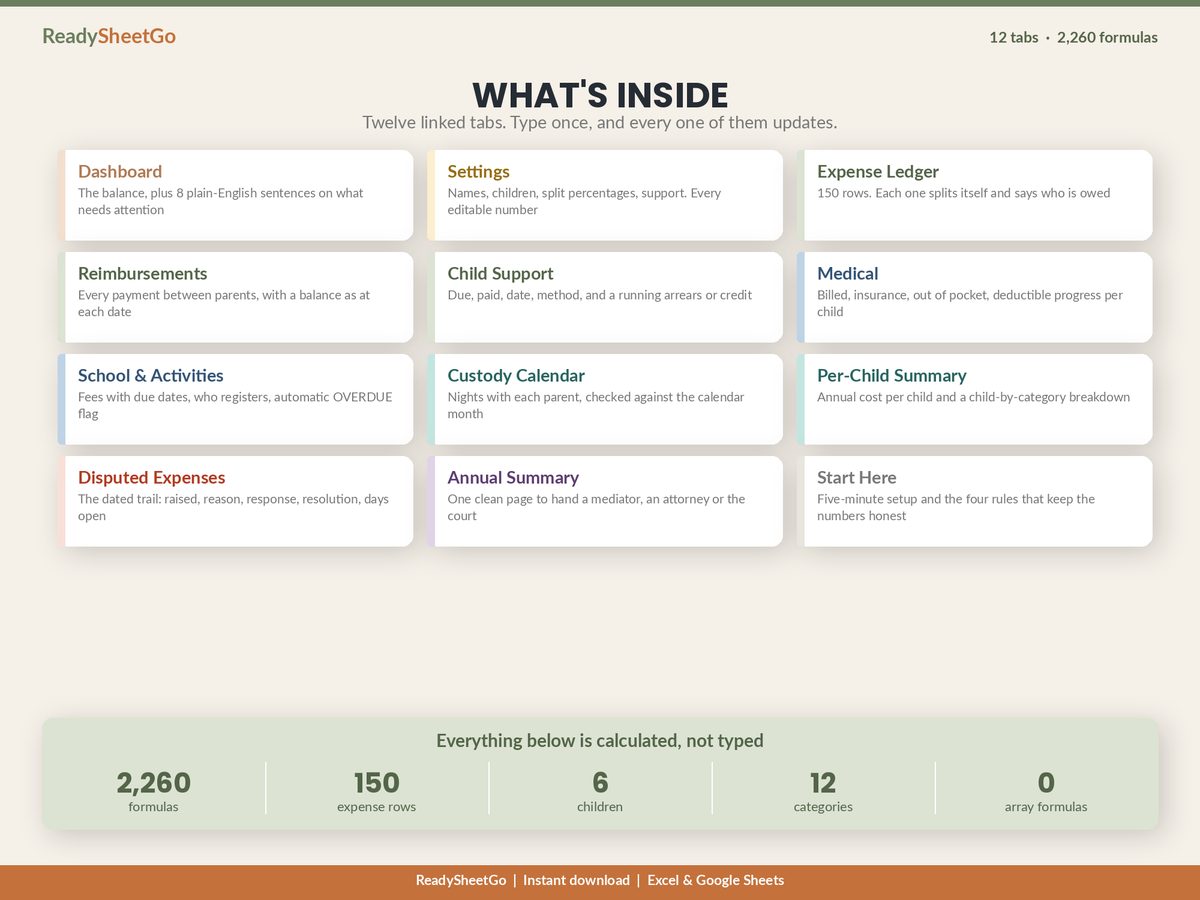
This is the most common error in the entire category and it is not close. The expense side gets maintained religiously — receipts photographed, rows entered the same day — while the record of money actually moving between the two parents is updated whenever someone remembers.
Drop the single $900.00 transfer from 28 February out of the log and the closing balance reads $1,556.30 instead of $656.30. The ledger is perfect. The receipts are all there. The number is wrong by nine hundred dollars, and it is wrong in the direction that makes one parent look like they have paid nothing.
The fix: log the payment the day it clears, in a separate log from expenses, with date, direction, amount and method. Two logs, one balance. If you only ever adopt one habit from this list, adopt this one.
2. Splitting everything down the middle when your agreement does not
What it costs: $573.30 in six months
Household budget templates assume a 50/50 split because that is what housemates do. Parenting agreements frequently do not: medical evenly, childcare pro-rated to income, one activity at 70/30 because one parent wanted it more.
Run the identical ledger at a flat 50/50 and the closing balance is $83.00 rather than $656.30. Over six months, on two children, a ratio assumption nobody consciously made is worth $573.30 — and the parent producing that number has no idea their file disagrees with their own agreement.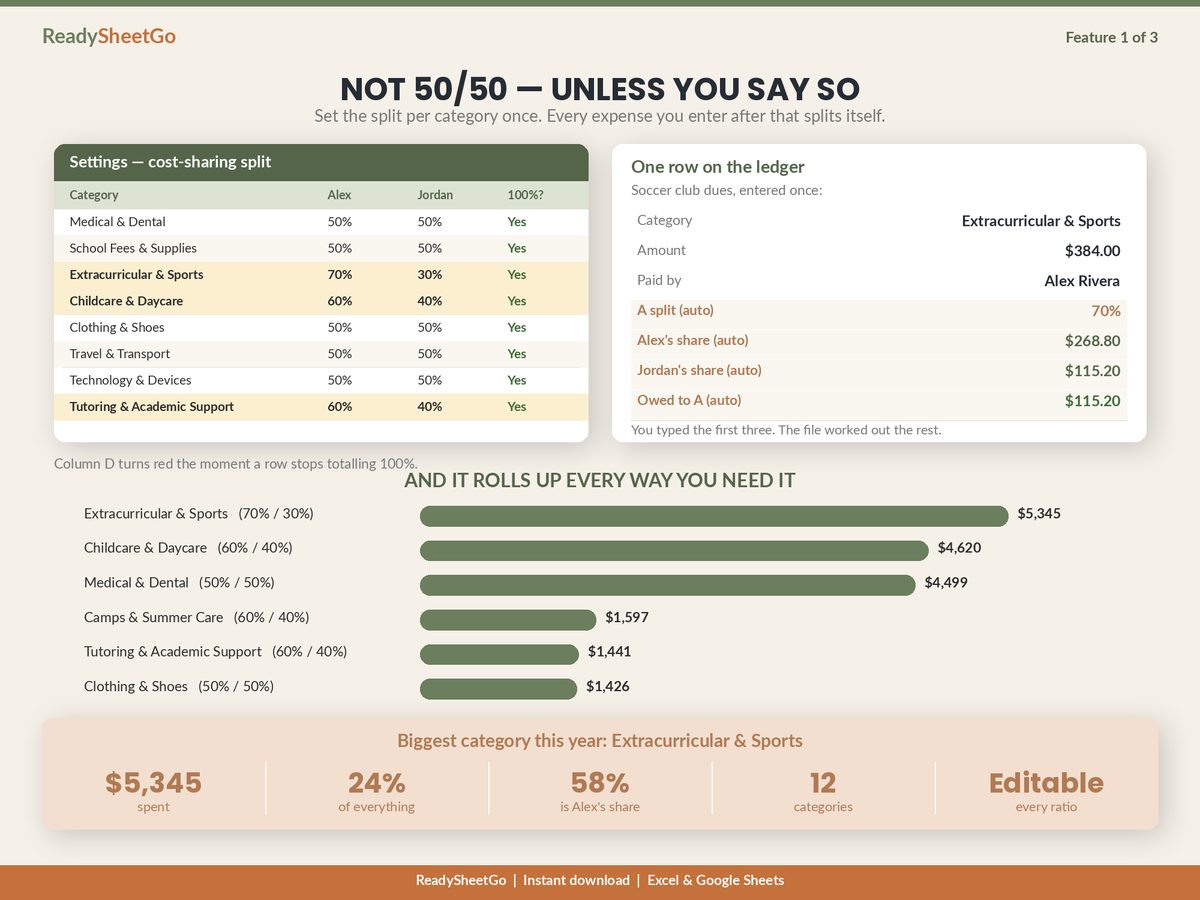
The fix: store the ratio per category in a settings table, and have every row look up its own category’s ratio rather than referencing a single global percentage. The proration arithmetic is here if you are setting the ratios for the first time.
3. Putting a disputed item in the claimed total
What it costs: $210.00, and the conversation
There is a $420.00 phone upgrade in the sample ledger that one parent bought and the other never agreed to. Include it at an even split and the balance moves to $866.30.
The $210.00 is the smaller half of the damage. The larger half is that the other parent now has to audit the whole file to find the one line they object to, which converts a two-minute review into an adversarial exercise — and next month they will audit the whole file again, because you have taught them to.
The fix: a status column on every row, defaulting to Pending, and a hard rule that only rows marked Agreed reach the balance. Disputed and pending items still get logged, dated and totalled — they appear on the summary as excluded, and here is why. A number that visibly under-claims is a number the other parent will actually read.
4. Paying against a specific expense instead of against the balance
What it costs: an argument that cannot be settled with arithmetic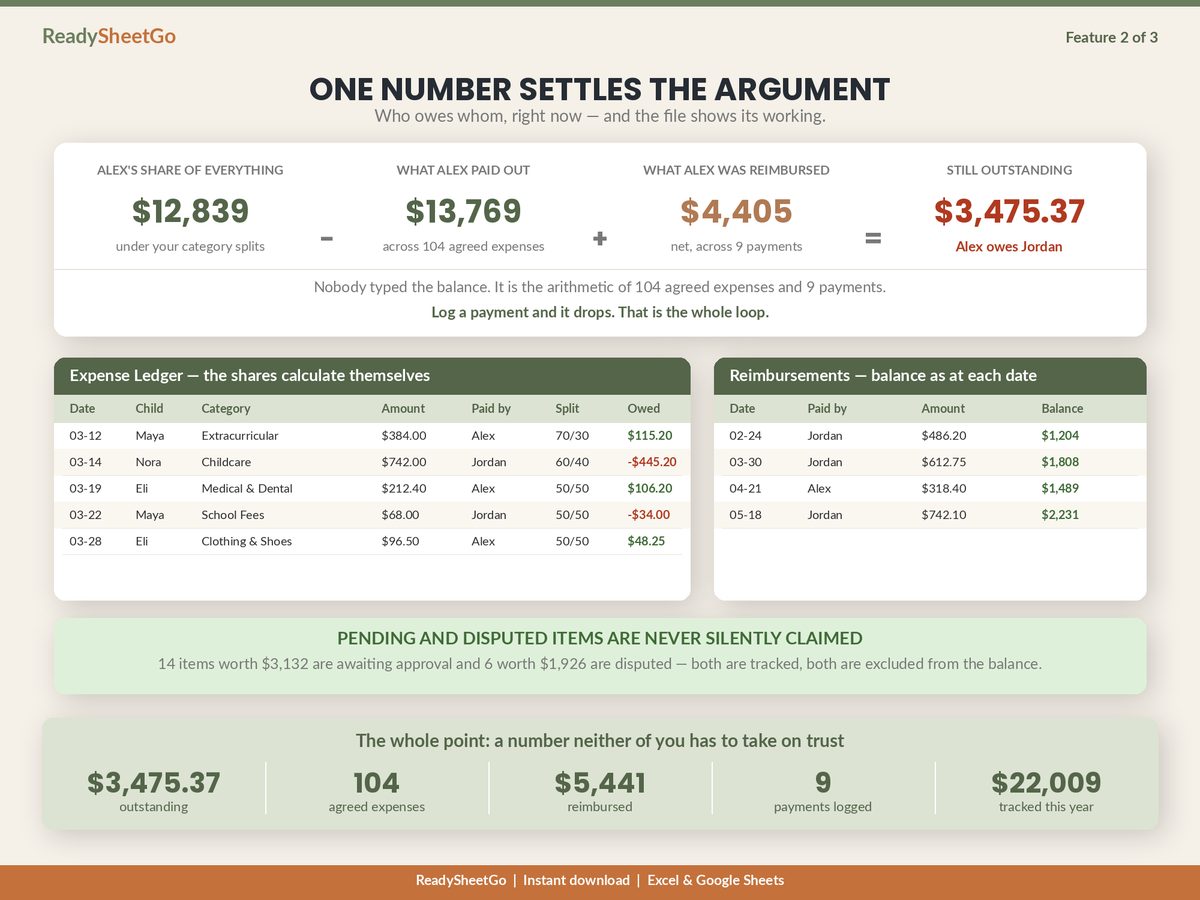
“The $1,100 in April was for the orthodontist.” It sounds tidier than paying down a running total. It is not.
Once a payment is attached to a line item, every subsequent complication becomes ambiguous. What if the orthodontist bill is later adjusted, or partly covered by insurance, or disputed? Was that payment for the first instalment or the second? Both parents will answer confidently and differently, and no amount of re-reading the ledger resolves it, because the information was never recorded.
The fix: payments settle the balance, never a line. The payment log records date, from, to, amount and method — and nothing about which expenses it relates to. The running balance does the rest.
5. Letting the receipt threshold slide
What it costs: whichever line gets challenged
Every file should have a dollar figure above which a receipt is required, and a flag on any row over it that does not have one. Most files do not, and the result is a ledger where the small lines are impeccably documented and the $1,450 orthodontist deposit is a row of typing.
Those large undocumented lines are exactly the ones that get challenged, and challenging one successfully casts doubt over the rest of the file.
The fix: set a threshold — $50, $100, whatever suits the scale of your costs — put a receipt reference column next to it, and let the file flag any agreed row over the threshold with an empty reference. It takes one formula and it aims your attention at the rows that actually carry risk.
6. Counting in-kind spending as a reimbursement
What it costs: the same money twice
A parent buys $180 of school clothes, logs it on the expense ledger as a shared expense, and also records it in the payment log as a reimbursement toward the balance.
It is an easy mistake to make — money left their account, after all — but it double-counts. The clothing purchase already moved the balance in their favour on the expense side; recording it again on the payment side moves it a second time. The parent doing it is not being dishonest; they have simply entered one event in two places that both reduce what they owe.
The fix: the payment log records transfers between parents only. If money went to a shop, a school or a provider, it is an expense. If it went from one parent to the other, it is a reimbursement. Nothing is ever both.
7. Starting a fresh sheet every January
What it costs: the entire carried balance
New year, clean file. The $656.30 outstanding on 31 December does not appear anywhere in the new one, and within a few months nobody can reconstruct it. Worse, questions about last year — a tax document, an adjusted medical bill, a disagreement resurfacing — now require opening an archived file that has a different structure.
The fix: one continuous ledger with a year column you can filter, running from separation onward. If a year genuinely needs closing out, close it with an explicit opening-balance row in the next period, carried by formula rather than typed.
The Two-Minute Reconciliation
If your two totals already disagree, do not argue about the totals. Compare the two ledgers on dates and amounts and the gap will identify itself:
| What the gap equals | The cause |
|---|---|
| Exactly one payment amount | A transfer logged by one parent and not the other — mistake 1 |
| A clean percentage of one bill | Different split ratios on that category — mistake 2 |
| The share of one specific item | One parent is counting something unagreed — mistake 3 |
| An expense amount, exactly | Something entered as both expense and reimbursement — mistake 6 |
| A round number from a prior year | A carried balance that got dropped — mistake 7 |
Five checks, and in almost every case one of them lands. Which is the real argument for keeping the record in a structured file at all: not that it prevents disagreement, but that it makes disagreement diagnosable in two minutes instead of two weeks.
Featured on ReadySheetGo
Co-Parenting & Blended Family Shared Expense Tracker — $14.99
Twelve linked tabs and 2,260 working formulas, built specifically so that none of the seven mistakes above can happen quietly.
Every row on the Expense Ledger carries a status, and only items marked Agreed reach the balance — pending and disputed items are tracked, dated, totalled and reported as excluded, so nothing is ever silently claimed. Reimbursements is a separate log holding transfers between parents only, with the balance as it stood on each date, which keeps in-kind spending from being counted twice. The Settings tab holds a split percentage for each of twelve categories with a check that turns red the moment one stops totalling 100%, and a receipt threshold that makes the Dashboard flag every agreed expense over it with no receipt attached.
Disputed Expenses keeps the dated trail — raised by, reason, response, resolution, days open — with anything past your reply window flagging itself. Child Support tracks due against paid with a running arrears-or-credit figure. Medical holds billed, insurance paid, out of pocket and deductible progress per child. Annual Summary prints the full position, including what was excluded and why, onto one page with signature lines.
The Dashboard writes the answer in a sentence — “Alex owes Jordan $3,475.37” in the loaded sample year — so there is one balance, derived, that neither parent has to reconstruct. No macros, no add-ons, no array formulas: identical results in Excel and Google Sheets. It organises your own records; it is not legal advice and does not interpret your custody order.
Get the Co-Parenting & Blended Family Shared Expense Tracker →
Frequently Asked Questions
Why do our two expense totals never match?
Almost always one of three causes, and they are easy to tell apart. Either one of you is applying a different split ratio to a category, in which case the gap will be a clean percentage of a specific bill; or a payment has been logged by one parent and not the other, in which case the gap equals that payment exactly; or one of you is counting an item the other never agreed to, in which case the gap is that item's share. Compare the two ledgers line by line on dates and amounts before arguing about the total — the difference will point straight at which of the three it is.
Should a reimbursement be matched to a specific expense?
No, and trying to is the source of a surprising amount of conflict. Pay against the running balance, not against individual line items. The moment a $900 transfer is described as covering 'the orthodontist', you have created a question about what happens when that bill is later disputed, adjusted or partially refunded — and two parents who each believe a different set of items is now closed. One balance, payments against the balance, and the arithmetic stays unambiguous.
How long should co-parenting expense records be kept?
Longer than feels necessary, and without ever restarting the file. Balances carry across years, questions about a prior year surface in the next one, and tax-related items such as childcare or medical costs may need supporting records well after the year closes. Keep the entire history in one continuous ledger with a year column you can filter, rather than a fresh sheet each January. Your own attorney, mediator or tax professional can tell you what retention period applies to your situation.
What counts as proof of a shared child expense?
The strongest record is contemporaneous and independently corroborated: a dated receipt or invoice from the provider, matched to a bank or card record showing the payment left your account, logged on the date it happened. A line typed into a spreadsheet months later with no receipt behind it is a claim rather than evidence. This is why setting a dollar threshold above which a receipt is required — and flagging any row over it without one — is worth more than any other single feature in a shared-expense file.