How Many Attendance Points Before Termination? Setting a Ladder That Fires When You Mean It
The honest answer is that there is no number, because attendance points are not a legal instrument. They are a bookkeeping device you invented to make discipline predictable, and the only threshold that exists is the one written in your own policy.
Which makes the useful question a different one: how do you pick a number that fires when you actually intend it to?
Full walkthrough of the template used in this guide.
Why Copying Somebody Else’s Ladder Fails
A termination review at 10 points sounds strict. Whether it is depends entirely on what a point is worth.
| Policy | Unexcused absence | Absences to reach 10 |
|---|---|---|
| A | 1.0 point | 10 |
| B | 2.0 points | 5 |
| C | 0.5 points | 20 |
Three policies, identical threshold, and the employee behaviour they tolerate differs by a factor of four. Only the ratio of point values to thresholds means anything, so a ladder borrowed from another company’s handbook tells you nothing without their point schedule attached.
The way to sanity-check your own is to stop counting points and start counting incidents.
Building It Backwards
Rather than picking thresholds and hoping, decide the behaviour first and let the arithmetic follow.
Step one — answer three questions in plain English. These are the only judgement calls in the whole exercise:
- How many unexcused absences in a rolling year are incompatible with the job?
- How many no-call-no-shows?
- How many latenesses should equal one absence?
Say your answers are: five absences, three no-call-no-shows, and four latenesses to an absence.
Step two — set the top of the ladder to a round number. Use 10. It is arbitrary and it makes the arithmetic readable.
Step three — divide. Five absences must reach 10, so an absence is worth 2.0. Three no-call-no-shows must reach 10, so a no-call-no-show is worth 3.34 — round it to 3.5, which means three of them hits 10.5 and trips the review with a little margin. Four latenesses equal one absence, so a lateness is worth 0.5.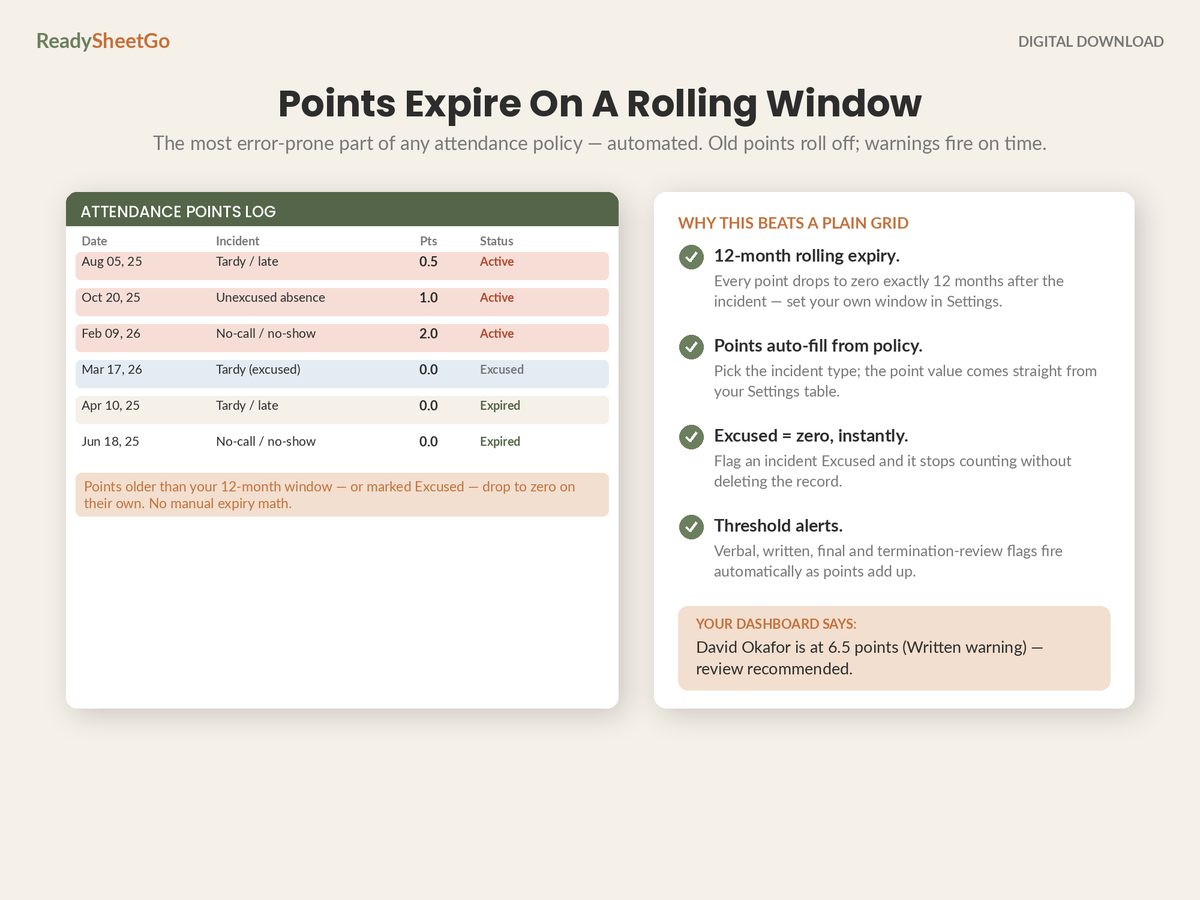
Every value in your schedule now derives from a sentence you can say out loud and defend.
A Copy-Ready Point Schedule
Built from the answers above. Change the three inputs and everything below re-derives.
| Incident | Points |
|---|---|
| Late, under 15 minutes | 0.5 |
| Late, over 15 minutes | 1.0 |
| Left early without approval | 1.0 |
| Absent, called in with notice | 1.0 |
| Absent, insufficient notice | 2.0 |
| No call, no show | 3.5 |
| Approved leave (PTO, personal) | 0 |
| Protected leave (see carve-outs) | 0 |
| Shift found and covered by employee | 0 |
And the ladder it hangs on, scored on a rolling twelve-month window:
| Active points | Action | Documentation |
|---|---|---|
| 4.0 | Verbal warning | Note to file, dated, employee told |
| 6.0 | Written warning | Signed, copy to employee |
| 8.0 | Final written warning | Signed, improvement period stated |
| 10.0 | Termination review | Full record printed, decision documented |
Notice the last row is a review, not an automatic termination. That single word is doing a lot of work: it preserves the discretion to look at the actual circumstances before acting, while keeping the process predictable everywhere below it.
Now test it by counting incidents, which is the step that catches a badly-calibrated ladder:
| Path to 10 points | Incidents required |
|---|---|
| All called-in absences | 10 |
| All insufficient-notice absences | 5 |
| All no-call-no-shows | 3 |
| All minor latenesses | 20 |
| Mix: 3 short-notice absences + 1 NCNS + 1 minor late | 5 incidents |
Twenty latenesses before a review, three no-call-no-shows before a review. If either of those numbers makes you uncomfortable, adjust the value — not the threshold. The threshold is just a scale.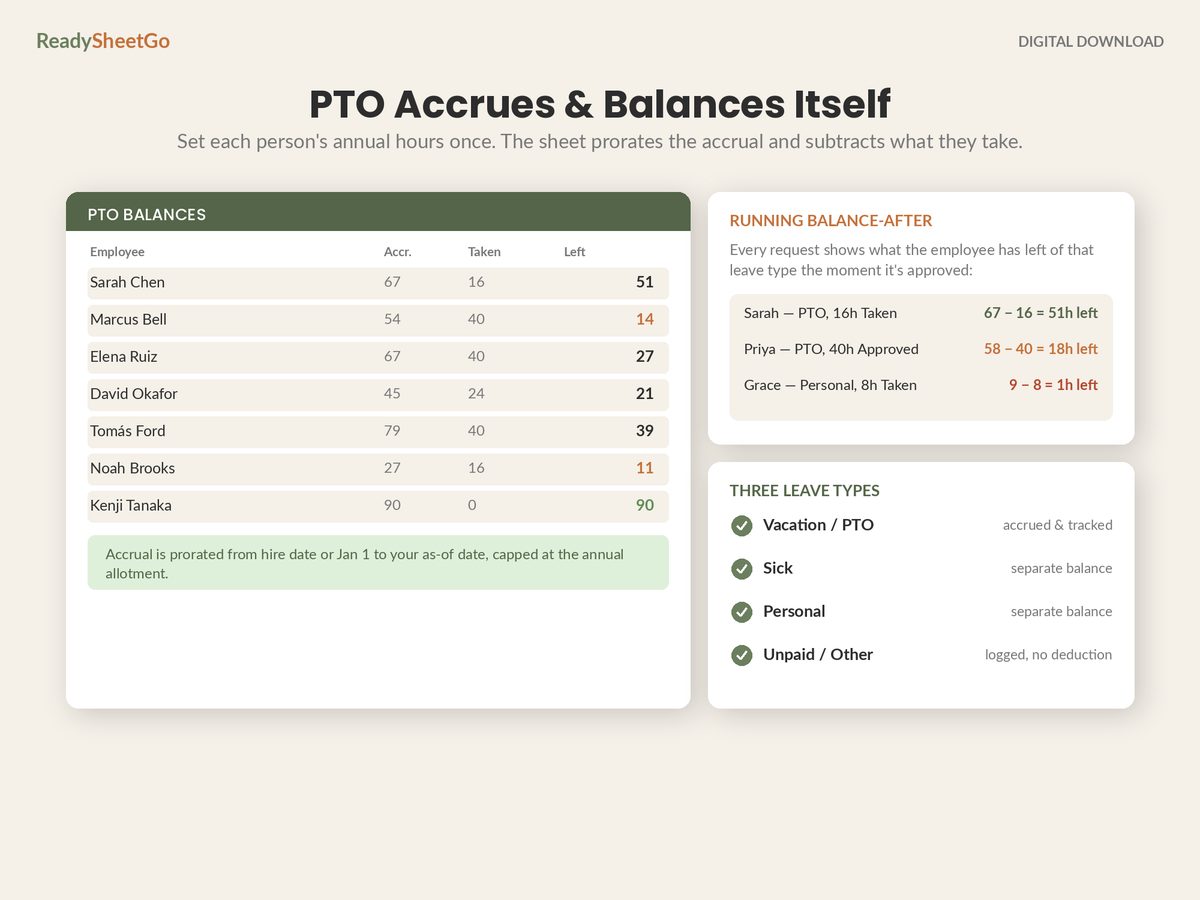
The Two Employees Problem
Here is why the schedule matters more than a raw absence count. Two people, same number of incidents, same quarter:
| Incidents | Points | |
|---|---|---|
| Nadia | 4 called-in absences | 4 × 1.0 = 4.0 |
| Tom | 1 called-in absence, 1 no-call-no-show, 2 insufficient-notice absences | 1.0 + 3.5 + 4.0 = 8.5 |
Four incidents each. Nadia gets a documented verbal warning; Tom is on a final written warning and 1.5 points from a review. That is the point system doing the thing an absence count cannot: distinguishing between an employee who is unwell and an employee who does not tell you they are not coming.
If your schedule cannot produce that separation, the values are too flat.
The Carve-Outs That Keep It Defensible
A no-fault policy is attractive because it removes judgement — the point applies regardless of reason. That is also precisely where the risk sits, because some reasons are legally protected and a point must not apply.
Absence that should score zero under any no-fault system:
- Leave covered by the FMLA, where the employer and employee are covered and eligible
- Absence that is an accommodation under the ADA
- State or local paid-sick-leave entitlements, which exist in many jurisdictions and frequently prohibit penalising their use
- Jury duty and military leave
- Workers’ compensation absence, in many states
- Legally protected pregnancy and parental leave
- Time off you approved in advance
Build that as a flag in the incident log — a column that forces the points to zero when ticked — rather than as something a manager is supposed to remember at 6am. An exclusion that depends on memory will eventually fail, and it will fail on the case where it mattered.
Three practical rules that go with it:
Write it down before you enforce it. A ladder that exists only in someone’s head is not a policy, and “we have always done it this way” is not a record.
Apply it identically. Waiving a threshold for one person and enforcing it on another with the same total is the single most common way these systems create exposure — and a tracker that shows everybody’s active points side by side makes the inconsistency visible before it becomes a problem.
Record the date of every warning. You need to be able to show what the record looked like on the day you acted, not just today. On a rolling window, those two numbers are usually different — which is exactly what a rolling window does.
This is a record-keeping article, not legal advice. Attendance policies interact with federal, state and sometimes city employment law, and the carve-outs above are not exhaustive. Have your written policy reviewed by an employment lawyer where you operate before you enforce a ladder against anyone.
The Thing Worth Remembering
There is no right number of points. There is only a ladder whose rungs match the behaviour you actually intend to act on — and the only way to know whether yours does is to count incidents, not points.
Derive your values from three sentences. Test them by writing out how many latenesses, absences and no-shows reach each rung. Force protected leave to zero with a flag rather than a memory. Then let the file expire the points on its own, so the total you are acting on is the total that is really there.
The full tracker build — accruals, requests, balances and a points log that expires itself — is here.
Featured on ReadySheetGo
Employee PTO, Attendance & Absence Point Tracker — $18.99
Nine ready-built tabs with 250+ formulas already written and tested, and twelve sample employees pre-filled so the ladder is running before you type anything.
Your point values and all four disciplinary thresholds — verbal, written, final and termination review — are editable inputs on the Settings tab, and the whole workbook reads from them, so changing what a no-call-no-show is worth re-scores every employee at once. The warnings fire automatically as active points accumulate; nobody has to scan a column.
The Attendance Points tab is the incident log, with point values auto-filling from Settings and an excused / protected flag that forces points to zero where they should never have applied. Old points expire on their own across a rolling twelve-month window you control, so the total you act on is the total that is really live. The Dashboard shows active points for the whole team side by side and flags who is over a threshold — which is what makes inconsistent application visible before it becomes a problem. Employee Summary prints a full single-employee record, dated, for the HR file or a 1:1.
Alongside it: an Employee Roster with wages, hire dates and entitlements, Time-Off Requests with approved / pending / denied status and balance-after previews, PTO Balances for PTO, sick and personal leave tracked separately, an Absence Calendar heatmap, and an absence cost estimate at each person’s own wage rate.
Nothing is password-locked — every formula is visible and editable so it can match your written policy exactly. Works in Excel, Google Sheets and Apple Numbers. No macros, no add-ons, no per-seat subscription.
Get the Employee PTO, Attendance & Absence Point Tracker →
Frequently Asked Questions
Is there a legal maximum number of attendance points?
No. Attendance points are an internal policy construct, not a legal standard, so no statute sets a number. What the law does constrain is what may earn a point in the first place — absence protected by the FMLA, an ADA accommodation, state paid-sick-leave law, jury duty or military leave should not accrue points under a no-fault policy — and whether the ladder is applied consistently across employees. The number is yours to pick; the exclusions and the consistency are not.
How many points should a no-call-no-show be worth?
Most policies weight it as the single heaviest ordinary incident, commonly two to three times a called-in absence, because the failure being penalised is the missing notice rather than the missing shift. A useful sense check: decide how many no-call-no-shows in a year you consider incompatible with continued employment, then set the value so that many incidents lands exactly on your termination-review threshold. If three is your answer and your ladder tops out at 10, a no-call-no-show is worth between 3.34 and 5.
Does the point value or the threshold matter more?
Only their ratio matters, which is why comparing your ladder to another company's is close to meaningless. A termination review at 10 points means something completely different when an unexcused absence is worth 1 than when it is worth 2 — ten absences versus five. Always test a ladder by counting incidents rather than points: write out how many latenesses, how many absences and how many no-call-no-shows it takes to reach each rung, and check those counts against what you actually intend.
Do I have to warn someone before the termination threshold?
Nothing forces progressive discipline in an at-will jurisdiction, but a ladder that fires a verbal, a written and a final warning before a termination review is the entire reason to run a points system rather than deciding case by case. The value is the documented, predictable sequence — the employee knew where they stood at each step, and you have a contemporaneous record showing it. Skipping rungs when you are annoyed and observing them when you are not is inconsistent application, which is the main way these systems create liability.