Is Pet Insurance Worth It? Use a Spreadsheet to Compare Premiums vs. Real Vet Costs
Pet insurance is one of those decisions people make on emotion and then never revisit. You sign up after a scary vet visit, the premium quietly leaves your account every month, and years later you have no idea whether the policy has ever actually saved you money — or whether you’ve paid in far more than you’ve ever gotten back.
The honest answer to “is pet insurance worth it” isn’t a blog opinion. It’s a number, and it’s your number. Here’s how to calculate it.
Full walkthrough of the template used in this guide.
Why the Generic Answer Is Useless
Every “is pet insurance worth it” article ends with “it depends,” and that’s actually correct — it just isn’t helpful. It depends on your premium, your deductible, your reimbursement percentage, your pet’s breed and age, and above all on whether your pet stays healthy or develops something expensive.
The economics are genuinely lopsided in both directions. A healthy dog might cost you $600 to $780 a year in premiums (NAPHIA’s State of the Industry data puts average accident-and-illness dog premiums around $50–$65 a month, on a market that reached $5.2 billion while only 4.27% of US pets are covered) and generate almost no claims for years — a clear loss on paper. But a single major event flips it instantly: emergency surgery for a swallowed object, a torn cruciate ligament, or cancer treatment can run $3,000 to $7,000 or more, and a chronic condition like diabetes or allergies bills every month for the rest of the pet’s life. In those cases the policy can pay back many times what you put in.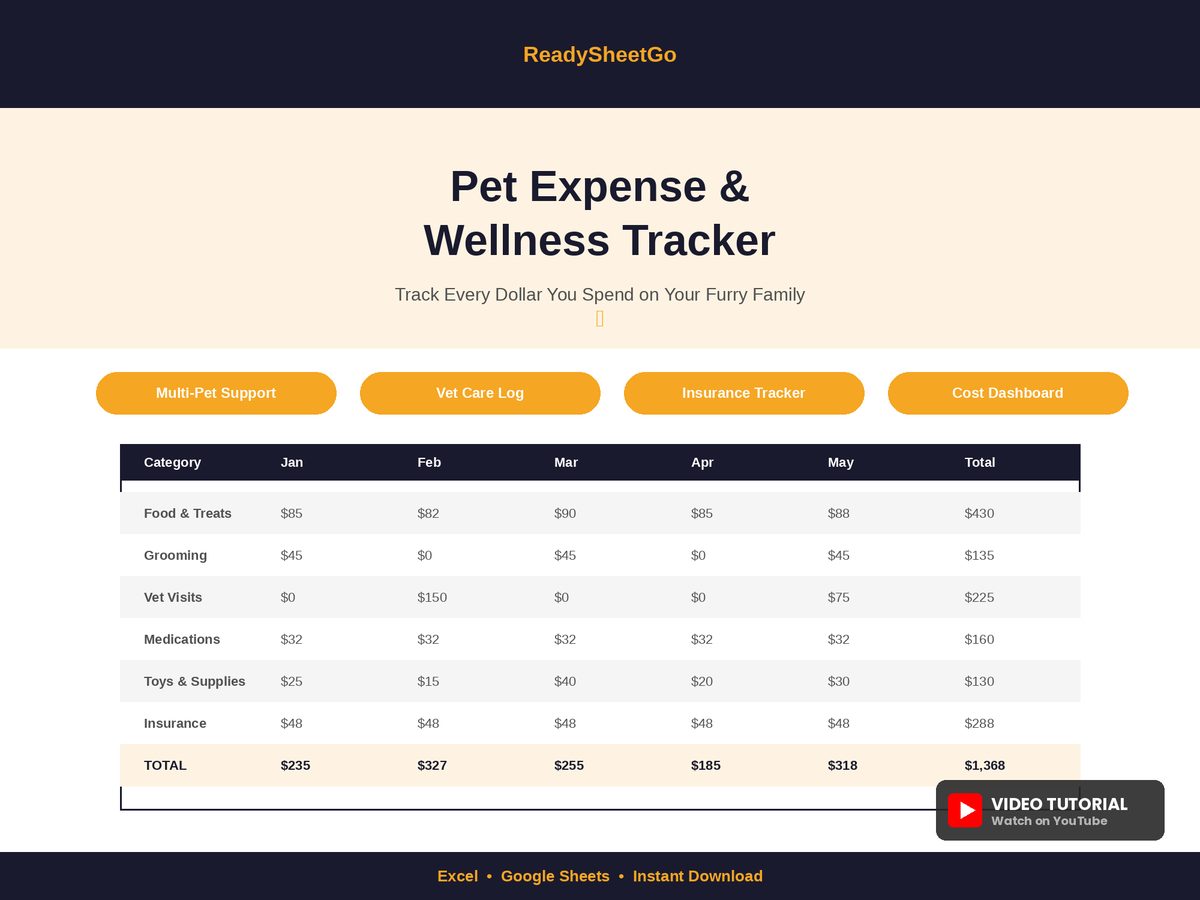
You can’t resolve that with a gut feeling. You resolve it by tracking.
The Only Numbers That Matter
To know whether your policy is worth it, you need exactly two running totals:
- Total premiums paid — every monthly or annual payment since the policy started.
- Total claims reimbursed — not what you submitted, but what the insurer actually paid you after the deductible and co-pay.
Subtract the first from the second. That single figure — call it your insurance ROI — tells you the truth. Positive means the policy has already earned its keep. Negative means you’re ahead on premiums so far, which is fine if it’s buying you peace of mind, but you should at least know it’s the trade you’re making.
The catch is the second number. Insurers reimburse after your annual deductible and at your reimbursement rate (often 70%, 80%, or 90%), so a $2,000 vet bill rarely means a $2,000 check. A $500 deductible and 80% reimbursement turns that $2,000 bill into a $1,200 payout. If you only track the bills, you’ll badly overestimate what insurance is doing for you. You have to track what was actually paid.
Set Up the Comparison in a Spreadsheet
Build (or use) a spreadsheet with two linked logs. In the premium log, record each payment with its date. In the claims log, record each claim with the vet bill amount, the deductible applied, the reimbursement percentage, and the amount actually paid. Then a summary cell does the one calculation that matters: total reimbursed − total premiums = your running ROI.
This is precisely what the Pet Expense & Wellness Tracker from ReadySheetGo automates. Its Pet Insurance tab logs premiums, tracks your deductible progress through the year, records claims filed versus claims paid, and runs an insurance ROI calculation that updates the moment you enter a new payout — so at any point you can open the file and see, in one number, whether the policy is winning or losing for you.
Deductible Progress Changes Your Decisions
There’s a second reason to track claims against your deductible: it tells you when to actually use the coverage. If you’ve already met your annual deductible in March, that borderline “should I even bother going in” vet visit in July is now largely covered — so you go. If you’re nowhere near the deductible and it’s December, a minor issue might not be worth a claim at all. Owners who don’t track their deductible progress routinely leave reimbursements on the table or file claims that never clear the threshold.
Insurance vs. Self-Insuring
The real alternative to a policy isn’t “nothing” — it’s self-insuring: putting the equivalent of a premium into a dedicated pet emergency fund every month and covering bills yourself. It works if you have the discipline to build the fund and the cash to survive a $5,000 emergency before the fund is big enough to absorb it. That “before” is the gap insurance is designed to fill.
Plenty of owners do a hybrid: a higher-deductible policy for catastrophic events plus a modest emergency fund for the routine surprises. The smart move is to track both in one place — the premium-vs-payout ROI on one tab, the emergency fund balance and goal on another — so you can see, with real numbers, which layer is actually protecting you and whether you’re over- or under-covered.
Whatever you decide, decide it with data. “Is pet insurance worth it” stops being an anxious guess the moment you can open a file and read the answer off a single cell.
Featured on ReadySheetGo
Pet Expense & Wellness Tracker — Settle the pet-insurance question with real numbers. The Pet Insurance tab tracks premiums, deductible progress, and claims filed vs. paid, then calculates your insurance ROI automatically. Plus a vet care log, medications tracker, 9-category monthly expense tracker, an emergency fund with progress bars, and a lifetime cost projector — 8 tabs and 200+ formulas across up to 4 pets. Works in Excel and Google Sheets, no macros. Instant digital download — $12.99.
Frequently Asked Questions
Is pet insurance worth it?
It depends entirely on your pet's health, your premium, and your ability to absorb a large surprise bill from savings. For a healthy pet, you may pay in more premiums than you claim back over a lifetime. For a pet that develops a chronic condition or has a major emergency — a surgery can run $3,000 to $7,000 or more — insurance can save you many times the premium. The only way to know for your situation is to track premiums paid against claims reimbursed and calculate the running difference, rather than relying on a gut feeling.
How much is pet insurance per month?
According to NAPHIA's State of the Industry data, the average accident-and-illness premium runs roughly $50–$65 per month for dogs and $30–$35 per month for cats, though your quote varies with breed, age, location, and the deductible and reimbursement level you choose. Over a year that's roughly $600–$780 for a dog — a number worth tracking against what the policy actually pays back.
How do I calculate the ROI on pet insurance?
Add up every premium you've paid since the policy started, then add up every dollar the insurer has actually reimbursed you (not what you claimed — what was paid after the deductible and co-pay). Subtract premiums from reimbursements. A positive number means the policy has paid for itself; a negative number means you're ahead on premiums so far. A spreadsheet that logs premiums and claims side by side calculates this automatically and updates every time you file a claim.
Should I get pet insurance or just save the money myself?
Self-insuring — putting the equivalent of a premium into a dedicated emergency fund each month — works if you have the discipline to build the fund and the cash to cover a $5,000 bill before the fund is large enough. Insurance transfers that risk for a predictable monthly cost. Many owners do both at a smaller scale. Tracking both a premium-vs-payout comparison and an emergency fund balance in one place lets you see which approach is actually protecting you.