Debt Snowball vs Avalanche: Which Pays Off Debt Faster?
You’ve decided to get serious about paying off debt. Good. Now you’re stuck on the first decision everyone hits: do you pay off the smallest balance first (the snowball) or the highest interest rate first (the avalanche)? Every finance blog swears by a different one, and the advice usually ends with a shrug — “just pick one and start.”
That’s not good enough when you’re the one making the payments. The wrong choice can cost you real money or, worse, cost you your momentum and send you right back into debt. So let’s settle it with actual numbers instead of opinions.
The One-Sentence Difference
The debt avalanche orders your debts by interest rate, highest first. You make minimum payments on everything and throw every spare dollar at the debt with the highest APR. Because interest is what makes debt expensive, killing the priciest debt first means less interest piles up over time. It is the mathematically optimal method — it always saves the most money.
The debt snowball orders your debts by balance, smallest first. You make minimums on everything and attack the smallest balance until it’s gone, then roll that payment into the next-smallest. It’s usually a touch slower and costs a little more in interest, but you eliminate entire accounts quickly, which feels like winning.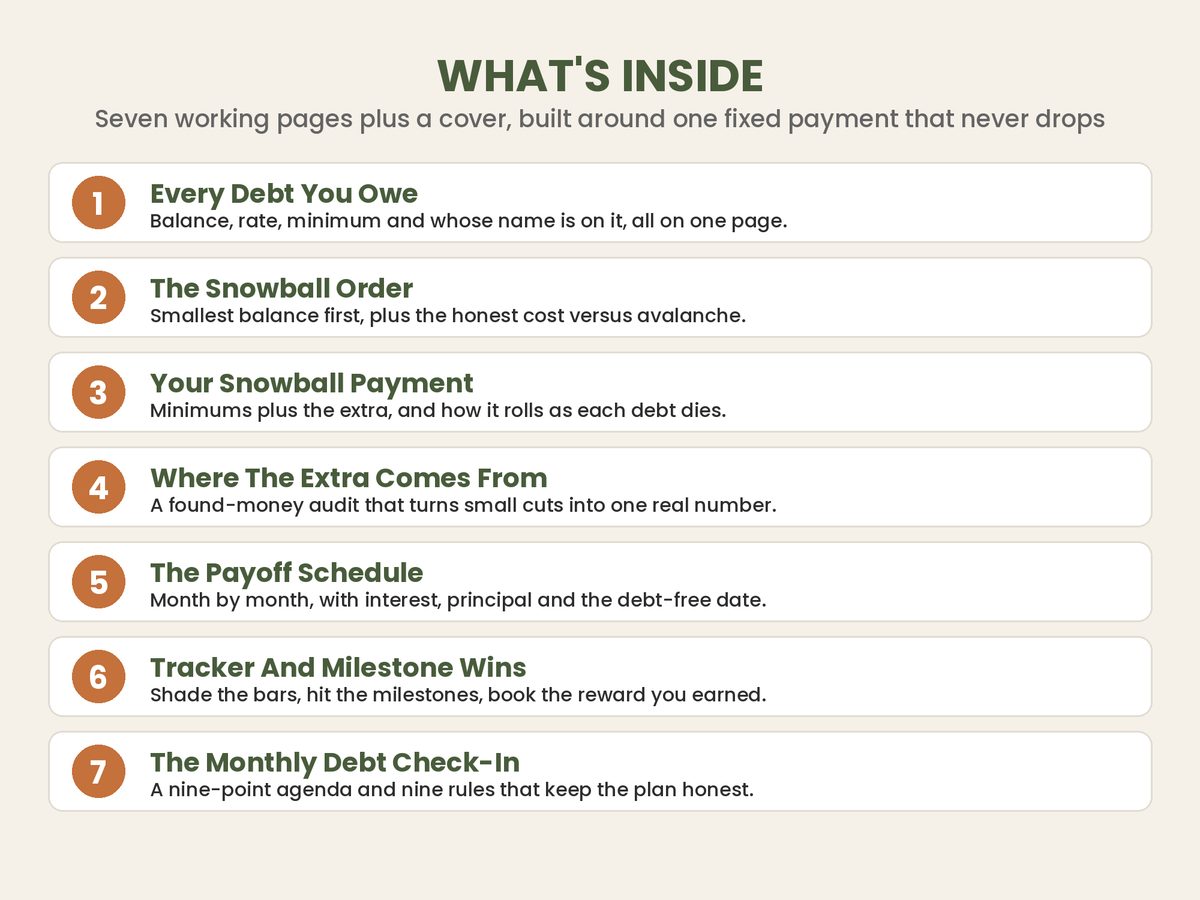
That’s the whole debate. Now let’s see what it means in dollars.
A Real Example With Four Debts
Here’s a debt load that looks like a lot of American households right now. Credit card APRs have climbed above 20% on average, and the typical family juggles a card balance, a student loan, a car loan, and a leftover medical bill:
- Credit card: $4,500 at 21.9% APR, $90 minimum
- Student loan: $12,000 at 5.5% APR, $150 minimum
- Car loan: $8,200 at 6.9% APR, $285 minimum
- Medical bill: $1,800 at 0% APR, $75 minimum
Total: $26,500 in debt, $600 in minimum payments. Say you can find an extra $300 a month to accelerate payoff.
Under the avalanche, you attack the 21.9% credit card first — it’s bleeding you dry every month — then the 6.9% car loan, then the 5.5% student loan, and the 0% medical bill last (there’s no reason to rush an interest-free debt).
Under the snowball, you attack the $1,800 medical bill first (smallest), then the $4,500 credit card, then the $8,200 car loan, then the $12,000 student loan.
Notice the tension: the snowball tells you to pay off a 0% medical bill before a 21.9% credit card that’s actively costing you money. That’s why avalanche wins on math. But the snowball hands you a fully closed account in the first couple of months, and for a lot of people that early win is the difference between sticking with the plan and quitting.
So Which Is Actually Faster?
For most realistic debt loads, the avalanche finishes one to three months sooner and saves somewhere from a couple hundred to a couple thousand dollars in interest, depending on how high your worst APR is and how big that balance is. The bigger the gap between your highest and lowest interest rates, the more the avalanche wins.
But here’s the part the math-only crowd misses. A 2016 study published in the Journal of Consumer Research by Alexandra Gal and Blakeley McShane analyzed real debt-repayment data and found that the number of accounts a person had already closed — not the dollar amount they’d paid down — was the best predictor of whether they’d eliminate their entire balance. In plain terms: people who knock out whole accounts stay motivated and finish. The snowball is engineered to produce exactly those wins.
So the honest answer is: avalanche is cheaper, snowball is stickier, and the best method is the one you’ll actually finish. If you’re disciplined and rate-driven, avalanche. If you’ve started and quit before, snowball. And if your debts all have similar interest rates, it barely matters — pick either and go.
Stop Guessing — Run Both at Once
The frustrating thing about this decision is that you can’t really see the difference until you model it. Doing it by hand means building two full amortization schedules across multiple debts and multiple years. Most people give up and just guess.
That’s exactly the problem the Debt Free Blueprint spreadsheet solves. You enter each debt once — balance, APR, minimum payment — and it builds both the snowball and the avalanche payoff schedules automatically. A dedicated Compare tab puts them side by side and tells you, for your exact debts:
- Months to debt-free under each method
- Estimated total interest paid under each method
- Exactly how much the avalanche saves you versus the snowball
- A plain-English recommendation for your situation
Instead of trusting a generic blog example, you see your own numbers. Maybe the avalanche saves you $180 — nice, but not worth it if the snowball keeps you sane. Or maybe it saves you $1,400 because you’ve got a nasty high-APR card, and now the choice is obvious.
The Move That Beats Both Methods
Here’s what almost no one tells you: the ordering matters far less than the extra payment amount. Whether you snowball or avalanche, adding even $100–$300 a month above your minimums is what actually collapses your payoff timeline. Minimum payments are designed to keep you in debt for years — on a credit card, paying only the minimum can stretch a $4,500 balance past a decade and more than double what you repay (here’s how long it takes to pay off a credit card on minimum payments).
This is where a What-If calculator earns its keep. The Debt Free Blueprint includes one that lets you test “what if I pay an extra $150 a month?” and instantly shows how many months and how much interest you’d save. Seeing that a modest $150 knocks two years off your timeline is far more motivating than any snowball-versus-avalanche debate.
Bottom Line
Avalanche is faster and cheaper on paper. Snowball is more motivating in practice. The gap between them is usually smaller than the gap between “having a plan” and “winging it.” Pick the method that matches your personality, commit to a fixed extra payment, and track every dollar so you can watch the balance fall. The comparison is the easy part — consistency is the whole game.
Featured on ReadySheetGo
The Debt Free Blueprint runs the snowball and avalanche methods side by side so you can see which clears your debt faster and cheaper — for your exact balances and rates. It includes a Setup tab, automatic Snowball and Avalanche payoff schedules, a Compare tab with a plain-English recommendation, a Payment Log to watch your balances shrink, a What-If calculator for extra-payment scenarios, and a visual Dashboard. 7 tabs, 420 formulas, works with Excel and Google Sheets. One-time purchase — $7.99 instant download.
Frequently Asked Questions
Which pays off debt faster, the snowball or the avalanche method?
The avalanche method is mathematically faster and cheaper because it targets your highest interest rate first, so less interest accrues each month. The snowball method targets your smallest balance first, which is usually a little slower and slightly more expensive in interest but delivers a paid-off account sooner. On typical household debt loads the difference in total interest is often a few hundred dollars, and the difference in payoff time is usually one to three months.
Is the debt snowball or avalanche better if I keep losing motivation?
The snowball is usually better if motivation is your weak point. A 2016 Journal of Consumer Research study found that people who paid off their smallest balances first were more likely to eliminate their whole debt, because closing an account entirely is a visible win that keeps you going. The avalanche saves more money on paper, but only if you actually stick with it.
How do I compare the snowball and avalanche methods side by side?
List every debt with its balance, APR, and minimum payment, then run two payoff schedules: one ordered smallest balance to largest (snowball) and one ordered highest APR to lowest (avalanche). Compare total months to debt-free and total interest paid for each. A spreadsheet like the Debt Free Blueprint calculates both automatically and shows the difference in one view.
Does the avalanche method really save that much money?
It depends on how spread out your interest rates are. If you have one high-APR credit card at 22% and everything else is under 7%, avalanche can save a meaningful amount by killing that card first. If all your debts have similar rates, the two methods produce nearly identical results and you should pick whichever keeps you consistent.